


Magazine Archive
Home -> Magazines -> Issues -> Articles in this issue -> View
News | |
EtceteraArticle from Sound International, January 1979 | |
Split as they are (these pages) into Studios and Recording, Instruments and Equipment, and Etcetera (for news pieces with no homes to go to).

Last of the Analogues
The enormous Studio 1 at EMI's Abbey Road complex (yes, the Abbey Road where Sergeant Pepper and all the other Beatle classics were recorded; if only walls could talk...) was recently the scene of a party — reception is too grand a name for such an informal gathering - organised by FWO Bauch to introduce the new Studer A800 multitrack to the UK recording scene. That most of those present had probably seen and played with the machine before, either at the European AES exhibition in Hamburg in March, or at the Los Angeles AES in May, seemed not to matter at all. (Never let it be said that FWO can't throw a lovely party.)
Apart from its extraordinarily high price - it's only available in 16 and 24-track versions on 2in tape, with the latter format costing around £30000 - the Studer A800 is an interesting machine in many other respects. Forget for a moment all the improved features — microprocessor-controlled, high-speed transport logic, ramped timing of audio electronics for click-free drop ins, master bias adjustment etc - and consider the recording process itself. Ever since the Thirties when Telefunken developed the first tape machine, signals have been recorded in analogue form. That is to say, the variations in magnetic held imprinted on the tape oxide follow exactly the variations in amplitude of the input signals. (I would be the hrst to agree that this represents a very crude thumbnail sketch of what is involved, but it does illustrate the basics.) Alter the speed of the tape on replay and the frequency of the recorded signal will vary accordingly. Slit the tape down the centre of a track and the two parts will each retain the audio signal.
In the last few years, however, several companies have been developing digital tape machines, which are a different kind of animal altogether. In a digital machine, the input signal is sampled at discrete intervals, and a stream of on/off pulses is derived that corresponds to the amplitude or frequency of the input (dependent on what sort of sampling technique is being used). The on/off pulses — that is 'signal' present or absent — are then recorded on tape in the normal way. On playback of a digital tape, the original signals can be retrieved with much better accuracy than with analogue machines. The reason for this is fairly simple. Since a digital signal can only be one of two distinct states, background noise will not affect it in any way. Hence signal-to-noise ratios with a digital recording can be as high as 90dB — some 30dB better than an analogue machine. Also since the original signal was digitised at an accurately-known sampling rate, this can be matched on playback to the speed of the tape machine. Hence wow and flutter is often 'immeasurable' or at least so low as to be unimportant. Also by accurately matching the encode and decoding process - very easy if the signals off-tape can only exist in two states, and the sampling frequency is precisely defined — the frequency response should be independent, to a certain extent, of head design and tape formulation. Hence a response — for the prototype 3M digital system — within 0.3dB (sic) from 30Hz to 15kHz at a tape speed of 45 in/sec.
With such amazing specification, digital recording is the obvious choice. The first machines are already undergoing trials in certain (almost exclusively American) studios and it won't be long before they are a regular sight in the more prestigious UK establishments. Compatibility problems — after all, once a master tape is in digital form the record company has to find a cutting room equipped for playback of such material — will be overcome quite quickly once a studio can offer their clients such improved quality. (What record companies will do about the appalling quality of pressings remains to be seen, however.)
All of which leads — in a roundabout way - to the Studer A800. For all its wonderful new features - and it really is a joy to use with its fast-acting, microprocessor-controlled transport that keeps a constant watch on the tape speed and passes from 'fast forward' to 'play' without going through 'stop' — it's still an analogue machine. And as such is strictly limited in its performance. So with digital machines just around the corner, is the A800 the last of the analogue 'up-market' multitracks? I can't help thinking that it is, but also wonder what wonderful pieces of digital (or other?) recording technology are lurking in Studer's research and development laboratories. Time will tell.
While we're on the subject of recording technology, I couldn't help noticing an odd sight among the many Studer machines that Abbey Road had gathered together in Studio 1 as part of a neat backdrop to the launch of the new A800. It was a very old J37 4-track model laced up with 1in tape. Now Sergeant Pepper was recorded on 4-track back in 1967; on A day in the Life, in particular, George Martin even slaved together two 4-track machines by recording a 50Hz tone on one track of the first machine and amplifying this to drive mains input of the second machine. Could the 4-track machine before me really be one of those used to record such a classic Beatles album, in the days before 8-track and racks of Dolby became de rigueur, let alone digital recording? It's a sobering thought.
Studios with plenty of money can obtain further information about the A800 from FWO Bauch Ltd, (Contact Details). Mel Lambert
Don't forget...
And an important note for all you overseas readers in your thousands... The closing date for entries for the Turnkey 'Win A MiniStudio, Teac 4-track, 4/2 Mixer, mics, an' all that' Competition (details in October and November SI) for all you far away sound-freaks is The End Of This Month... January 31st. So get writing. If you're in the UK it's already too late (unless you've got a sneak preview of this issue) because your closing date was December 31st. Sorry...
Surround sound discs
At last!! A record company has been astute (adj crafty, cunning: shrewd, sagacious... thank you, Chambers) enough to start issuing discs encoded in the UHJ surround-sound format, with the help of the Calrec Soundfield microphone. The company concerned, Nimbus Records, specialise in classical recordings, their recent Ambisonic release (Nimbus 2117) being Kodaly's Cello Sonata Op 8/Bridge's Cello & Piano Sonata, with Christian Hocks, cello, and Martin Jones, piano. This recording has plenty of ambience, and the performance and pressing are excellent. For all those of you with Integrex ambisonic decoders, by the way, we got best results in the BBC Matrix HJ mode, rather than the more obvious UHJ. The use of the former system is designed to enhance the record's stereo and mono compatibility. The company intends to update most of its catalogue to UHJ as time goes on.
It's refreshing to see a record company being so forward-looking; their pressings are some of the best we've ever heard, too.
Nimbus Records, (Contact Details).
Now tours the Glimmering Landscape
You'll be aware of our liking for Landscape, a good band if ever we heard one (see SI August '78 Rhythm Section and Andy Pask's contributions to the Copy Guitar Test November and December '78 as examples of ongoing relationship situations...) So now, if you haven't seen them, here are some tour dates in Britain for early 1979: January 18 Sheffield Limit Club, 27 Basingstoke Central Studio, 30 Manchester Poly, 31 York Arts Centre; February 1 Northern JCS (Manchester), 2 Leeds Playhouse, 3 Sheffield Hurfield Campus, 4 Birmingham Arts Lab, 5 Leicester Phoenix Theatre, 6 London Purcell Rooms, 7 Basildon JS, 8 Norwich Premises, 9 Cardiff Chapter Arts Centre, 10 Shrewsbury School.
More dates will be added, Londoners watch out for one at the seedy Music Machine in Camden Town; in the meantime ears should home in on the Scaper's new Quad/MM/Gauss horn PA (that's a PA for the horns, not a PA consisting totally of horns).
Publisher: Sound International - Link House Publications
The current copyright owner/s of this content may differ from the originally published copyright notice.
More details on copyright ownership...
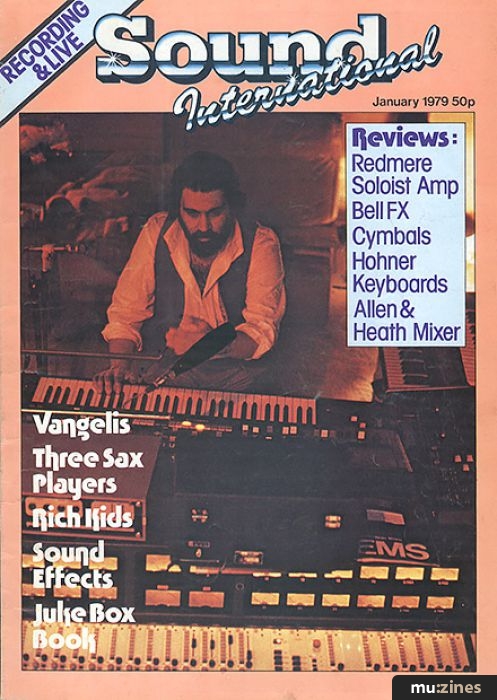
Sound International - Jan 1979
Donated & scanned by: Mike Gorman
News by Mel Lambert
Help Support The Things You Love
mu:zines is the result of thousands of hours of effort, and will require many thousands more going forward to reach our goals of getting all this content online.
If you value this resource, you can support this project - it really helps!
Donations for April 2026
Issues donated this month: 0
New issues that have been donated or scanned for us this month.
Funds donated this month: £0.00
All donations and support are gratefully appreciated - thank you.
Magazines Needed - Can You Help?
Do you have any of these magazine issues?
If so, and you can donate, lend or scan them to help complete our archive, please get in touch via the Contribute page - thanks!
Please Contribute to mu:zines by supplying magazines, scanning or donating funds. Thanks!
Monetary donations go towards site running costs, and the occasional coffee for me if there's anything left over!

 @mu_zines
 RSS Feed
 Blog
Blog