Blackpool Rock - Summer Holiday On Stage
Live
(STG Nov 96)


Magazine Archive
Home -> Magazines -> Issues -> Articles in this issue -> View
Article Group: | |
Popping Your Clogs | |
Article from Sound Engineer and Producer, June 1987 | |
Every year it happens: 'Denmark, nil points', 'I am sorry but we seem to have lost the Yugoslavian jury', and 'this song, she is called Bong Ding A Bang Bong'. Recognise the quotes? Yes, it's the Eurovision song contest.
This year the venue was Brussels, fittingly enough as it's the home of the EEC. As you'd expect from a city which is so deeply entrenched in bureaucracy there were piles of deeply impressive statistics.
This, for instance, was the 32nd contest and it had 22 candidates, all reaching 500 million viewers in a bid to be Biggest Banality on the Planet, or whatever the title is.
But joke as I may, it's taken very seriously by many of the countries, particularly the host nation. The Belgian media was full of little else.
Likewise the sound system was taken very seriously and every effort was put into making the event, both broadcast and live, as good as humanly possible. Belgium being where it is, they had several components in the sound system from Britain, and not a few from Germany. Of course the Japanese got a look in.
The whole system was based around several large Soundcraft desks, a Series 500 and a couple of 8000s. These were monitored in a sort of nearfield way via one lonely Auratone mounted next to the desk to simulate the Godawful noise that usually comes from one's TV set.
'The biggest problem,' said technical co-ordinator Louis Naegels, 'is the number of different artists. Some want a rock band sound and some want an orchestral arrangement with solos from, say, the violin or the flute. That means a lot of setting up in a short time while the compere is speaking.'
And of course, the compere (the lovely Viktor Lazio, who you might not realise is a minor pop star in Belgium and appears on her single sleeves clad in perilously close to naff all) has to be nattering during the breaks. Which means a close eye has to be kept on all levels while trying to change everything for the next act.
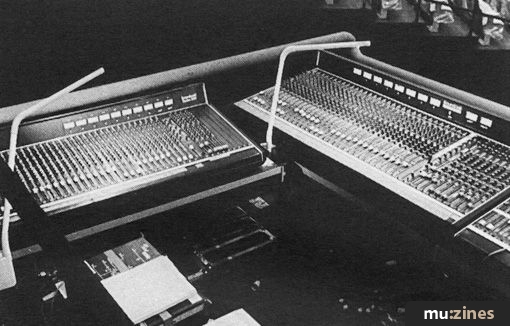
Soundcraft desks at the Eurovision song contest
On-stage monitoring caused some headaches due to the widely differing requirements of the competitors, from running about a la Plastic Bertrand to having trillions of backing singers.
That end of things was handled competently by Tannoy Cougar wedge monitors manhandled into place between sets. The dress rehearsal the day before featured some intriguing feedback which made the cute German boys and girls sound more like the Jesus and Mary Chain. But that, I was assured, was due to one of the orchestra mics playing up rather than a desire to be Das Velvet UnterGrond.
The interchangeable aspect had obviously been considered, for attached to the scribble strip on the front of each mixer was a roll of paper, rather like a roll of Tesco till receipts, listing all the channels and what was assigned to them.
As one act left the stage, the engineer wound a handle and the whole lot reeled off to be replaced by a new set of markings and settings notes: simple, and extremely useful.
Mind you, the orchestra was already submixed to some extent. The keyboard players — who tinkled almost exclusively Yamaha gear give or take the odd Akai sampler or two — and the two drummers, who played conventional and Yamaha electronic kits intertwined, had submixers of their own, again Yamahas, giving out merely a stereo feed to the main desk.
All the violins and brass, and the bangy bits of the drumkits, were miked with Sennheisers, mostly as close-miked as practicable to avoid picking up such unwanted noises as cameramen swearing, the feet of the energetically dancing artists, and the audience noise.
The signal was gated and compressed, as you'd imagine for broadcast, pretty heavily on a couple of dbxs strapped over the outputs.
The only other real effects, as only the vocals were live, were a couple of Yamaha Rev 7s. Again the bods from the orchestra took care of their own sound, with the guitarists and the bassist (also equipped with a DX7) using a couple of SPX90s apiece. Did they get a bulk discount deal from Yamaha Belgium or what?
After a week of continuous rehearsals, everything ran smoothly on the night and the VIP audience wobbled inside their penguin suits very appreciatively inside the imposing, if slightly tacky auditorium. All the right noises were made, and no technical hitches got in the way of transmitting two-and-a-half hours of Europop to several million people.
A good job, too. Anyone who has the bottle to field a group called Bang! singing a song called Stop! deserves to hear the sound of an entire world going to make a cup of tea.
More from these topics
 |
 Talking Pictures |
 Flight Delays Hamper ex-Byrds |
 Bandstand - The Candyskins |
 Vive La Difference! - Choosing Mixers For Live Sound |
 Stage Fright - Nerves |
 Stagecraft - Big George's Guide To Good Gigging |
 The Sound Of Simon |
 Box Pop |
 Doing the Video (Part 1) |
 Live Sound - Introduction To PA (Part 1) |
Trip Around The World - MUMBAI, NÉE BOMBAY |
Browse by Topic:
Live
Video / Film / Picture
Publisher: Sound Engineer and Producer - Media Week Ltd.
The current copyright owner/s of this content may differ from the originally published copyright notice.
More details on copyright ownership...

Sound Engineer and Producer - Jun 1987
Donated by: Chris Maund
Sound Review
Feature by Chris Maillard
Help Support The Things You Love
mu:zines is the result of thousands of hours of effort, and will require many thousands more going forward to reach our goals of getting all this content online.
If you value this resource, you can support this project - it really helps!
Donations for October 2026
Issues donated this month: 0
New issues that have been donated or scanned for us this month.
Funds donated this month: £0.00
All donations and support are gratefully appreciated - thank you.
Magazines Needed - Can You Help?
Do you have any of these magazine issues?
If so, and you can donate, lend or scan them to help complete our archive, please get in touch via the Contribute page - thanks!
Please Contribute to mu:zines by supplying magazines, scanning or donating funds. Thanks!
Monetary donations go towards site running costs, and the occasional coffee for me if there's anything left over!

 @mu_zines
 RSS Feed
 Blog
Blog