


Magazine Archive
Home -> Magazines -> Issues -> Articles in this issue -> View
Article Group: | |
Pulsar Universal Interface | |
Article from Music Technology, October 1993 | |
Let your MIDI rig control your lighting
"Light up the sky with Standard fireworks". Well, it scans better than "light up your gig with the Pulsar Universal Interface". But you can, according to Ian Masterson, transform your performance with this simple black box...
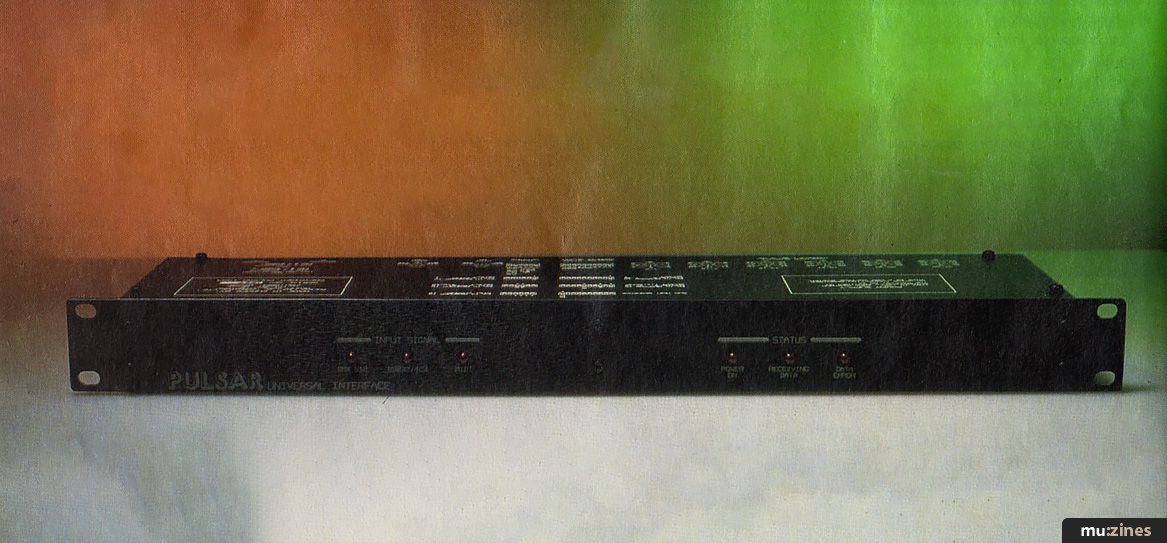
Image credit: James Cumpsty
You have to smile at Pulsar's sense of understatement. I mean, take this Universal Interface thing. Here is a device that can literally take your stage act - be it at a pub, club, hall or stadium - and reinvent it. It'll help you create a lightshow that not only complements your music, but which picks it up, shakes it thoroughly and sends it spiralling out at your audience. And how do Pulsar package it? In a bright pink and green case with loads of flickering LEDs and a badge that reads 'Instant Orgasmic Lightshow'? No. They put it in a black box with no front panel controls, a few simple LEDs and a smattering of DIP switches hidden around the back. Honestly, some people have no imagination.
If you've ever had the briefest of encounters with lighting technology, you'll know that it operates in a world of its own. Music has the MIDI data protocol, lighting has DMX. And, er, PMX. And analogue 10-volts. And mains, for that matter. All quite straightforward in their own ways, but not exactly designed to be mixed. Which isn't great if you're one of the countless musicians or programmers looking to create a lightshow that compliments your music - or, for that matter, which is capable of being programmed on the same sequencer controlling your sounds. Wouldn't it be great if you could 'play' lighting information on a keyboard, record it into a computer, edit it, quantise it and save it on disk the same way you can with a MIDI song file?
A couple of companies on the MIDI circuit (pun intended) have thrown their hats into the ring with various systems allowing MIDI-to-mains interfacing. These units work perfectly at a basic level, but are limited, for example, by the number of lamps you can chain off their mains outputs. To deal with the more professional lighting control protocols, be it straight analogue 10-volts for linking to dimmer packs, or digital DMX for more advanced control, you need to produce a unit that handles lighting information as well as it handles MIDI. In other words, an interface that will take in MIDI, DMX or PMX (Pulsar's proprietary version of DMX) data and translate it into analogue control voltages for linking directly to dimmer and switching packs, which in turn deal with the mains side of things. Enter the Universal Interface.
The simple design of the unit is, of course, both intentional and praiseworthy. For the purposes of this review I used the Universal Interface to control a bank of eight standard stage lanterns from Cubase on an ST, via one of Pulsar's own small dimming packs. This simply involved hooking a MIDI lead from the ST to the Interface's MIDI In (Pulsar also provide a MIDI Thru for chaining to further units), and one of the analogue outputs on the Interface to the dimming pack. A set of digital inputs and outputs for DMX/PMX are also provided, should you wish to control the Interface over that protocol instead.
In common with most of Pulsar's control equipment, the Interface takes its power from the 10-volt supply rail provided over the analogue lines by a dimmer pack. One of the LEDs indicates that everything is healthy in this area, while a further two indicate whether MIDI or digital information is being decoded (the unit automatically recognises which). The rear panel DIP switches are arranged in two banks; the first to select which of the 16 MIDI channels the Interface will respond to, and the second to select which groups of analogue channels over the six available outputs are to be controlled. For example, if you have six dimming packs connected, then you'll generally select all the channels to be controlled. There are also three further switches, the first of which runs a test sequence to ensure your dimmer packs are responding correctly. The remaining two allow you to select whether the brightness of your lamps is controlled by how hard you hit a key on your keyboard (MIDI velocity), and whether the lamps stay on as long as a key is depressed, or stay on until that key is pressed again (known as toggling).
Once everything is set up and ready to rock, you discover that playing a key on your MIDI keyboard causes the lamp 'connected' to that note (via the Interface) to - surprise, surprise - come on. From here on, what you do with your lighting rig is limited only by your imagination; you can do everything from programming simple chase sequences and flashes to complicated crossfades and animated displays. The analogue outputs can even be used to control strobes, multiple light effects, projectors and indeed anything else requiring mains and control feeds. Once you start exploring the options, you'll find it hard to leave your lighting rig alone.
And that about covers it. This is an invaluable unit for anyone wishing to put on a visual show of the more imaginative variety; with a whole bank of these, a stage of any size becomes your oyster. Add to this simplicity of operation and versatility, and you begin to realise that Pulsar have a lot to crow about with the Universal Interface. Not that they would, of course. But I will say this for them - if ever my stage rig gets shot down in a blaze of light, and my MIDI setup explodes in protest, this is one black box I'm taking with me when I abandon ship.
THE LAST WORD
| Ease of use | No degrees in button-pushing required |
| Originality | A new approach to an old problem |
| Value for money | Considering the potential end results, very good |
| Star Quality | Explosive |
| Price | £368 plus VAT |
| More from | Pulsar Light of Cambridge, Henley Road, Cambridge CB1 3EA. Tel: 0223 66798, Fax: 0223 460708 |
Publisher: Music Technology - Music Maker Publications (UK), Future Publishing.
The current copyright owner/s of this content may differ from the originally published copyright notice.
More details on copyright ownership...
Music Technology - Oct 1993
Donated by: Ian Sanderson
Quality Control
Gear in this article:
Review by John Wright
Help Support The Things You Love
mu:zines is the result of thousands of hours of effort, and will require many thousands more going forward to reach our goals of getting all this content online.
If you value this resource, you can support this project - it really helps!
Donations for September 2026
Issues donated this month: 0
New issues that have been donated or scanned for us this month.
Funds donated this month: £0.00
All donations and support are gratefully appreciated - thank you.
Magazines Needed - Can You Help?
Do you have any of these magazine issues?
If so, and you can donate, lend or scan them to help complete our archive, please get in touch via the Contribute page - thanks!
If you're enjoying the site, please consider supporting me to help build this archive...
...with a one time Donation, or a recurring Donation of just £2 a month. It really helps - thank you!

 @mu_zines
 RSS Feed
 Blog
Blog