


Magazine Archive
Home -> Magazines -> Issues -> Articles in this issue -> View
Sample Shop | |
Article from Sound On Sound, August 1993 | |
Wilf Smarties gives a new batch of CDs a spin.

The shelves of Sample Shop are once again getting crowded, especially as your reviewer has made inroads into several CD-ROMs, the results of which will be published when space is available. So apologies to products awaiting review, but everything had to be pushed aside to make way for XL1 from Polestar Magnetics, the Swedes who took us by storm with X-Static Goldmine.
POLESTAR MAGNETICS XL1 ••••½

So what's new from PSM this time? Well, for starters, they have ventured into risky terrain with this release, for the first CD is mostly given over to Construction Sets, a format not usually indicative of anything very interesting. Secondly, there is claimed to be no sample overlap between XTG and the 2500 samples on XL1.
SIDE A: Here are 60 self-contained collections of loops, hits, tones and stabs, from which a demo piece has been composed. All sets adopt the same sample format, namely: Demo Tune, 'Talk', three Loops, 12 Drum Hits, three more Loops, another Voice sample, followed by eight tones (bass, chords, synths, and so on). The many samples are taken from vinyl or tape (possibly via CD releases), or specially prepared, carefully trimmed and presented in glorious mono.
Tracks 1-60 have 30 samples each (not including the 3-bar demo tune), and BPMs are given. Titles are very representative of the demo tunes, all of which sound more like snippets from real dance tracks than silly CD demos and cover many styles, including Rappy Jazz, Sleaze, various Funk forms, a curious blend of Betty Boo and Shaft, Raggamuffin, Rave, Kraftwerk-0-Kraftwerk, Oriental Disco and Techno, Tekno Soul, Chill-Out, Moody, Cool Jazz — the list goes on. Gripes: the 12 single drum hits are grouped in fours, with almost no time out between members of a group, necessitating taking a single sample of all four then splitting them up in the sampler. Also, due to the preponderance of vinyl sources, fidelity is not pristine: many a demo tune sounds rather muffled. Some added aural excitement or treble emphasis might not go amiss on all but the rootsiest noises.
Beyond track 60 come 30 conventional 10-sample sets. Actually, these are a restatement of the single hits, so hard to separate from the construction sets, answering my only real gripe so far. Each sample is indexed to the construction set where it first appeared. Neat! Track 61 covers 909 and 808 voices, chosen for general purpose usability. Track 62 has 10 Tekno Kicks, all very sensible. Same goes for the clipped Tekno Snares of 63. Tekno Hats mixes 909 and some other quite similar ones. And so on... Most samples are dry and have a grungy off-D-record feel even when they are not. Probably they have been compressed already. You could lose yourself in the maze of kicks and snares.
Easier to spot are the percussion voices: there are 'only' 10 tambourines, for example. The congas come out of it particularly well.
SIDE B: Organised like a conventional sampling CD, side B kicks off with a collection of 360 loops, 12 to a track. Most are tempo synchronous sets to tempt you into stacking loops. Live loops have, in these cases, been tuned to tempo, and at least one sounds staggeringly slow! First impression is that the loops are more workhorse than those on XTG, which were quite wild. Not all are fresh, particularly from the rare groove selection, but if you haven't got these already they are still viable feel templates to build a song around. I wouldn't leave them too exposed in the final mix, though. All loops are taken in mono and are no longer than they need be.
A colourful selection of 36 percussion and hi-hat loops breaks the monotony before we're into that 'Whoo Yeah' loop again. To be avoided at all costs!
The Trance, Electro and Beatbox collections (19-21) are much more inspiring. In fact, as the tempo picks up, the loops become more interesting. The House beats are happening as they steam along in the high 120s (the place to be right now). I'm too old for the post-130 beats that occupy the last six tracks, but I wouldn't be averse to slowing some of them down.
No less than 36 rolls and breaks follow, starting with the obviously useful and working through to more adventurous antique jazz snippets. Track 34 (bass loops) offers something old, something new, something borrowed and something blue. I liked the electric bass tones of 35 and 36: no funky slapping here, but the notes were clear. The dub basses of 37 were up to scratch: shifting lots of air without blowing out the speakers. Useful palettes of Synth and Tekno basses make way for authentic but probably unusable 303 lines and blip sequences. Then comes a 'Garage Kit'. Quite why you'd have a piano, organ and string chords in your garage, I don't know.
A trackload of mainly Fender Rhodes piano chords introduces two of organ chords. All very well, but track 46, 'Fonky', has some genuinely devious clav and guitar rhythm work. The sitar strokes that open track 48 are from well-worn analogue tape. Probably a sixties Ravi Shankar record. Some classic guitars follow, including the opening swoop to 'Wild Thing' by The Troggs.
Horns and trumpets take up the next five tracks. Solo riffs vie with hits and ensemble tones. I liked the cool jazz. Round about now stereo samples start to appear, a theme that continues into 'FX hits'. Hard, no-nonsense rave blips, buzzes and stabs take us through the next four tracks, whereupon 'Trance Tones' offers us some spectacular Sonar. Twelve Tuners follow, standard fare, followed by a swathe of synth sweeps, chords, wave sequences and dreamy pads. Not a passenger among them.
Track 66 (string riffs and runs): a classy selection. Spot that tune and serve that writ! Track 67 has stabs and hits. Surprisingly fresh, these. Back into stereo for 68: orchestra notes and chords, mainly from Radio 5 FM or similar. Nice harp.
Two tracks of ethnic/pseudo ethnic sounds next; the drones of track 70 are favourites for MIDI gating. Many vocal hits take us out. I won't go through them all but they're more on the money than those on any other sample CD release.
Despite having organised to have an Akai CD3000 in the house, I was unable to check the data sections that terminate both CDs. This is because, despite its intergral CD player, the CD3000 cannot as yet read this data. (A call to Akai UK revealed that they were unaware that these files existed. They are currently writing new software to address this issue.) Check with the distributor if it means that much to you, though to be honest the data sections are relatively small.
Conclusion: this is another definitive dance collection from Polestar Magnetics. I was not too impressed with the rare grooves, but they are designed to complement rather than duplicate material on the X-static Goldmine double CD set, and this they do. The sources are wide, authentic and relevant, and the samples cover a huge number of bases. There is more feel than fidelity in this collection, but that may be no bad thing: XL1 has a consistent sound character which, like any classic instrument, makes it easier to place in the mix. It might be an idea to throw in a little hi-fi from a 16-bit workstation to keep all frequencies clear, however. An exciter wouldn't go amiss, either. Still, as a currently relevant source of noise, XL1 has to be highly recommended. At 2500 samples for £80, it's got to be good value, too. A CD-ROM is coming, you might like to wait for that — I reckon it'll be a goodie. Otherwise, it's time to fork out again, I'm afraid.
Polestar Magnetics XL1 £79 inc VAT.
Time & Space, (Contact Details).
CHARLIE MORGAN: MASTER DRUMS •••½
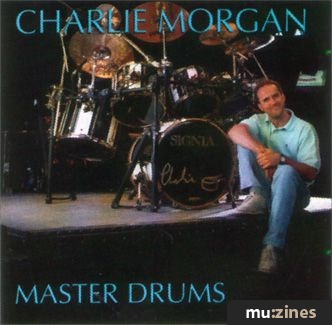
Charlie Morgan has played with Kate Bush, Elton John, Tina Turner, George Michael and Tasmin Archer. Now he can play for you also. There are several sample CDs of live drumming already on the market. We shall see if this one is special.
There are 38 tracks of Loops, each of which supports (usually) three tempos. For each of these there are three patterns, a 4-bar groove, 2-bar start and stop, and a 5+-bar loop with several pretty sensible variations leading to a stop. No cymbals are used: these can be added later (a selection of single hits is included).
The drumming was obviously done against a metronome; each loop is introduced by two electronic bleeps, and presented at exact tempos (70, 80, etc). If you want intermediate tempos, the idea is to use timestretch. By playing the same loop at 80, 100 and 120 BPM, for example, Charlie has made sure that you need never timestretch beyond the 10% 'Oh God I can hear that it's been timestretched' threshold.
Because relatively few different tempos are used, many different Tracks travel at the same speed. Since the dynamic seems to be consistent over the entire CD, cutting from one to another should not be a problem if the playing styles are not too incongruous.
Recording took place at London's Townhouse, famous for its stone drum room. Loops are presented in pretty natural-sounding stereo. Let's drop in on Track 2 (JB-1) as our first example. It comes from the first chapter of eight 'Soul' tracks. A Premier Soundwave kit was employed, and the acoustic was dry, though the tom mics were left open. Lovely rim sound, hi-hats slightly spread, kick dry but exciting one of the hanging toms, snare crisp without sounding metallic. A warm, natural sound that would take compression. The three loops on offer are each played at 80, 100 and 120 BPM. The playing? Of course it's tight. The toms were not damped and sounded really nice when hit on later tracks. I noticed on some of the faster loops (Track 5, for example) that the usually immaculate hi-hat playing was having to work hard to keep swinging in time with the metronome. A minor point, though.
Rock is the name of the game from Tracks 9-16. The format is the same, but the kit is now an ambient Premier XPK. Track 9 is actually a Motown Soul beat. What's it doing in this section? For those of us used to dance drum samples, this second kit sounds pretty similar to the first, reverb notwithstanding. To a drummer, of course, there will be no comparison! Since the room (presumably the stone one at the Townhouse) is a big part of the sound here, I will describe it: not too big (RT60 is probably under two seconds, and no big early reflections are evident). The reverberated sound is very diffuse (non-resonant) yet quite hard, an unusual and pleasant combination. The drumming here is, if anything, better and more confident.
Blues & Jazz: five tracks this time, same kit as for Rock. A 6/8 ballad which crawls along at 100 (half tempo?) shares houseroom with Jazz Swing at 210! Wait a minute, the kit has dried up again. I wasn't expecting that. Actually, I think the style change should have been from track 18, for here the sound has indeed dried up, and brushes are being delightfully employed. Brush Jazz is my favourite so far. Ethnic starts with some Country beats: a Waltz, Rock and Shuffles. Also covered are four Latin and four reggae rhythms. Kits start dry, playing is surefooted. I particularly liked the Louisiana shuffle and Bossanova. Here ends the Drum Kit loops: all are well or better played, tempos are strictly adhered to, and the playing sticks to the script. There are no nasty or pleasant surprises.
Three general purpose hi-hat loop tracks and two for the ride cymbal follow, each at 80, 100, 120 and 140. The hi-hats had an annoying ring to them and were not crisp enough for my taste, but would doubtless sound fine when used as intended, as an overlay to the loops? The ride cymbal sounded expensive, but a little lacking in life. Several hits of each drum are offered for the two kits used on the CD, and ambient and dry samples are offered, though only one dynamic (full on) was addressed.
Conclusion: The creators of this CD assume that you are into timestretching. Even if you are not, you can still use the loops at any tempo simply by tuning up or down a maximum of 10%. As for the drumming, the playing is professional and very tight tempo-wise. Feel is not the absolute best for funk, but is generally very good. Samples are in stereo throughout (except for some single hits and hi-hat loops) and the sound is warm and clean rather than clinical. Styles are classic rather than dangerous. Most useful, perhaps, is the fact that so many loops are time-locked, making for easy mixing and matching of samples. Me? I still prefer Clyde Stubblefield, but it takes all sorts.
Charlie Morgan Master Drums £59.99 inc VAT.
Bridge Recording Company, (Contact Details).
STAR TRIBUTE
| Les Dawson | ••••• |
| Tommy Cooper | •••• |
| Frankie Howerd | ••• |
| Eric Morecambe | •• |
| Andy Warhol | • |
(Whaddaya mean he wasn't a comedian?)
Publisher: Sound On Sound - SOS Publications Ltd.
The contents of this magazine are re-published here with the kind permission of SOS Publications Ltd.
The current copyright owner/s of this content may differ from the originally published copyright notice.
More details on copyright ownership...

Sound On Sound - Aug 1993
Review by Wilf Smarties
Help Support The Things You Love
mu:zines is the result of thousands of hours of effort, and will require many thousands more going forward to reach our goals of getting all this content online.
If you value this resource, you can support this project - it really helps!
Donations for September 2026
Issues donated this month: 0
New issues that have been donated or scanned for us this month.
Funds donated this month: £0.00
All donations and support are gratefully appreciated - thank you.
Magazines Needed - Can You Help?
Do you have any of these magazine issues?
If so, and you can donate, lend or scan them to help complete our archive, please get in touch via the Contribute page - thanks!
If you're enjoying the site, please consider supporting me to help build this archive...
...with a one time Donation, or a recurring Donation of just £2 a month. It really helps - thank you!

 @mu_zines
 RSS Feed
 Blog
Blog