


Magazine Archive
Home -> Magazines -> Issues -> Articles in this issue -> View
Shredder | |
Article from One Two Testing, May 1985 | |
news from the front
Notice the small and beautifully-formed 64-page booklet, lovingly adhesed to the front cover of this month's One Two? Hands up those who thought it explained where your superiors keep their keys (Boss... pockets...??). Right, hands down and now eat your fingers. It might keep you quiet. It is, of course, a thoroughly handy directory of Boss effects pedals, what they do, how to use them, methods of getting the best results and the favourite patches of certain 'rock and roll' stars. If we were to suggest that you could take the setups outlined and apply them to other non-Boss effects pedals we're sure the nice men at Roland who gave us a big bundle of dictionaries and a tube of sticky, wouldn't complain. If they did, we might ask, embarrassingly 'who is this Trevor Ravin who plays for Yes' (page 42, ha-ha). But we're not that cruel. A jolly useful publication. Many ta's to Roland for coming up with the goods.
Stuck for an overhead winding saddled grommet on your Wince-o-caster? Part & Parcel of Kettering have hit upon the (brilliant) idea of a rare-parts seeking service, a sort of Computer-Dating to bring together unusual components and the repairers desperate for them. Send details of the bits needed to 'Partsearch' with templates if any cover or scratchplate is essential, and Part & Parcel will hunt through their own catalogues and outside sources to track them down. It may take a bit longer, they say, but they have a better idea of where to look than the average man-with-solder in the street. Contact Part and Parcel, (Contact Details).
Otari's EC101 synchroniser for their MTR9011 multitrack recorder will be in the UK from April. It comes with the CB121 remote controller at £2,970.
"We have frequently been asked," say Carlsbro, humbly, "for low-cost, no-frills, mixer amps suitable for pub, club and hotel installations." Those who asked have got the Cobra X-90 and Marlin X-150. Both have high and low inputs, plus an input for tape, and simple bass and treble eq. Able to handle mike, instrument, tape deck and 100-Volt line inputs, the amps work out at £160 for the 90W Cobra and £199 for the 150W Marlin (into 4Ohms). Released at the same time are Carlsbro's Taurus PA cabs. Most boast 12 or 15in cones with high-frequency horns. At the apex is the four-way ST8150 with 15 and Sin speakers, radial horn and bullet HF unit (20Hz to 20kHz, 300Watts). Prices run from £217 to £383.
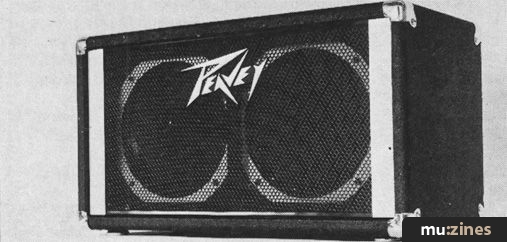
Two ten-inch Scorpion speakers sit in Peavey's new 210 powered cab. Designed primarily to augment their Bi-Amp pro amplifiers, it's recommended for a crossover frequency between 250 and 500Hz. The enclosure comes with a built-in 210W amp (with Peavey's DDT Distortion Detection Circuitry) and inputs for main power and auxiliary amps, plus a volume control. Handy.

Time for a lesson on bass pickups from UKG's Peter Cropley. In his new PLC2 and PLC3 single coils he's gone for massive pole pieces "15mm heads to give a very broad field at the place it's needed most" and a base plate of strontium barium ferrite "the strongest magnetic material currently available". More turns of heavier gauge wire give a better transient response and a broader frequency spectrum, promises the pickup pounder of Poole. Rich, punchy sounds with tight transients from the PLC2, he says, and sustained, resonant tones from the PLC3, "very clangy if you wind up the treble, rather like a deep Strat."
Simmons put their foot down again this year entering their Colt and VW Golf GTI (broom-brooms) in the Uniroyal and Monroe Production Saloon Car Championships. First race out, Andy McLennan took their Colt across the finishing line nine seconds ahead of the rest of the field at Uniroyal's opener at Silverstone. There are another 20 outings between now and the final in October. So this is how they spend our money... hah!!!
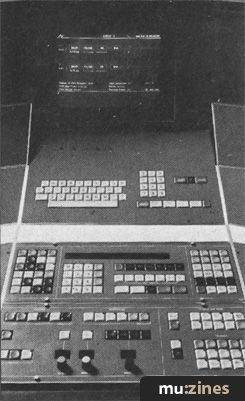
Digital processing is now an everyday part of professional audio processing: digital delays, reverbs, harmonisers and even tape recorders adorn many a studio throughout the land. However, unless you've been to CTS Studios in Wembley, you probably won't ever have seen a fully-comprehensive multi-track digital mixing console, because they're the first studio in the world to have one.
Theory runs that it's all very well having digital tape machines and processors, but a chain's only as strong as its weakest link, etc, and as practically every signal has to pass through the mixing console at least a couple of times, it rather undermines the digitally clean efforts of the rest of the equipment. The Neve DSP is an all-digital 48:32:6:2 console. All signals get converted into digital form on entry, and need never return to analogue form until they leave the outputs of the consumer's compact disc player. You get to hear exactly what was on the master tape, plus or minus your amp/speaker system's colouration, and the affect of your living room acoustics of course.
In this, the 'digital domain', all processing is 'soft', ie it becomes simply a matter of creating the correct number-crunching computer programme. Hence each channel has its own 4-band parametric eq, compressor/limiter, expander/gate and delay line (700ms max), and as the software is continually being expanded, a point may be reached where auxiliary processors become redundant, and companies will simply be creating alternative software for the DSP processor. Is the whole world gradually going soft?
This year's British Music Fair has flourished, seemingly beyond most participants hopes or dreams. It should provide the UK with the largest musical instrument show it's seen for years.
The venue for the six-day event was finalised back in late '84 — the modern and multi-tiered complex of Olympia 2.
Apart from stands displaying plenty of new gear, there will be demonstrations and concerts (with luck) in the side halls, and the show should run from 10 in the morning to 7 at night. It starts on Tuesday July 30th tend finishes (at 5pm) on Sunday, August 4th, but the first three days are trade only. From Friday, August 2nd it's trade and public.
Musicians' Joke, courtesy R. Goudie (who he, tha'noo — ed). The rehearsal has finished and the players are gathering in the pub. Two are talking in the corner.
1st Musician (to 2nd Musician): "My IQ is 135, what's yours?"
2nd Musician: "136."
1st M: "Great, let's talk about MIDI."
Enter 3rd Musician: "What are you doing?"
1st M: "Well, my IQ is 135, and his is 136, so we're talking about MIDI. What's yours?"
3rd M: "137."
1st M: "Great, let's talk about computer interfaces."
Enter 4th Musician: "What are you doing?"
1st M: "Well, my IQ is 135, his is 136 and his is 137 so we're talking about computer interfaces. What's yours?"
4th M: "41."
1st M: "Really... what sticks do you use?"
No 374 in the One Two Testing series of Drummist wisecracks. And while we're on the subject of musicians and their strange ways, this month's plaque for the most imaginative method of raising cash for gear goes to an anonymous duo using the rehearsal studio run by One Two Typemerchant, Billy Jenkins. This couple reckon they paid for a Roland TR707 by... donating to the sperm bank three times a week. They claim you get £8 a shot. Who cares if it's true? The story is brilliant. Adds a whole new concept to the idea of a rhythm machine.
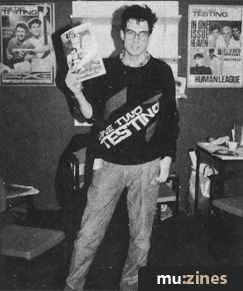
You think we're just willying about when we publish 'knitting patterns' and 'road recipes', don't you? "Oh, those zany One Two Testing bodkins are just larking us on." Well it can be done, and here is a doer if ever we saw one coming. Proudly wearing his very own One Two Testing jumper on our very own One Two Testing stand (at Frankfurt) is Lloyd Taylor of Southern Music, Brighton. Apparently he stapled his girlfriend's mother (Mrs Houghton of Hastings) to a pair of number ten knitting needles until the job was done.
The first two prototypes of Wal's 5-string bass should now be going through their paces with Martin Jones (Howard's brother and bassist) and Robbie Burns (currently with Eric Burden). These two prototypes take the low 5-string route — in other words, they have an extra low B-string, rather than an extra high B- or C-string as other makers have opted for. Pete Stevens of Electric Wood, who build the Wal basses, told us that this "low-option" was first suggested to them by long-time Wal collaborator Percy Jones, although Manhattan Transfer bassist Mike Schnoebelen had brought up the idea of a 5-string Wal years ago and nobody had taken much notice. After the prototypes, will come a second batch that Pete reckons will have a "slightly wider neck" than the first two — after that it's a matter of seeing how the orders come in. Electric Wood are not exactly a high volume production line anyway — about four 4-string basses a month at present — so, as Pete says, "We don't expect the 5-strings to take over. If we make ten this year we'll be happy." Might be worth checking out. Contact: Electric Wood, (Contact Details).
HAYMAN DRUMS were known in the 1960s and 1970s as good quality and good value instruments, but up until recently they've been out of production. Two notable points loom from the history: these were British-made drums (three swift choruses of "The British Grenadiers", please, maestro), and they featured a strange treatment to the inner surfaces of the drums called Vibrasonic Lining, which very old drummers have told us made them sound even in their projection. But why the history lesson, you ask? Because Hayman is back, and is being distributed by a company run by Ivor Arbiter, the man who first had the drums built back in the 1960s when he ran Dallas Arbiter Ltd. With that company and the following CBS/Arbiter set-up Mr Arbiter marketed Fender, and so it's interesting to note that he'll also now be running the UK end of the new Fender company which several US employees have bought from CBS (see last month's interview with Fender's Dan Smith).
No time to fit in this interview with Kahler king Dave Storey last month. We were Frankfurter! to the rims. Seemed a shame to miss his words of wisdom, however, so here goes for May.
INTERVIEW - DAVE STOREY
Designer, Kahler Tremolos, USA.
Kahler tremolos — certainly one of the Concordes of the trem business — began as Dave Storey's cost-saving exercise. Eight years ago, playing in New Zealand bands, he built his own guitar (to save money) and decided that extra hardware was out of the question unless he constructed that, too. Boldened by the merits of his silky trem (and its innovations) he filed patents in England and found a partner in the form of American Gary Kahler, who gave his money, backing and name to the product.
"I suppose the thing about Kahler is it's got a really smooth operation," commented Dave Storey in Frankfurt. "Too smooth for some people; too soft, y'know?
"One of the things we'll be doing in the future is to offer a heavier spring which can be immediately retrofitted to any Kahler bridge and almost doubles the tension — you have to account for people being used to... er... bad technology."
Why did he think there had been such a resurgence in the use of the tremolo, and had this prompted designers like himself to look for better systems?
"No, it was the other way around — more guitarists use tremolos because they now work. Okay, you can make a Strat trem work, like Hendrix did, but then he was good enough to be able to tune his guitar without stopping playing AND make a feature of it... not everyone can do that. Anyway, I'm sure 90 per cent of all fulcrum trems are screwed down against the body so they can't be used!"
While pausing to give credit to Floyd Rose for the first lockable trem system, Dave Storey opined that his was developed in New Zealand isolation long before he heard of the Rose system. Technically, the Kahler recipe is one of carefully calculated gear ratios between the arm and the spring movement, the spring tension itself, and fine machining to thousandths of an inch... it wouldn't help you to know, most of it is protected by patents.
The next immediate development is a low-priced ($75) fixed, fine-tune bridge, requiring no routing of body cavities and which can be bolted directly to the guitar. The twist is that with a smidgeon of extra development, each fine tuner will become a miniature tremolo worked by its own small lever. Kahler's first step will be to turn it into a G and B bender, perhaps in the hope that guitarists will begin to explore that technique now it's cheaper and more reliable, in the same way that they were spurred to 'tremming' by better hardware.
Did he approve of Steinberger's Transposing Tremolo, quizzed the voice of One Two? "Yes, great idea... but it has been around for 22 years. There was a patent on the transposer idea in 1962."
Was there any point Dave Storey thought the public might have missed about Kahler add-ons? Yes. Upgradeability.
"Every bridge we make has completely retrofittable parts so you could pull out a pin and replace the brass roller sets with steel ones, or add sideways adjusting saddles... you don't have to spend another £150 on the whole system. You can put a little more dough into your existing bridge when you're a better player, and notice the improvement. I'd like people to be aware of that."
Publisher: One Two Testing - IPC Magazines Ltd, Northern & Shell Ltd.
The current copyright owner/s of this content may differ from the originally published copyright notice.
More details on copyright ownership...

One Two Testing - May 1985
Donated by: Colin Potter
News
Previous article in this issue:
Next article in this issue:
Help Support The Things You Love
mu:zines is the result of thousands of hours of effort, and will require many thousands more going forward to reach our goals of getting all this content online.
If you value this resource, you can support this project - it really helps!
Donations for June 2026
Issues donated this month: 0
New issues that have been donated or scanned for us this month.
Funds donated this month: £0.00
All donations and support are gratefully appreciated - thank you.
Magazines Needed - Can You Help?
Do you have any of these magazine issues?
If so, and you can donate, lend or scan them to help complete our archive, please get in touch via the Contribute page - thanks!
Please Contribute to mu:zines by supplying magazines, scanning or donating funds. Thanks!
Monetary donations go towards site running costs, and the occasional coffee for me if there's anything left over!

 @mu_zines
 RSS Feed
 Blog
Blog