


Magazine Archive
Home -> Magazines -> Issues -> Articles in this issue -> View
Soundproofing Windows | |
Article from Home & Studio Recording, January 1984 | |
Often there is confusion between soundproofing and sound control, perhaps because the all embracing term 'acoustically treated' is used when describing a room or studio which has been modified to provide either or both qualities.
To clarify the situation, a room may be sound proof and exhibit poor acoustic properties, similarly a room may have ideal qualities for listening or recording, yet despite masses of absorbent materials, admit extraneous sound quite freely.
Poor acoustics and lack of soundproofing are no problem for the totally electronic musician/recordist, but for the rest they are the bane of their artistic efforts, and will continue to be so until the secret of direct injection of the voice is discovered and since that is unlikely it's best not to wait. Take up the tools now and start the proofing and controlling.
Whatever the ideal studio acoustics may be, there will certainly be a lot of compromises in a home studio, some because of time or money limitations, others because the room or equipment may serve dual functions. With regard to the problem of money and time, HSR intends to feature cheap and quick ways to improve your studio but you are on your own with the second problem.
HSR has already featured a cheap method of improving studio door performance, another source of unwanted noise is a window and there are few rooms without one, so that would seem the next logical step for improvement. If the window were to be bricked up both inside and out, that would bring its sound transmission value down to that of the wall and solve the problem, but landlords, parents and spouses are not that obliging so a method of plugging the 'hole' in the wall, which can be removed quickly, is the only answer.
Methods
Two methods spring readily to mind, the first being a sound curtain, which is a vertical equivalent of the method adopted by some studios for reducing sound transmission through the roof. The second method is the use of sealing panels which fit into the frame. Within the two systems there are several ways of achieving the goal. The constructor may even choose to combine elements of both systems.

Figure 1. Sandbagging method.
First the sand method, which for those who are not proud and wish to save money could be the 'muck' method. The easiest method is to fill small, strong polythene bags (about 10 lbs each) and stack them up on the window sill until the entire window space is filled. Though effective, there are two disadvantages, the first being the time to stack and unstack the bags when the room changes its guise. The second is the danger of the pile toppling over, though this problem can be overcome if provision is made to clip in a safety retaining panel. Figure 1, shows a modification of this idea in which the bags are carried on crossbars. They are hung in place in an overlapping 'tile' arrangement, many lighter layers are used to ease assembly and each bar fits into slots in a pair of uprights screwed in each side of the frame. The thickness of the insulation should be at least 4-6" and this should provide around 30dB attenuation across a wide range of frequencies. A thick muck or sand plug could well match a brick wall at around 45dB and go a long way towards eliminating traffic and city noises from recordings.
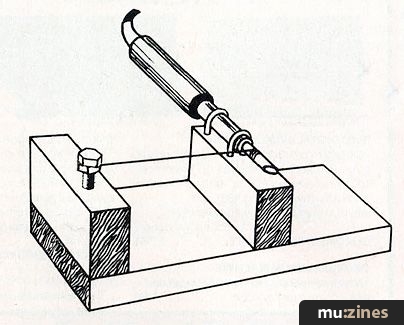
Figure 2. 'Hot iron' system.
The alternative to 'sand bagging' is to block off the window with a stiff heavy wooden panel, a simple enough task, but for those who must remove such a panel after every studio session, it is a little impractical. One solution to this heavyweight problem is to use expanded polystyrene: it is light, easily worked and non-resonant, but unfortunately not very rigid, except when several inches thick and then the price is prohibitive.
There is, however, a cheap alternative to expensive polystyrene sheet and this is reclaimed packaging from large electrical goods. This may be sliced up into 'bricks' of a standard thickness and width by the use of a 'heat saw'. Figure 2 shows a suggested construction using a soldering iron and a taught wire - the height of the wire governs the depth of cut as the polystyrene is fed into the unit.
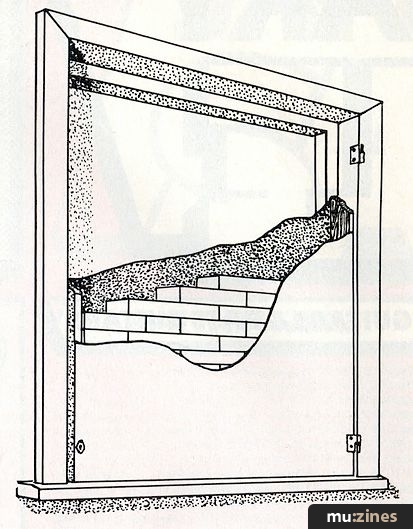
Figure 3. Block panel method.
The bricks may then be glued in position within a chipboard skinned frame, designed to fit snugly into the window frame (Figure 3). A suitable adhesive for the purpose is PVA, the solvent in many others will destroy the polystyrene. The key to success with this system is rigidity, so a combined thickness of panels and foam of at least 6 inches should be aimed for.
Effectiveness
Whilst neither of the suggested approaches are conventional, they do offer an inexpensive solution to a real problem - the effectiveness of that solution will obviously vary from studio to studio. The degree of success will very much depend upon achieving a good seal between the window and the 'plug', be it sand or polystyrene. In the case of the former method, small bags could be used for packing any gaps, in the latter case a soft rubber seal around the window frame and a locking system (sash window fasteners) which will hold the panel tight against it, is the answer.
More from these topics
 Studio DIY |
 Studio Project - Introduction |
 Technically Speaking |
 A Shiftin' air affair - Bass Traps |
 Speaker's Corner - CHOOSING & USING: studio monitoring |
 Sound Systems For Synthesizers |
 Sound Bites - Production Tips & Techniques |
 The Stuff That Rooms Are Made On |
 Small Studio Acoustics |
 Bass á la mode - Bass modes |
 Building a Home Recording Studio - Acoustics |
 Making waves - Acoustic diffusers |
Browse by Topic:
Acoustics
Construction / Build
Publisher: Home & Studio Recording - Music Maker Publications (UK), Future Publishing.
The current copyright owner/s of this content may differ from the originally published copyright notice.
More details on copyright ownership...

Home & Studio Recording - Jan 1984
Donated & scanned by: Mike Gorman
Feature by Steve Taylor
Help Support The Things You Love
mu:zines is the result of thousands of hours of effort, and will require many thousands more going forward to reach our goals of getting all this content online.
If you value this resource, you can support this project - it really helps!
Donations for May 2026
Issues donated this month: 0
New issues that have been donated or scanned for us this month.
Funds donated this month: £0.00
All donations and support are gratefully appreciated - thank you.
Magazines Needed - Can You Help?
Do you have any of these magazine issues?
If so, and you can donate, lend or scan them to help complete our archive, please get in touch via the Contribute page - thanks!
If you're enjoying the site, please consider supporting me to help build this archive...
...with a one time Donation, or a recurring Donation of just £2 a month. It really helps - thank you!

 @mu_zines
 RSS Feed
 Blog
Blog