


Magazine Archive
Home -> Magazines -> Issues -> Articles in this issue -> View
Steinberg MIDEX+ | |
Key Expander/SMPTE SynchroniserArticle from Music Technology, December 1990 | |
Integration is the name of the game with Steinberg's Midex - a single unit combining a software key expander and a SMPTE synchroniser for the Atari ST. Nigel Lord even likes the colour.
When you're working with several dongle-protected programs and trying to sync everything to a timecode like SMPTE, things can get complicated - unless you opt for an integrated system such as MIDEX.
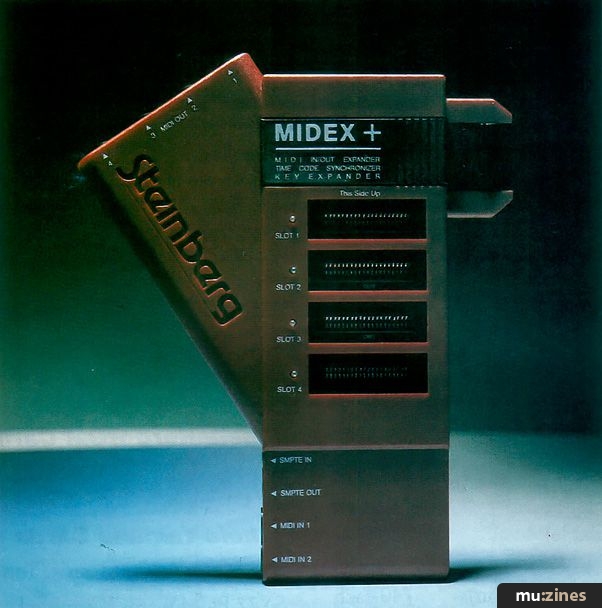
Image credit: James Cumpsty
YOU ONLY HAVE to look at the packaging of their recent software to realise that Steinberg are the type of company who invest more than a little time and effort in making sure their software looks the business, as well as acts it. There's something about the colour scheme and the graphics on a Steinberg floppy that makes you want to slip it into the disk drive to see what delights it holds. The fact that it's a Steinberg disk, however, means you'll almost certainly need to insert the requisite dongle into the side of the computer in order to find out. As many a luckless hacker has discovered, the best software comes with the best protection these days. No dongle, no dice.
Of course, if you have the sort of computer that's bristling with extra RAM and the disk you're about to load is a program such as Cubase, the chances are you'll want to explore the possibilities presented by the multitasking facilities now at your disposal. But even if you intend nothing more adventurous than tailoring a couple of synth voices to suit a new song you're working on, you have a problem. Your computer has only one slot and you need to insert two dongles. Needless to say, this is a problem Steinberg anticipated when they released Cubase, and a key expansion board was immediately made available for those who wanted to avail themselves of the kind of advanced computer control M.ROS has opened up.
The trouble is, after shelling out over a grand for a Mega ST (or at least, an extra few hundred for the additional RAM to beef up a 1040), five hundred for Cubase, and two to three hundred for a couple of synth editors - potential multitaskers were (understandably) miffed at then having to fork out another hundred for a small board with four extra MIDI sockets to get the system working. Steinberg would no doubt claim that it wasn't just four extra sockets they were paying for; I'm sure there was some serious electronics on that small board. But the fact remains that punters who had quite legitimately bought copies of Cubase and other Steinberg software were being penalised for the nefarious activities of the pirates.
Enter the MIDEX+ - an object lesson in lateral thinking. If a key expander has to be used and the one you make is already as cheap as it can be, what do you do? Answer: you make a much more expensive version. But - and it's a big but - you include on it various other bits of associated hardware which ST/Cubase users are almost certain to find themselves needing in their quest for a fully integrated MIDI system. Like, for example, an output port expander offering a further four MIDI Outs to alleviate the problem of time delays in larger systems. And for incoming data? There can be few people using computer-based sequencers who haven't found themselves in need of an extra MIDI In (or two) at some time or other. The pair included on the MIDEX+ gives you a total of three to play around with and that means being able to input signals from your synth and your drum machine whilst simultaneously receiving clock information from your MIDI sync track.
On the subject of sync tracks, how does a built-in SMPTE read/write time code synchroniser grab you? Those who have not yet addressed the problem of synchronisation would find this the perfect solution for keeping tape and sequencer locked together. And with SMPTE still the preferred choice of synchronisation on most professional equipment, it could also prove useful for those who already have a MIDI sync unit by providing the option of SMPTE code when this is required - in video or film work, for example.
And since this is actually a key expander, wouldn't it be handy to have a small LED next to each of the keys to let you know which is currently in operation? With the connection of up to four keys possible using the MIDEX+, I think you'll find it would.
The MIDEX+ could have been built into a grey oblong box with ugly pink lettering and a tendency to put undue strain on the ST's cartridge slot. In other words, your average piece of utility gear. That it comes in a rather fetching shade of red, has a truly unique shape and is designed to fit perfectly alongside the ST is further testament to Steinberg's design sense (again) and their obvious familiarity with as users, rather than simply manufacturers of software and computer peripherals.
The MIDEX package includes a disk from which you're asked to copy an M.ROS folder containing the latest driver software (currently v2.03) onto your program disk so that it is automatically recognised each time you load up. Also included in the folder are all the other driver modules which have been developed by Steinberg. At the present time these include the Fostex R8/MTC1 combination (see MT, September '90 for full review), Steinberg's own SMP24 and Timelock systems and (rather sportingly), C-Lab's Unitor.
INS & OUTS
THE EFFECT OF MIDI time delays has been well-documented, and there can be few people these days who (by choice) would daisy-chain more than two or three MIDI instruments within their setup. However, the greater reliance placed on System Exclusive as a means of addressing specific MIDI functions has, in recent years, served to compound the problem considerably. The difficulty stems from the fact that MIDI protocol gives priority to SysEx messages, and being a serial data system, this means that while these messages are being transmitted, no conventional MIDI data (notes and controller messages, for example) can be sent. Given the length of some SysEx messages and the fact that software utilities such as Steinberg's own MIDI Manager (included on Cubase) rely on them quite heavily, this clearly constitutes a very real problem - even in systems where instruments are only linked in chains of two.
Whether the four Outs provided by the MIDEX+ (five, when you include the ST's own MIDI Out) is sufficient for your needs, only you can decide. But I'd have thought it offered a pretty good starting point for the average setup. Of course, the real beauty of the MIDEX/Cubase combination is that the selection of output ports takes place on screen and doesn't rely on any form of manual switching. Besides being a much more elegant system, this should make it easier to optimise the MIDI Outs you have at your disposal - as well as making it possible to record setups as part of the song data for each track you're working on.
"The fact remains that punters who had quite legitimately bought copies of Cubase and other Steinberg software were being penalised for the nefarious activities of the pirates."
If the five Outs provided by the MIDEX system represents a useful figure for the average setup, I think I'd have to say that three MIDI Ins still rates as a bare minimum and would demand a setup with a master keyboard at its heart to be sufficient. Only then could all your keyboard data be entered into the sequencer through a single MIDI In, leaving the other two to handle (say) a drum machine and sync track. That said, if you're making use of the onboard SMPTE timecode, this would obviously free one of the ports, and we shouldn't forget those readers who aren't involved in recording at all. Even so, I think many of you will find yourselves with a certain amount of plugging and unplugging to do if you wish to avoid the expense of a MIDI merge box.
Speaking of which, I could have lived without the manual offering me a useful "tip" for inputting data to my sequencer and finding that even with MIDEX's additional ports I still don't have enough inputs. "Just use a relatively cheap MIDI merger" it advises. Thanks, Steinberg, glad to have had that one sorted out.
EXPANDING HORIZONS
RECORDING AND SYNCING to the SMPTE generator/reader proved completely trouble free, though the standard warnings about noise reduction systems and EQ settings still apply. In conjunction with Cubase, the MIDEX+ can read and write in all the common formats - 24, 25 and 30 frames per second (as well as 30fps drop frame) - and the system locks in within (typically) half a second. You have to ensure that the timecode is read in the same format it is recorded (or generated by third-party equipment) but on Cubase you're provided with a very straightforward editing window for this, accessed via the Options menu.
The key expander needs no explanation from me except to say that it works in conjunction with Steinberg's Switcher program (included with Cubase) and that care has to be taken to ensure dongles are inserted the right way up. It might be imagined the MIDEX+ would offer some kind of buffer to the effects of inserting and withdrawing dongles whilst the computer is switched on. Not a bit of it: and dire consequences are forecast for anyone foolish enough to try such a move.
Dutifully, when the time came for me to unplug the sleek red form of the MIDEX+ from my ST, I made sure the power was off and that I withdrew it at ninety degrees so that no damage was done to the socket. It wouldn't budge. A little more force; still no joy. I began to worry. The MIDEX+ had to be sent back and I couldn't get the damn thing out of my computer. I had visions of damaged pins and a huge repair bill. My mind went back to an incident a few years ago when our golden retriever, having never previously shown any interest in the mongrel bitch that lived next door, suddenly decided to make her the object of his desires. But somehow, throwing a bucket of cold water over my ST and the MIDEX+ didn't seem altogether appropriate.
It then occurred to me that there might be some kind of locking device to prevent the MIDEX being accidentally pulled out while the computer was switched on. And sure enough, I discovered a notch in the black plastic inset running across the top of the unit which engages part of the ST's casing and locks the two together. Pressing the strip immediately allowed the MIDEX to be withdrawn from the computer. Thinking about it, it's actually a very neat idea but one which I feel would benefit enormously from being mentioned at some point in the instruction manual. Still, I suppose it does allow me to say, you read it here first...
VERDICT
AS WITH MANY recent pieces of equipment, the MIDEX+ is the kind of tool which relies to a considerable extent on people realising just what it can do for them before deciding whether or not it represents value for money. There can be no doubt that if you were to add up the cost of the individual pieces of hardware it comprises, it would appear pretty cost effective. Having said that, I imagine many people would have to give serious thought as to whether they need an extra SMPTE facility if they already own a sync unit. I suppose it depends whether you're likely to find yourself working with SMPTE in the future. If you decide you're not, then Steinberg can offer you the same expansion facilities of the MIDEX+ in the shape of the MIDEX. And this translates to a cash saving of some £125.
Either way, Steinberg have effectively turned what under normal circumstances would be a handful of deadly boring accessories into a rather desirable piece of MIDI hardware - and that kind of imagination is always to be congratulated.
Prices MIDEX+ £475; MIDEX £350. Both prices include VAT.
More from Evenlode Soundworks, (Contact Details)
Publisher: Music Technology - Music Maker Publications (UK), Future Publishing.
The current copyright owner/s of this content may differ from the originally published copyright notice.
More details on copyright ownership...

Music Technology - Dec 1990
Gear in this article:
Review by Nigel Lord
Ads for Gear in this article:


Previous article in this issue:
Help Support The Things You Love
mu:zines is the result of thousands of hours of effort, and will require many thousands more going forward to reach our goals of getting all this content online.
If you value this resource, you can support this project - it really helps!
Donations for October 2026
Issues donated this month: 0
New issues that have been donated or scanned for us this month.
Funds donated this month: £0.00
All donations and support are gratefully appreciated - thank you.
Magazines Needed - Can You Help?
Do you have any of these magazine issues?
If so, and you can donate, lend or scan them to help complete our archive, please get in touch via the Contribute page - thanks!
Please Contribute to mu:zines by supplying magazines, scanning or donating funds. Thanks!
Monetary donations go towards site running costs, and the occasional coffee for me if there's anything left over!

 @mu_zines
 RSS Feed
 Blog
Blog