


Magazine Archive
Home -> Magazines -> Issues -> Articles in this issue -> View
Technart TUK 200 | |
Pitch-to-MIDI Conversion SystemArticle from Music Technology, June 1989 | |
The search for an alternative to the keyboard as a MIDI controller continues - with a system from a new British company called Technart. Debbie Poyser tracks down the TUK 200.
Since the adoption of the MIDI standard, a variety of units have become available to turn almost any instrument into a MIDI controller - the latest is the TUK200.

PITCH-TRACKING SYSTEMS, designed to give musicians other than keyboard players access to synthesised sound sources, have been around for quite some time now. They take various forms and work with varying degrees of success. Some, like the Synthaxe guitar controller and Yamaha WX7 wind controller, are used instead of the player's usual instrument, while others derive pitch information from "conventional" instruments, which is then converted to MIDI information.
Much research has gone into developing the best of the systems currently available, and any new arrival on the scene is going to encounter stiff competition from the like of Roland, Casio, Canada's IVL Technologies, and many others. With this in mind, British company Technart UK's TUK200 is about to enter the race.
What it is
THE TECHNART TUK200 is a monophonic pitch-to-MIDI system with accompanying chord generator. It's primarily designed for guitarists, though it can be used successfully with other instruments (wind instruments, for example). The end result of using the TUK200 should be that a guitarist (or acoustic instrumentalist) would be able to play monophonic melody lines via MIDI and accompany him or herself with the integral chord generator running from another (or the same, if multitimbral), MIDI sound generator.
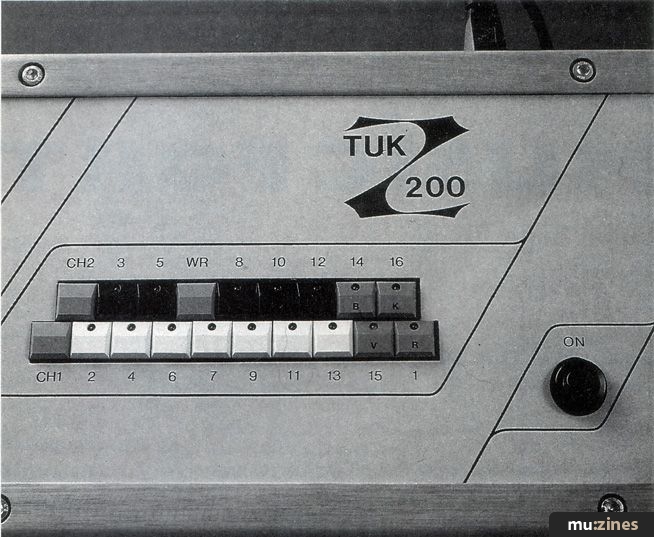
The device consists of two parts: a control panel with rotary pots to adjust the various functions, and a matrix of switches representing one octave of a keyboard (though some of these switches also have dual functions); and a pedalboard of seven footswitches which activate the system's other feature: a chord and arpeggio generator.
Both control panel and pedalboard are hand-made and don't conform exactly to the usual matt-black, hi-tech rackmounting box image we've all come to know and love (haven't we?). Slick wouldn't be the word I'd use to describe them; perhaps we could settle on quaint. The casings are sturdy, however, and meant to stand up to the vagaries of live work - it is possible to put your full weight on the pedalboard without reducing it to splinters, although it's not recommended that you make a habit of it. The control box especially is thoughtfully designed, with the controls well-spaced and towards the front of the panel so that if the TUK200 is stacked below a keyboard in a stand they are still visible and accessible. On the rear of the control unit are two seven-pin DIN sockets marked A and B, which must be connected to similarly-named sockets on the footswitch board, two audio inputs, one for high- and one for low-impedance input, a signal output socket marked OUT (providing a pre-amplified version of the input signal), and a five-pin DIN socket - the magic MIDI Out.
Controls on the panel consist of Gain (for input level), OP Level (adjusts volume of input instrument's own audio output), Velocity Adjust, Decay (matches the TUK200 to the natural decay characteristics of the input instrument), a pot marked AB which adjusts the degree of conditioning of input signal by the TUK200 (helps to eliminate brief instabilities like fret buzz on a guitar), and two controls named Mark and Space - these adjust the length of notes and rests when the arpeggiate function is being used. The matrix of switches to the right of the panel represents the middle octave of a keyboard and is used to assign chords to the controlling footswitches, for use with the chord generator. Some of these switches have dual functions, which include K (Keyboard), allowing the switch matrix to be played audibly as if it represented the middle octave of a keyboard; WR (Write), which is pressed to write a chord being held down into the TUK's memory; B, to activate the Bass function, which derives bass notes from the input notes; R (Root), which enables the root note input to be output over MIDI - these two switches, if activated, will "double" the input note (though both must be played on the same patch from your sound generator); V (Velocity), which, when activated, takes velocity data from the level of the input signal - if not activated, velocity byte data is constant at 60; finally, 16 of the 19 switches are numbered from 1-16. These switches allow you to choose which two MIDI channels you would like the Root and Bass and the Chord functions respectively, to be assigned to. The TUK200 transmits on two channels only, but you can choose which two of the 16 MIDI channels you want it to transmit on. Channel 1 on the TUK200 (assigned by the CH1 switch on the matrix) carries the Root and Bass together and Channel 2 (assigned by the CH2 switch) carries the Chord function. So, say, if you wanted the Root and Bass (or just the Root or Bass) to be transmitted to your sound source on MIDI channel 12, you would need to simultaneously press the CH1 switch which assigns the Root and Bass, and the switch marked 12, and Root and Bass notes derived from your input would then be transmitted on MIDI channel 12. The same goes for the Chord output, assigned by the CH2 switch.
The Generation Game
THE TUK200 WILL simply provide monophonic MIDI control from an input instrument if you like, but having laid out hard cash for one of these systems, it would be a shame not to take advantage of the chord generation facility. As previously mentioned, this is controlled mainly from the pedalboard. Five of the seven rocker switches are "address" footswitches, to which chords can be written; the other two are "special function" switches labelled U (Up) and D (Down). Logically enough, these determine whether the sequence of notes in the currently selected chord arpeggiates up or down. If you hit both U and D switches (an LED will light up on the left-hand side of the board to show which of the special function switches is activated), you can access something called "Strobe". This gives a pseudo-delay effect on each of the notes of the chord that can be quite interesting.
The mechanics of assigning chords to the address footswitches are quite straightforward; with a foot on one of the address switches form the required chord structure (with your fingers) on the control unit switch matrix and press the WR switch briefly at the same time. LEDs will light up and the chord will be written to that footswitch. In this way, it's possible to, for example, assign a major chord to footswitch 1, a minor chord to footswitch 2, a seventh to number three, and so on up to five chord structures, all of which can be used as accompaniment.
When the required chords are signed, a melody line can be played into the TUK200 and chords derived from the pitches of the melody will be generated according to which footswitch is depressed - in the low position of each footswitch, the chord generator will generate a new chord for every change in pitch played on the input instrument. In itself this could be of limited usefulness, as you don't usually want a chord change for every note you play. However, the footswitches are of the rocker variety and the "address" set of switches have an alternative position at the top labelled H (Hold). This means that if you don't want the chord to change every time a new note is played, the Hold position of the switch can be used to ensure that a new chord is generated only when the switch is re-depressed. So all you widdly-widdly guitarists can jam away over held chords 'til you're blue in the grass. Using the TUK200 in this way, it's possible to derive quite a complex accompaniment, though the foot/brain coordination required to do it smoothly is no mean feet er, feat.
The final two functions of the footswitch board are L (latch) and M (Manual). In normal use, the footswitches are momentary in action; a chord will only be generated for as long as your foot is on a switch. The Latch function, if activated, allows the last chord generated to sustain until either this function is turned off or another address footswitch is pressed. The Manual function allows you to use the footswitch board completely independently of input pitches - depressing a footswitch will result in a chord being generated even if nothing is being played on the input instrument. However, in this mode any chord written to the switches will be treated literally as if it were played in the middle octave of a keyboard. Input notes are ignored as regards chord generation but the Root and Bass functions are free to track these notes as usual.
In Use
PITCH EXTRACTION AND tracking on the TUK200 are very good when the Gain and Decay levels have been set to suit the input instrument. The delay between plucking a string on a guitar, say, and hearing it sound on your source, is minimal and, given a little practice, not enough to cause problems (unless you play very quickly indeed). Setting of the Gain control in particular, is critical - too high and the TUK200 picks up harmonics instead of the central pitch. When this happens, you sound like Sparky's Magic Piano on acid. With Gain correctly set, tracking is even OK on the lower strings (traditionally a trouble area for pitch tracking systems), though it has become almost axiomatic with a pitch extraction system to say that playing technique needs to be modified. The TUK200 prefers a clean attack to a note to begin tracking, and this means it responds patchily to tonguing on a wind instrument. Guitar pitchbend is another problem area as the TUK200 rounds up a bent note to the nearest semitone.
The chord generator is quite fun to use, though the degree of co-ordination required to play the desired notes cleanly and step on all the right footswitches to accompany them at the right time, is considerable. It can be done, as demonstrated by the units developer, if you're sufficiently determined.
The aspect of the TUK200 I enjoyed most was the arpeggiation function, which produces immediate, manic changes in direction and arpeggio depending on what notes you input, which footswitch is held down and whether the arpeggio is scanned Up or Down. Never mind Sparky, this is Philip Glass on acid. However, it's worth bearing in mind that it's not possible to clock the arpeggiator to or from anything, so you can't, for instance, record interesting arpeggios into a sequencer with any degree of rhythmic integrity. Incidentally, the manual mentions that the TUK200 is good for vocal training. I can vouch for this being true you need to be constantly and superhumanly in tune to make it track properly.
Verdict
WHILE ITS FUN exploring the TUK200, I can't help asking myself whether it will make the grade in the big vicious world. Alternative guitar controller systems now proliferate - consider the Casio MG guitars and the more recent PG380, all of which provide a conventional guitar, respond to pitchbend and string glissando, have tremolo arms, and are polyphonic into the bargain. Other dedicated systems include the K-Muse Photon, also polyphonic (and incidentally, also with an arpeggiate function and an 8-track, real-time sequencer with 400-note capacity), though the above do come more expensive than the TUK2O0.
True pitch-to-MIDI systems include the Roland GM70 guitar-to-MIDI interface, which, though now superseded by the GR50, has sophisticated MIDI implementation and 128 program memories; it is also polyphonic and at £700 or so comes reasonably close in price to the TUK200. The IVL Pitchrider pitch-to-MIDI converter (designed for wind players and little more expensive than the TUK200) adopts a similar design to the TUK200, with a control unit and footswitch board, is six-voice polyphonic with a hold function for chord generation, and once more, has a comparatively sophisticated MIDI spec. The systems available are really too numerous to mention.
Originally developed for the personal use of its designer, the TUK200 is out-classed in some ways by the competition, but has the advantage of being accessible and very easy to use. And since its MIDI spec is quite basic, it shouldn't allow you to get into too much of a mess. This could be a boon to its target market, which I'm told is mainly the pub musician.
The arpeggiate function is interesting, and would be even better if it could be clocked from some external source - MIDI drum machine or MIDI sequencer. The pitch-tracking is very good to excellent when the correct technique is developed. The chord generation facility is simple to comprehend and put into operation, though it takes practice to use properly for musical accompaniment. In short, I can't find a lot to pick fault with apart from its targeting. However, it's worth remembering that the TUK200 tracks monophonically and will only transmit on two MIDI channels - and that bearing in mind the comparitive sophistication of the competition, the price may look steep to the prospective buyer.
Price £599 plus carriage
(Contact Details)
Publisher: Music Technology - Music Maker Publications (UK), Future Publishing.
The current copyright owner/s of this content may differ from the originally published copyright notice.
More details on copyright ownership...

Music Technology - Jun 1989
Gear in this article:
Review by Debbie Poyser
Help Support The Things You Love
mu:zines is the result of thousands of hours of effort, and will require many thousands more going forward to reach our goals of getting all this content online.
If you value this resource, you can support this project - it really helps!
Donations for May 2026
Issues donated this month: 0
New issues that have been donated or scanned for us this month.
Funds donated this month: £0.00
All donations and support are gratefully appreciated - thank you.
Magazines Needed - Can You Help?
Do you have any of these magazine issues?
If so, and you can donate, lend or scan them to help complete our archive, please get in touch via the Contribute page - thanks!
If you're enjoying the site, please consider supporting me to help build this archive...
...with a one time Donation, or a recurring Donation of just £2 a month. It really helps - thank you!

 @mu_zines
 RSS Feed
 Blog
Blog