


Magazine Archive
Home -> Magazines -> Issues -> Articles in this issue -> View
The Musical Micro | |
Editing PackagesArticle from International Musician & Recording World, June 1986 | |
Tony Mills on sequencing and editing software for the C64 and Atari 520 ST micros
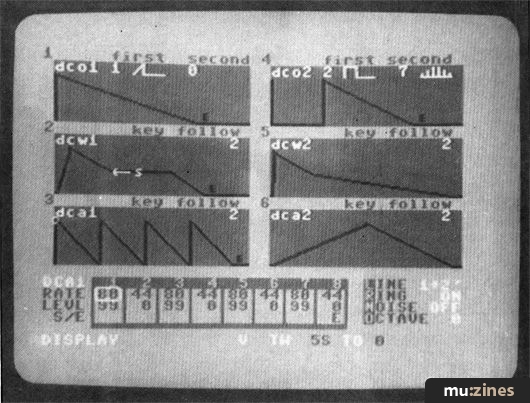
Joreth CZ Editor
Last time around we promised a look at some affordable editing packages for affordable synths, and the best possible combination of these two must be the Commodore 64-based Joreth system and the Casio CZ-101. The Casio has been a massive success of late, largely as a powerful multi-timbral MIDI expander (thanks to its dinky little keys), but editing it isn't much fun due to the digital access control system.
Granted, the Casio's Phase Distortion system isn't half as difficult to come to terms with as Yamaha's FM, but at the same time the CZ-101 only has 16 user memories in which to record your fab new sounds (the presets don't really do the machine justice) and so a library/editor package is an enormous boon.
The Joreth package runs on their AL25 MIDI interface which also supports their compositional package MCS and various other products. One version of the Casio editor runs from within MCS, so you can change sounds and store them in the middle of composing, but the editing is still done with the synth controls in this mode and there's no screen display of parameters.
In the independent mode the Joreth package has a little real time sequencer built in so that you can still hear the sound playing as you alter it.
Envelopes for DCO 1 and 2, DCW 1 and 2 and DCA 1 and 2 are displayed graphically with values listed underneath, and all values are changed using the computer keyboard. Key follow and waveshape values are shown together with a little diagram of the wave shape for each oscillator bank.
Eight stages for each envelope can be called up together with Ring Mod, Noise, Octave and other parameters, so you can make any changes to the sound on just one display. Once you're happy with the new sound you can store it as one of 16 in the computer's memory, and dump all 16 new sounds to disc orto the synth.
You can move sounds around within the computer's memory to create sets of sounds for particular songs, and you can invent names for each sound, a facility which isn't available on the synth itself. You do have to actually load the sounds up to see a list of names though, so perhaps access to a disk directory would have been a short-cut.
The Joreth package works with all the CZ models – the CZ-101, CZ-1000, CZ-3000 and CZ-5000, and costs £44.85. More information from Joreth.
They do say as how you pays for what you gets, and if the price of the Supertrack software from C-Lab is anything to go by it should be pretty amazing. Well, it is. Anything that turns the very inexpensive Commodore 64 into the centre of a professional MIDI/SMPTE studio must be worth every penny of £100 or so, which is how much the pretty pink C-Lab disk will set you back.
There's one more expense apart from a computer, disk drive and monitor – the MIDI interface. But the software is unusually flexible here and will quite happily run on units from Korg, Yamaha, Passport, Jellinghaus and Steinberg apart from C-Lab's own model, which comes in two parts with a MIDI section and separate sync box. If you don't want sync to tape and other options, the cheapest simple interface will cost you only £30 or so.
SuperTrack is similar to the Steinberg Pro 16 we looked at a few months ago, displaying almost all functions on a single 'page' with 16 tracks of real time recording which can be assigned to any MIDI channel. The first time you load the package you have the opportunity to enter a code which will allow only you to use the software. Thereafter you can enter music in real time or step time, in the former case with a four-beat metronome count-in which can be lengthened, shortened or omitted as desired.
Each channel has a channel number, on/off status, MIDI channel, velocity level, transpose value, quantise value and loop length. Tempo can be altered as the patterns run and tracks can loop around any portion of their total length quite independently of each other. Maximum pattern length is 256 quarter notes (you can define odd time signatures such as 7/4 and 5/4 and using shorter lengths) and the computer will store 63 patterns in its memory.
Playing can be auto-corrected to any value up to 1/192 notes, and the auto-correct value also acts as the note length in Step Time mode. The space bar enters rests and you can enter single notes or full chords in step time.
If neither real time nor step time allows you the precision you want, you can load a single MIDI track of a single pattern into the Edit page, which displays all MIDI events numerically with simple labels. For instance, you may have an event listed as NOTE, C#4 ,67, which simply means that a C# note has started with a velocity of 67. You can edit the note (its corresponding Note Off changes automatically), its starting point in time, the patch number with which it's played, its velocity or degree of pitch bend or modulation, simply using the computer's cursor keys.
Pretty powerful, huh? And there's more to come, because completed tracks can be transposed, time-delayed for compensation or echo effects, doubled or halved in speed, copied or 'ghosted' to experiment with new velocity or transpose values, merged or punched into for overdubbing. Then you can set about writing a song, which can be up to 255 patterns long and which, like patterns and individual tracks, can be saved to disk.
Patterns don't have to play in the same way each time they recur in a Song – they can be transposed (for choruses later in the song) or have some tracks muted. The drum machine sync output can be switched off on any occurrence of a pattern so the accompaniment takes a break, and the software allows you to set eight auto-locate points so that you can skip around a song quickly.
Supertrack also gives out MIDI Song Pointer signals which with a Roland SBX-80 interface will allow you to lock to SMPTE equipment and so synchronise to multitrack machines and videotape – great for film composers. Other synchronisation methods are an external 48 pulse per quarter note signal (which can be recorded on tape for tape sync), external 24 ppqn (pulses per quarter note) signal for drum machines, or MIDI clock.
Supertrack's total note capacity is around 8,500 notes and the package is tremendously easy and rapid to use, particularly if you can afford a colour monitor to make the best of its multicoloured display. Apparently it's the best-selling package on the Continent, naming Tangerine Dream among its users, and is selling well in the States. UK importers are Sound Technology who will be pleased to give you any further information.

Eek! A mouse
Going a little up-market to the Atari 520ST, we find an astonishing lack of software which is bound to be rectified soon due to the computer's inclusion of a built-in MIDI port. In fact this isn't as much of an advantage as it sounds, because adding a MIDI interface to a computer is pretty easy and having a built-in MIDI socket means that you don't have footswitch, DIN sync, tape sync and other sockets to hand. But Steinberg are hoping to take care of that about the time they launch their 520ST 24-channel MIDI compositional system.
In the meantime there's the Treesoft MIDI Recorder from MoPro, available in the UK through SECS.
The MIDI Recorder is just that – a simulation of an eight-track, 16 MIDI channel tape machine complete with a little picture of a tape recorder with spools which turn while the package plays. The system records in real time and gives you a variable count-in before starting, and you can replay at the speed you recorded the passage or at one of seven other speeds.
The Timing display which is 'pulled down' from the top of the screen with the Atari's Mouse allows you to offset the start of each pattern by a variable amount (something you could never do with a tape recorder!) and the MIDI display allows you to seta MIDI channel for each track and enter a note of what synthesiser was connected and what patch it was playing.
Each track can hold up to 12 hours of music (yep, the Atari's memory is pretty gross) and information can be copied from one track to another. Like the C-Lab software, the MoPro package allows you to create a 'ghost track' with the same notes but different delay and other settings without using up any extra memory.
Sections can be labelled with a name (such as 'Intro') which allows you to jump to them immediately and you can sync to drum machines and other MIDI devices. MoPro plan a MIDI scoring package, a Music Programming Language, a DX7 library editor and much more, so the Treesoft package is clearly just a start, only fractionally more versatile than having an eight-track tape machine on hand and recording your synthesiser parts individually. Still, it gives some indication of what can be done with the 520ST, and if you do want to record and overdub spontaneously without being able to edit or arrange very much, its capacity is quite staggering.
Next time – more jokes, more editor packages, and hopefully some sampler editing software.
MoPro, (Contact Details).
Joreth Music, (Contact Details).
Sound Technology, (Contact Details).
More with this topic
 The Musical Micro - Of Mice And Micros |
 Amiga Notes |
 Software Support - Hints, Tips & News From The World Of Music Software |
 Digital Signal Processing (Part 1) |
Mac Notes |
Using Microprocessors (Part 1) |
 What The Computer Does... An Introduction |
ST Notes |
 PC Notes |
 On the net |
 Apple Notes |
 Driving in the fast lane - Silica CD-ROMs |
Browse by Topic:
Computing
Publisher: International Musician & Recording World - Cover Publications Ltd, Northern & Shell Ltd.
The current copyright owner/s of this content may differ from the originally published copyright notice.
More details on copyright ownership...

International Musician - Jun 1986
Feature by Mark Jenkins writing as Tony Mills
Previous article in this issue:
Next article in this issue:
Help Support The Things You Love
mu:zines is the result of thousands of hours of effort, and will require many thousands more going forward to reach our goals of getting all this content online.
If you value this resource, you can support this project - it really helps!
Donations for April 2026
Issues donated this month: 0
New issues that have been donated or scanned for us this month.
Funds donated this month: £0.00
All donations and support are gratefully appreciated - thank you.
Magazines Needed - Can You Help?
Do you have any of these magazine issues?
If so, and you can donate, lend or scan them to help complete our archive, please get in touch via the Contribute page - thanks!
Please Contribute to mu:zines by supplying magazines, scanning or donating funds. Thanks!
Monetary donations go towards site running costs, and the occasional coffee for me if there's anything left over!

 @mu_zines
 RSS Feed
 Blog
Blog