


Magazine Archive
Home -> Magazines -> Issues -> Articles in this issue -> View
The Youth Of The Wang Bar (Part 2) | |
Article from One Two Testing, December 1983 | |
Second instalment: the bender gets acne.
More twists for the tremolo as the man with the Wang, Jakko Jakszyk, continues his search into the early sixties.

Gibson go sideways
For those of you stupid enough not to have read the last instalment of this series and are scanning this in the hope of some kind of re-cap... tough.
The editorial dictatorship that we poor slaves have to work under suggests that you stop being a bunch of cheapskates and go out and buy a copy of the last issue. For those of you who had the sense to purchase issue one, but can't remember the story so far, I will briefly explain.
Doc Kauffman designed the first tremelo in 1929. Paul Bigsby followed with his device in 1946 and then Leo Fender, in the mid-fifties, eventually perfected the Stratocaster tremelo, and by the end of the decade had added the Jazzmaster trem to the list. Got it? Good.
So as the guitar playing world entered a new decade the sound of whammy bars being hit with fury was becoming a common one. Bigsby units were particularly popular and many guitar making companies were fitting them (or similar copies) as standard to their instruments — Gibson, Epiphone, Gretsch and Guild to name but a few. Rickenbacker were sticking with a slightly up-dated version of Doc Kauffman's original design and Leo Fender's Strats were much in demand.
But the units themselves were obviously useless without certain individual musicians to exploit them and subsequently bring them to the public's attention. The first great guitar innovator of this period has got to be Les Paul.
Les Paul, always eager to expand the possibilities of the guitar, had been tinkering around with different instruments and solid-bodied electrics since 1937, and even on the earliest Les Paul solid prototype, known as 'The Log', he had fitted one of Kauffman's vibrolas. By the end of the fifties, though, he had plumped for a Bigsby.
It's well worth trying to get hold of some of his recordings with his wife Mary Ford. The guitar work and pioneering multitracking technique (unheard of in the fifties) is quite amazing. A single called 'How High The Moon' was re-released last year because it was part of the soundtrack to the movie 'My Favourite Year', so it should be fairly easy to obtain. It's on the Capitol label C1282. I advise you to cop a load of this one, it's got some great stuff and some subtle tremelo tweaks here and there. This was released originally in 1953, and will astound you.
Meanwhile, bang up to date in 1960, Gibson launched their new Les Paul Standard range. They looked exactly like what became known as the SG Standard and featured Gibson's new sideways vibrato. There are two interesting myths worth exploding which surround this guitar.
Firstly, the name. I am sure I would not be alone in being very confused about this rare beast. Les Pauls to me have always been that classic single cut away shape. Yet this model looked like an SG, and shortly afterwards was retitled with that very name, thus making the Les Pauls of that shape the very rare guitars that they have become. Have you ever wondered why? I know I have.
Well the story goes like this: Les Paul was still under contract to Gibson, which meant that they could manufacture guitars with his name stamped on them. By the time 1960 arrived our Les was less enthusiastic. He was in the middle of a divorce and was taking less interest in Gibson's new product. So much so, in fact, that one day he walked into a music shop and says, "I saw this guitar hanging up and it said Les Paul on it. I was shocked. I didn't like the shape of the thing at all — hell, a guy could kill himself on those sharp horns." He went on to say how much he disliked the "skinny neck" and just about everything else about it. So he called up Gibson and said "Take my damn name off it, it's not my design." So from then on it was simply called an SG.
The other myth concerns the sideways vibrato. Les Paul suffered an accident in which his right arm was badly crushed. Doctors had told him that he would not be able to have free use of the right elbow joint and that once the arm was set it would be permanently straight. So Les, thinking of guitar playing first, asked to have the arm set in the guitar playing position, a permanent right-angle bend in the elbow joint. This they did.
It is widely believed that the sideways vibrato was designed purely for this disability, as the unit operates on similar lines to Doc Kauffman's of 30 years previous: the tremelo arm lies parallel to the body of the guitar and is pulled across the body toward the bridge, instead of up and down. This movement releases a joint that is tensioned by two strings and thus detunes the guitar. There is actually very little evidence to suggest that the sideways vibrato was built because of Les Paul's injury. He was never seen playing one and, as I mentioned, he had no hand in the design. He was using a Bigsby before and does so to this day. So it appears to be a story that was put around to create interest in the new instrument.
Although these vibrato units appeared on 335s at the same time, they didn't prove to be that popular. They neither worked very well nor stayed in one piece. Doug Chandler, whose shop in Kew is often filled with such collectors' items, tells me that because of the simple die-cast construction of the lever, they often turn up nowadays with the unit intact but the actual lever completely snapped off.
But in these heady days it was the clean and twangy sound of Fender and Mosrite guitars that was really starting the new revolution. The American band the Ventures were using Mosrite axes featuring the featherlite vibrato. The band's involvement with these instruments was so total that The Ventures Organisation became sole distributors.
The instrumental hits that they and their tremelo-armed guitars produced spawned countless imitators all over the globe. This in its turn increased the public demand for more vibrato-giving devices.
Before we move on to all that stuff though, I'd like to suggest a few records you might like to catch up on. Just in case the Ventures are a complete mystery to you, I'll start with them. The band have made, would you believe, around 60 LPs. And I'm told that they are still going strong.
Back in 1960-61 they had a lot of hit records. 'Walk Don't Run' is the best known, but a couple of tunes that display their wang bar virtuosity to the full are 'Lullaby Of The Leaves' and 'Perfidia' These were available on Liberty records. How easy to obtain they are now I'm not too sure, but it's got to be worth a quick rummage around your local second-hand store to find such classic examples of the early art of whamming.
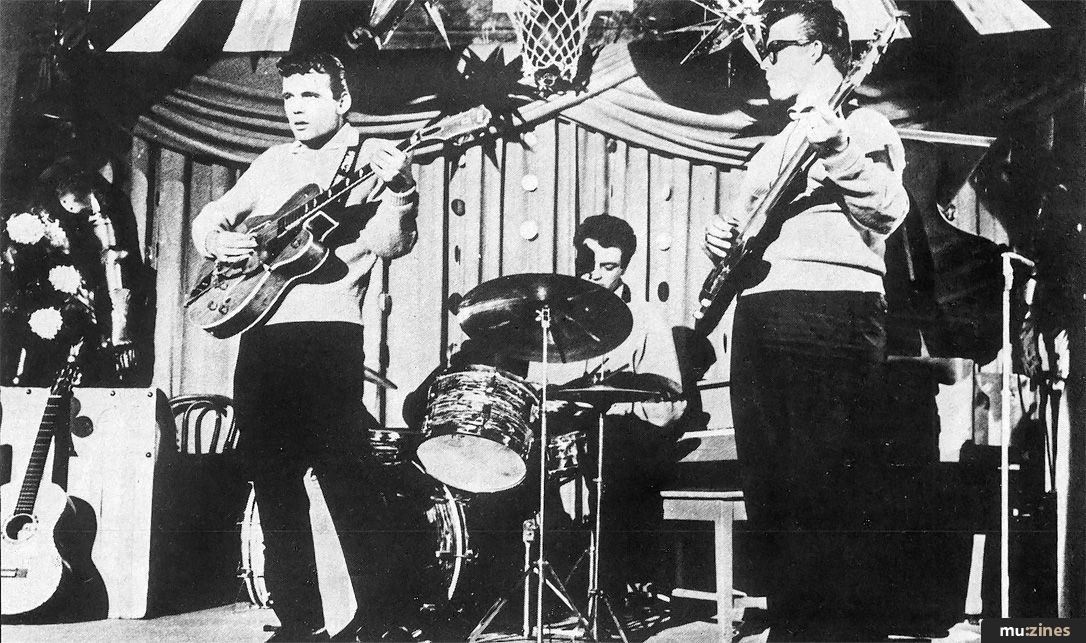
Duane Eddy goes twangy
Some years earlier both Chet Atkins and the immortal Duane Eddy had started to achieve popularity with their Bigsby-oriented singles. Their popularity grew into the early Sixties, Duane in particular earning a string of hits. 'Movin And Groovin' is a goodie to hunt for. But there are loads of compilations of his stuff that must be worth purchasing. 'One Million Dollars Worth Of Twang' by Duane Eddy and his Twangy Guitars you must buy if only for the title.
Meanwhile, back in old blighty, a certain Hank B Marvin and his band The Drifters had seen photos of their hero Buddy Holly playing a Fender Strat. So Hank and lads ordered one. When it arrived complete with whammy bar a pop guitar hero was in the making. The rest is, as they say, history. The Shadows' impact on the charts and the guitar-making industry in Britain was extraordinary.
At this juncture, I thought to myself let's talk to Hank himself. After all he was the first and biggest exponent of the vibrato unit that this country has ever seen. That's the kind of stuff our readers want! Surely he wouldn't begrudge a ten-minute phone call about the device that made him so acclaimed? Wrong.
After two months or so of continual conversations with his manager's secretary and answer-phone, I have come no nearer. It would have been a damn sight easier to speak to the Pope (a very good friend of my father's, actually), but as tremelo arms are seen as an unnatural device in the eyes of the Catholic Church there seemed little point.
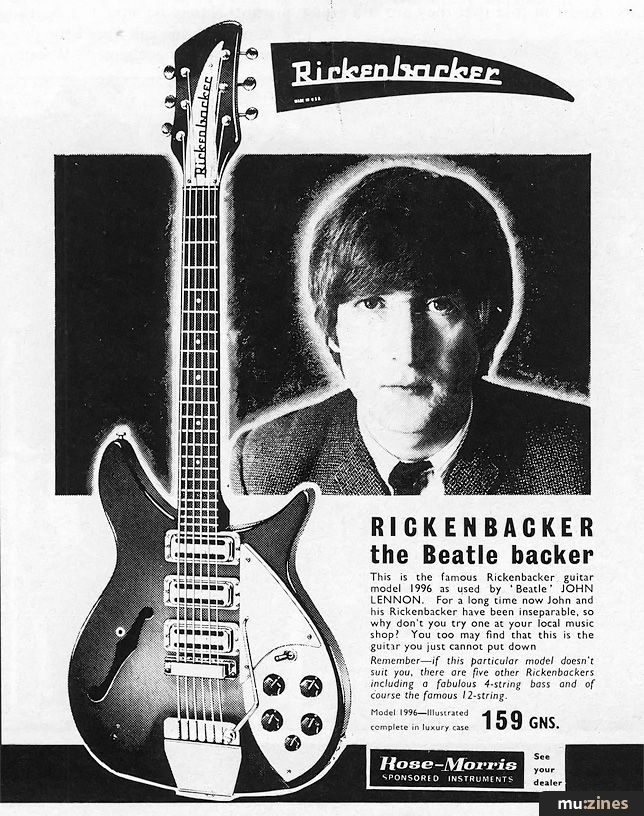
Along with the Shadows there were of course the Beatles who, though hardly renowned for their use of tremelo, did have a lot of early photos taken featuring John Lennon playing a Rickenbacker 325. This guitar had a vibrato unit made from sprung steel. Very simply, the arm was attached to a steel plate and when the arm was pushed down the strings would flatten and then return to pitch when released. It looked very distinctive too, bearing an angled lever with a pointed end. Anyway, the result of all this publicity meant that whammy mania had hit Europe.
There were so many instruments available during this period it is difficult to know where to start. Many guitar heroes of the Seventies cited the name Futurama as their electric guitar initiation, so we'll start there.
In 1960 these cheap and cheerful guitars featured tremelo arms on most models. One used the sprung steel idea of Rickenbacker. The other was based more on the Strat principle, except that it had six individual tension springs that were adjustable for the separate tension of each string.
Hofner, too, had their own units in the early Sixties. These had enormous casings which suggested much more complicated machinery than they actually possessed. Grimshaw, an English company, had their own 'Perfection' vibrato tailpiece. Designed for semi-acoustics, it boasted ball-bearing action. It was in fact a spindly version of the Bigsby with bearings used to give a smoother action in the joint nearest the tailpiece.
The Fenton-Weill is a little more interesting, though. Available again in the first few years of the Sixties, this unit combined the conventional spring and a pad made from rubber. The idea was that the initial impact of the depression of the lever is absorbed by the rubber pad. Once the rubber has expanded to its maximum, the spring gives way and contracts. These two events happen very quickly and are supposedly unnoticeable, resulting in a continuous movement. Again, ballbearings were used to make the moving joints even smoother. I have been trying to hunt one of these down as they sound rather interesting. If you find one lurking in your loft do let me know, I'm sure it won't work.
Hundreds of manufacturers had their own designs fitted. The infamous Bells Music Catalogue was full of them. Every schoolchild who dreamt of a pop guitarist's life just wouldn't feel secure without one.
In an attempt to jump on the tremelo-arm band wagon, various companies were making units to add on as afterthoughts. Some of these really are breathtakingly brilliant.
Egmond (does that name bring back memories?) produced a great device specially for 'cello' guitars. This would fit in between the bridge and the tailpiece.
One part would rest underneath the strings, the other clamped on top. When the arm was pressed down it, in turn, pushed the strings sharp and then, under the pressure of the strings themselves, when released they would return to normal. I say 'normal' (snigger, snigger). This unit is great: I love it. It's cheap, ugly and absolutely useless.
The kind of effect that a vibrato arm is designed to produce is dependent on the strings being flattened, and not overly sharpened. Here, sharpening is all it does. Not only that, but it knocks the whole guitar out of tune more than any other unit. Great stuff.
Not to be outdone, Framus had a very similar one. This unit attached to either side of the bridge with a bar resting across the strings behind the bridge. A little palm rest at the top of the device is pressed down, and bingo! Sharp down and out of tune.
Even Gretsch would not be outdone in this war of nerves. Their own 'Tone Twister' worked with the same idea and was equally naff. Epiphone had a unit that was called the Tremtone. It sounded pretty awful to me, but unfortunately this turned out to be another Bigsby copy.
The difference is that the lever had holes along it and, by unscrewing the nut securing the lever to the rest of the unit, you can alter the lever's length.
There really are so many variations that it would take forever to list them all. The list of groups these units created is equally endless, but again I would like to suggest a few from this era that may have slipped your notice: eg 'Jazz Banana' by Nick Nantos and his Fireballers (I kid you not). And whose whammy bar faves would be complete without 'There Are Eight Million Cossack Melodies And This Is One Of Them' by Group X (on the Fontana label). But for sheer Eartha Kitt-like ferocity of tremelo technique, The Scorpians' version of 'Riders In The Sky' on EMI in 1961 takes some beating.
Well, that just about takes us to 1965. However, there is one English guitar-making pioneer whose influence was none too small. Consequently it would be unjust to chart briefly his very interesting tremelo designs right now. His name is, of course, Jim Burns and I go in to his story in next month's issue. I'll also tell you about new trem technology in the late Sixties, the coming of a new vibrato hero in Jimi Hendrix, and I'll explode the myth of the rarely-seen Fender Marauder. Keep on Twanging.
Series - "The Wang Bar"
Read the next part in this series:

The Growth Of The Wang Bar (Part 3)
(12T Jan 84)
All parts in this series:
Publisher: One Two Testing - IPC Magazines Ltd, Northern & Shell Ltd.
The current copyright owner/s of this content may differ from the originally published copyright notice.
More details on copyright ownership...
One Two Testing - Dec 1983
Donated by: Colin Potter
Feature by Jakko Jakszyk
Help Support The Things You Love
mu:zines is the result of thousands of hours of effort, and will require many thousands more going forward to reach our goals of getting all this content online.
If you value this resource, you can support this project - it really helps!
Donations for May 2026
Issues donated this month: 0
New issues that have been donated or scanned for us this month.
Funds donated this month: £0.00
All donations and support are gratefully appreciated - thank you.
Magazines Needed - Can You Help?
Do you have any of these magazine issues?
If so, and you can donate, lend or scan them to help complete our archive, please get in touch via the Contribute page - thanks!
If you're enjoying the site, please consider supporting me to help build this archive...
...with a one time Donation, or a recurring Donation of just £2 a month. It really helps - thank you!

 @mu_zines
 RSS Feed
 Blog
Blog