


Magazine Archive
Home -> Magazines -> Issues -> Articles in this issue -> View
Vigier Passion Passive | |
BasscheckArticle from International Musician & Recording World, June 1985 | |
Dave Burrluck passes judgement on a carbon fibre-necked original. Not a carbon copy at all.

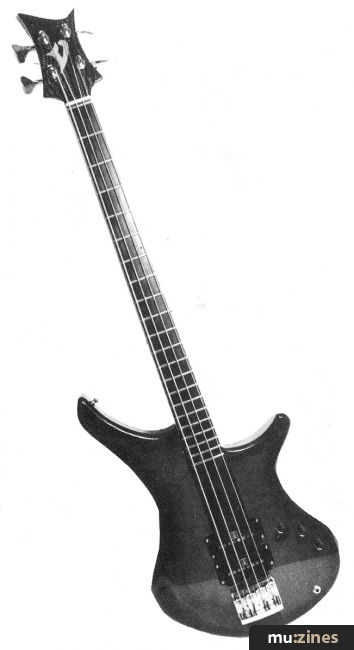
The French company of Vigier produce some of the finest and technologically advanced basses and guitars presently available. This review concerns a bass in the Passion series featuring one of their latest updates, a carbon-fibre neck. Vigier have always strayed from the norm, for example they have been using metal finger boards and synthetic fingerboards for a few years now plus their STM system — a piece of metal below the fingerboard. Their ideas are not just limited to neck design either — the ROM pack system guitars and basses provide an instrument with simple controls but an interchangeable ROM into which can be blown any sound combination from the guitars pickups, including parametric Eq, volume boost and phase selection. Once the ROM pack is inserted the sounds can be called up with a simple switch. The potential of this system is enormous, especially now that a large ROM pack 'library' is becoming available. A sample price for a bass with this system would be around £900.
However, Vigier instruments are not cheap, so I chose to review what is possibly the cheapest carbon fibre necked instrument available featuring only passive electronics as opposed to their more usual active circuitry. A weekend in the studio plus a live rehearsal left me a bit knackered, but the bass sailed through its test with... well read on.
Construction
Vigier guitars and basses are always full of innovation in construction methods. Their standard neck design incorporates a combination of Maple and Walnut and a slab slice of metal under the Phenowood fingerboard. They are also the only company I know who offer a Delta metal fingerboard! It's not at all illogical then that they should move into the carbon fibre field — after all, Vigier are old hands at incorporating new materials into guitar design.
The construction of the neck features a carbon fibre weave process which when unlacquered reveals quite a spectacular 'tweed' effect as featured on this bass. It is apparently difficult to regulate the pattern of the weave so those that are irregular are lacquered. This revealed weave effect can also be seen on the Status basses.
A casual glance at the Vigier would lead you to think that it is a straight through neck but in fact it is what they call the 'Half and Half System', thus introducing the phrase 'semi straight-through' — the Carbon fibre neck stops just before the pickups. The finish on this bass is a see-through red sunburst with a central black stripe which furthers the illusion that it is a straight-forward neck. However, the reasoning behind this semi straight-through construction is interesting. Vigier believe that it gives a more natural sound — a combination of carbon fibre and wood in the all important area from the bridge to the nut. The timber body is not constructed in the usual manner with two 'wings' laminated to a central spine, rather a slot is cut in the body to take the neck similar to the way a glued-in neck would be fitted.
The shaping of the neck is very very good. It's extremely thin in depth with a shallow flat curve and is certainly the sleekest carbon fibre neck I've laid my hands on. At 40mm the width of the neck at the nut is thin and extremely playable. The fingerboard on this sample is Vigier's Phenowood board which is a synthetic material unaffected by differing humidity variations. It has a satin finish which looks very stylish with only small dot markers on the side of the board. The fretting is typically good as it should be on an instrument in this price bracket, although only 22 are fitted — possibly a 24 fret board would be an advantage.
The straight-through design allows a very comfortable neck/body join and access to the top fret is very good.
The body itself is of the familiar offset Vigier design which personally I like. It has only a small contour on the front and back but is nonetheless very comfortable. Gerard of Cappelle (Vigier's UK distributor) remarked that some players who strap on a bass extremely high may find the long top horn a bit uncomfortable, as in this position it rests just below the chin, but for more general positions both standing and sitting the bass feels good and is pleasantly lightweight.
Interestingly I found that other people I showed the bass to weren't so happy about the shape of the body as I was; a couple thought it was a bit clumsy. Still, at least Vigier haven't plumped for a Fender copy...
Hardware
On the more expensive Vigier instruments the hardware is custom made — on this sample, however, it is standard Schaller. The Machine heads are of the M4 variety while a 3-D bridge is employed with standard chrome finish. Neither of these units should need any introduction as both are regarded as the best you can buy for the money. Strangely, a white bone nut (actually it's a string guide as there is a zero fret to provide the string break and height) is fitted — I would have preferred something black to fit in with the colour scheme.
Pickups and Electronics
This sample is the passive model — an active model is available at a higher price — which features a simple two pickup and three control layout. The pickups themselves are Energy 8B types and are made for Vigier by the French company Benedetti. The construction of the units is quite interesting. They have eight Alnico pole magnets round which the coil is directly wound. The front plastic plate and the base are far larger than the actual coil winding which only contributes to the look of the pickup. Certainly the construction method appears very similar to the single coil Fender units. Each pickup is mounted directly into the body with four alien-keyed bolts which not only hold the units in place but also provide height and tilt adjustment.
Both units are mounted next to each other at the bridge end of the body leaving the neck end free for slapping techniques.
The control layout is very simple: a volume for each pickup and a single tone control — not a switch in sight. This Jazz bass type layout is, of course, very expressive with a great number of tonal possibilities available very easily. The knobs themselves are simple matt black plastic with a single white indicator stripe.
Taking a quick look inside the control cavity reveals the simple circuit — tidily executed with three enclosed pots. The cavity is screened with conductive paint resulting in a very noise-free guitar. The jack socket is mounted on the face of the instrument below the controls so as not to hinder playing.
Sounds and Playability
At £750 this bass ought to sound good — let's face it, we're not talking cheap. The annoying thing is it sounds surprisingly good. The combination of an extremely good neck and body construction and rather excellent pickups result in a sound which has a great sustain and very good tonal quality. The controls may only be passive and simple but the important thing is that they work! Certainly the single tone control — only providing treble cut — provides a useful range of control. At full cut the sound is bassy and not muddy — perfectly useable.
I was surprised by the range of sounds available despite the closeness of the two pickups. With a flat amp setting I experimented with as many styles as I could muster, slapping, plectrum and fingerstyle and found a sound which catered for each. Although the bass hasn't really been designed for a specific style it certainly compliments anything you care to try on it. Specialist slappers may find the instrument a bit too straightforward but the bass should appeal to a wide range of players.
In a studio situation I was more than happy with the bass. DI'ing it straight into the desk proved no problem and less Eq than normal was necessary. In fact, while laying down four bass parts all requiring different tones I kept the bass DI'd and the results were very pleasing. What so many basses lose in this situation is attack and depth, but the Vigier simply sounded great.
Ultimately it is the shaping of this neck that contributes to the feel and playability — the action is set fairly standard — but this illustrates what can be achieved with a moulded neck. If I were an industrial spy I think I would be looking very closely at the mould that Vigier use.
Conclusions
As usual we have the problem of justifying the instrument against the retail price; quite simply, is this Vigier overpriced? I think to put the price in perspective we have to consider the carbon fibre neck. Firstly, to my knowledge, this is the cheapest instrument available that uses carbon fibre technology in such a quality fashion and we must remember that the whole process of producing a carbon fibre neck of this type is very expensive. The price of the raw material is somewhere around £100 per square metre, not to mention the cost of producing the actual mould. Tooling costs here can run into thousands just to produce a metal mould that will last. These costs obviously affect the cost of each item — the more you make or plan to make the cheaper each unit becomes. Another factor is that Vigier farm out the production of their necks to another company which, while decreasing production costs for Vigier themselves, will increase the price per item.
The blunt fact of the matter is that the neck really does do the job — that is apparent in the sound and performance itself but also this type of carbon fibre neck construction gives a lot of advantages over wooden necks, or any other materials so far used in guitar construction, for instance it has tremendous stability even in extreme temperature change, provides longer sustain and eliminates dead spots and has a 'warm' feel to the touch.
On the negative side of this bass it must be said that the quality of timber is only adequate and that the hardware and finish while being of good quality are not in the 'stunning' class. Likewise the control configuration is standard although the pickups do seem a bitspecial.
I think Vigier have tried to produce a bass that features a construction that is of the highest possible quality while making economies in other areas resulting in an instrument that is expensive, yes, but overpriced, no. At present I don't think you'll find a better bass featuring a carbon fibre neck and retailing at £750 on the market. I suggest that any bass players who haven't experienced a carbon fibre neck check this out immediately. Vigier are serious, are you?
VIGIER PASSION PASSIVE WITH CARBON NECK — RRP: £750 approx
Also featuring gear in this article

Publisher: International Musician & Recording World - Cover Publications Ltd, Northern & Shell Ltd.
The current copyright owner/s of this content may differ from the originally published copyright notice.
More details on copyright ownership...

International Musician - Jun 1985
Donated & scanned by: Mike Gorman
Review by Dave Burrluck
Help Support The Things You Love
mu:zines is the result of thousands of hours of effort, and will require many thousands more going forward to reach our goals of getting all this content online.
If you value this resource, you can support this project - it really helps!
Donations for May 2026
Issues donated this month: 0
New issues that have been donated or scanned for us this month.
Funds donated this month: £0.00
All donations and support are gratefully appreciated - thank you.
Magazines Needed - Can You Help?
Do you have any of these magazine issues?
If so, and you can donate, lend or scan them to help complete our archive, please get in touch via the Contribute page - thanks!
Please Contribute to mu:zines by supplying magazines, scanning or donating funds. Thanks!
Monetary donations go towards site running costs, and the occasional coffee for me if there's anything left over!

 @mu_zines
 RSS Feed
 Blog
Blog