


Magazine Archive
Home -> Magazines -> Issues -> Articles in this issue -> View
Advances At Advision | |
Article from International Musician & Recording World, March 1975 | |
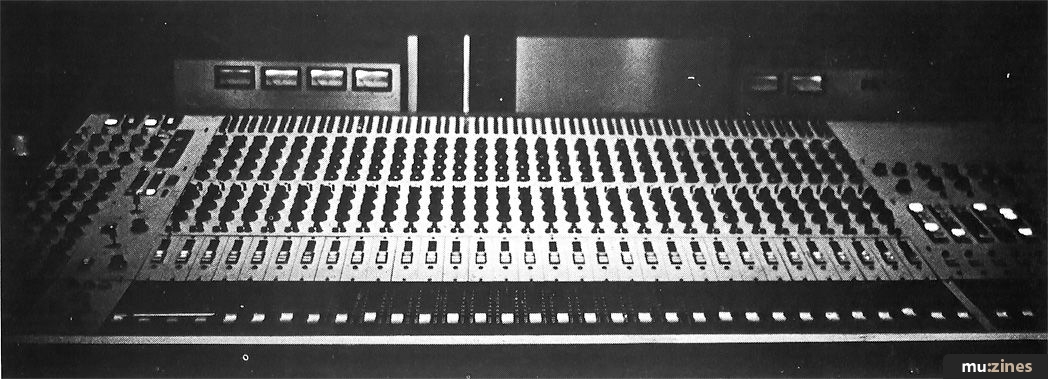
Compumixing is here and it works! So many times studios claim that this piece or that piece of equipment has revolutionised the recording industry — usually with only marginal accuracy. Now we claim that for a studio which doesn't claim it for itself. Advision has installed a desk that is the beginning of a major revolution in the recording world. More than that, Advision have proved that it works.
Three months ago a giant 32 in., 4 out mixing desk was flown in to Advision from Quad 8 in California. Naturally, a lot of publicity surrounded the event because it was among the first fully computerised mixing consoles to be installed anywhere. Now everybody knows that it works and the thing is so solidly booked that International Musician had real trouble getting their hands on it for ten minutes.
The desk is the centre piece of the re-development of Advision's Studio 2. The whole complex has been completely ripped apart and redesigned, and about now Studio 1 is re-opening — also with a Quad 8 desk, although not computerised since it won't be used for mixing.
"We are absolutely delighted," studio director Roger Cameron said, "The desk has worked like a dream and it's been in use for almost 24 hours each day since it was installed."
The re-equipping of Advision started 18 months ago. "I realised that Compumixing had to come although a lot of people disagreed with me. I'm delighted to say that the success of the mixing suite has spoken for itself."
When 16-track recording became the norm, many people in the industry scoffed at the idea of using 24 tracks or more. The usual argument was that no engineer could possibly mix down so many tracks at one go and be able to do a reasonable job. Of course, to an extent, they were right. The huge multi-track tape machine was something of a premature baby. It developed far faster than the techniques (and the men) for handling it.
During the late 60's and the very early 70's, thousands of very, very bad mixes staggered into the limelight because of the maddening job of handling 16 or more tracks at the mixing stage. I remember spending hour upon hour mixing tracks that were, in reality, completely uncontrollable. In the end, engineers had to develop a system of removing the advantages that the multi-track system offered them.
Usually, the answer was to do intermediate mixes that removed some of the faders before the final mix. Naturally, this completely defeated the object of the system.
The alternative was that horrific scene with the engineer, the lead vocalist and the roadie all bent over the desk racked with tension as they each try to get their little part right for the final mix. Mix after mix failed, tension (and the bill) mounted and finally the session would disintegrate and everybody would go home, or the producer would declare himself satisfied just to get the bloody job over with.
It's still happening bloodily, of course, in studios all over the country. But not at Advision.
At Advision you start the process just like everywhere else. The multi-track tape is put on the machine. Then two tracks are cleared from the tape, usually by placing two or three items together on one track. If that's impossible, another machine is set to run in sync with the multi-track (an M.C.I. machine in this instance). These two tracks are for the data which will control the computer during the mix.

The engineer then starts to run his tape and get the sounds he wants on each fader. The board has many, many refinements which have never been seen before. For instance, the Pre-Fade Listen button can be switched to "Solo" so that the track alone is heard, but it is heard with all the desk alterations (including echo) added. It goes straight to the tape without the other channels. Thus by putting the P.F.L. on one channel and switching to the solo mode, a solo voice or instrument can go onto tape with all the additions and alterations made on the board intact.
I could go on about the ancillary facilities this board offers, but the main thing is the Compumix. When the engineer is happy with the individual sounds he has on each fader, he can start his first mix as he normally does. However, before he starts this, he switches every channel to the "Write" position. (In practice, he doesn't have to switch each individual channel to this mode, but merely operates the master "Write"). Each minute movement of each fader is then recorded as computer information on one of the spare tracks on the multi-track tape.
At the end of the first run through, the engineer runs the tape back to the beginning (naturally, Advision has an automatic search and locate device) and starts again. Only this time, he presses the master computer control to "Read". The chief difference that the newcomer instantly notices at the computer desk is an oscilloscope sitting beside the desk.
With the programme switched to "Read", the multitrack plays again but this time the computer reads the information stored on the data track and automatically adjusts each channel volume as the engineer did during his first mix. Unlike the pianola, the faders don't move up and down their tracks automatically — things are not so basic these days.
Unlike their usual counterpart, the sliders are not linear potentiometers, but voltage controlled. Therefore it is not necessary for the computer to move the fader so as to alter the levels. On the oscilloscope, an electronic trace produces an electronic facsimile of the faders (rather like the electronic football machines in pubs) and as the computer reproduces your first mix exactly, you can sit back and actually watch an electronic drawing of the fader movements made in the mix.
It's uncanny and it's also a novelty that engineers must learn to overcome. You can end up doing a visual mix, watching the faders move as if by remote control, and forget to listen.
After the initial mix is stored on the first track that's available to the computer, the engineer runs the mix again, allowing the mode to be switched to "Read" and listening to the mix he has done earlier. At this stage, any channel that requires alteration can be individually switched to "Write" and as the second mix progresses, the initial data (plus any alterations made to the mix) are recorded onto the other track that's available to the computer. Thus, at the end of the second mix, the data that controls the computer is made up of the information supplied during the first mix, plus all alterations made on that specific channel during the first mix.

Then another mix can be undertaken with any changes that are necessary and this information — the initial mix, the second mix and the new information that is laid down by switching to "Write" on individual tracks — is put back onto the first track that was made available to the computer.
Thus mix after mix can be undertaken and each minute altering is stored so that at the end of a few run-throughs, it is possible to sit back and listen to your track being mixed automatically while watching the electronic readout of your combined fader movements and decide on any further alterations.
Think about it. Obviously, this system can offer the most sophisticated mixing available in the world. Bu think how good it can make the mixes. Think about the strain it removes, think about the time it saves. Above all, it is the most significant contribution electronics have made to musical art since the introduction of the multi-track machine.
But the joys of this desk don't end here. Because the faders are not the usual pots but are only electronic governors of the signal(s), any group of faders can be switched to operate on one fader. Thus, the four tracks used for a drum kit, can be adjusted for internal balance, then routed to one fader, whether they are to be placed in stereo or quad. The signals can be controlled by one fader without an automatic inter mixing of the incorporated signals.
Thus each mix can be reduced to groups — perhaps three or four — which can be manually mixed. The mixing of this group can be stored along side the basic mix information, so that when the computer governs the mix, all basic faders are controlled. Each group is controlled, so that leaves the engineer free to do things that were absolutely impossible before. Like adjusting the EQ of individual tracks as the mix runs. This of course would be a lengthy job (luckily it's rarely necessary), but the computer can handle that too.
It's possible to use spare tracks on the 32 in board as EQ channels and by bringing up the signal on these channels and adjusting them (against the first signal if necessary) and adding that information to the data track, it's possible to have the ultimate control of sound on the mixing desk.
"I think we're approaching the ultimate as far as desks go now," says Roger. "I think we're now limited by the capabilities of the machines."
That puts the ball firmly in the court of the machine manufacturers. It's really up to them to produce better machines and better tapes. It would seem that now we can mix anything.
More from these topics
 Effective Automation - Creative mixing with MIDI controlled effects (Part 1) |
 Studio Of The Month - Abbey Road Studios |
 A Day in the Life of a MIDI Studio |
 Studio Of The Month - Terminal Studios |
 Speaker's Corner - CHOOSING & USING: studio monitoring |
 MIDI Automation Systems - How Good Are They? (Part 1) |
 On The 8-Track - Sackville Sound - Studio Focus |
 MIDI Futures at the BBC |
 Studio Of The Month - The Chocolate Factory |
 Studio Diary |
 Studio Diary |
 Millstream Studio |
Browse by Topic:
Mixing
Recording Studios
Publisher: International Musician & Recording World - Cover Publications Ltd, Northern & Shell Ltd.
The current copyright owner/s of this content may differ from the originally published copyright notice.
More details on copyright ownership...

International Musician - Mar 1975
Donated & scanned by: Mike Gorman
Feature
Previous article in this issue:
Next article in this issue:
Help Support The Things You Love
mu:zines is the result of thousands of hours of effort, and will require many thousands more going forward to reach our goals of getting all this content online.
If you value this resource, you can support this project - it really helps!
Donations for May 2026
Issues donated this month: 0
New issues that have been donated or scanned for us this month.
Funds donated this month: £0.00
All donations and support are gratefully appreciated - thank you.
Magazines Needed - Can You Help?
Do you have any of these magazine issues?
If so, and you can donate, lend or scan them to help complete our archive, please get in touch via the Contribute page - thanks!
Please Contribute to mu:zines by supplying magazines, scanning or donating funds. Thanks!
Monetary donations go towards site running costs, and the occasional coffee for me if there's anything left over!

 @mu_zines
 RSS Feed
 Blog
Blog