


Magazine Archive
Home -> Magazines -> Issues -> Articles in this issue -> View
Back to Black | |
Black SabbathArticle from Phaze 1, June 1989 | |
twenty years after they invented heavy metal the seminal sabbs are back
While today's "heavy" rock bands continue to clutter the charts with clichés, yesterday's metal merchants are respected as innovators, not imitators. Few more so than Black Sabbath who, against all the odds, have just reformed.
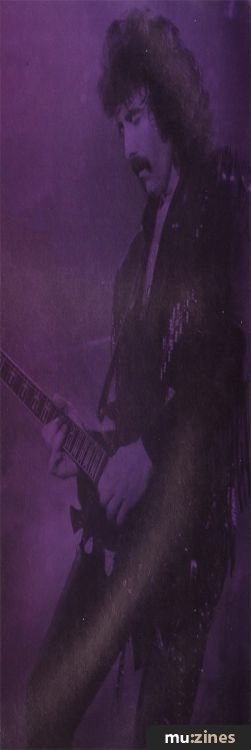
THE MORE THINGS change, the more they seem to stay the same. Look at the current state of heavy rock, for example. First off, we have Led Zeppelin riffs rattling up the charts like they've never been away. Except this time they come courtesy of The Cult. Then we have the resurrection of dirgeful epics that sound just like Black Sabbath. Except this time they're by... Black Sabbath!
Nearly 20 years after their eponymous debut album, "The Sabbs" are back, this time based around a nucleus of original guitarist Tony Iommi and stalwart drummer Cozy Powell. To many, the new 'Headless Cross' album may seem to retread a wellworn path of monolithic riffing and quasi-satanic nonsense lyrics, but to write off Black Sabbath as just another "joke metal" band would be doing them scant justice.
By stripping rock to the bare bones of thunderous riffs, devastating drums and screaming vocals, some claim that the young Sabbath invented Heavy Metal. Maybe so. But throughout their chequered career they've always shown a sophistication that dwarfs the achievements of the new breed — Bon Jovi, Def Leppard, and the rest.
The legendary line-up of Tony Iommi (guitar), 'Ozzy' Osbourne (vocals), 'Geezer' Butler (bass) and Bill Ward (drums) first came together as the blues band Earth, playing on the Birmingham club circuit during the late 1960s. They arrived on the scene at the wrong end of the blues boom and in order to get gigs, they were forced to change. Their repetitive riffing was an idea culled from jazz and blues records, genres championed by their manager, Jim Simpson. Geezer, who was an avid fan of the supernatural in general and of author Dennis Wheatley in particular, produced a nice line in black magic lyrics, and within a short time, Earth became Black Sabbath.
At this point (1969), they recorded their first album for £600 and went in search of a record deal. At that time, the older and more established record companies were waking up to experimental music from the contemporary "independent" scene. Phonogram's answer was to launch a new label called Vertigo, which started out by signing Manfred Mann's Chapter Three and Colosseum. In 1970, Black Sabbath were added to the label's list. In today's state-of-the-art business it would be ridiculous for a four-track tape to be used for a debut album. But back in 1970, it was all Vertigo needed.
Although the label did not go overboard in heralding the arrival of Black Sabbath, the ensuing press releases more than compensated. "Since changing their name to Black Sabbath the band have awakened in themselves an interest in black magic, and the most deeply affected is Geezer. One night he succeeded in raising a demon in a churchyard and has been so terrified at releasing the forces of the occult that he has sworn never to dabble in the black arts again." Half the public probably thought it was a joke, the other half that Sabbath were just four dope-crazed kids who were about as sinister as Cliff and the Shadows. Did Vertigo care? The Sabbath propaganda certainly worked like magic, and just for good measure, the debut album 'Black Sabbath' was released on Friday 13 April, 1970.
Considering the album was made so cheaply in a couple of days at a small London studio, it's remarkable for the way it conveys the spirit of the band and the power of their performance. The title track fades in with the sound of teeming rain, crashing thunder and the toll of a church bell, Iommi's awesome guitar riff and Ward's heavy drumming are the perfect backdrop to Ozzy's tortured vocal. The gothic horror of 'Black Sabbath' would mould the group's identity for the next decade. But the second track on the album, 'The Wizard', reveals Sabbath's blues roots. Rather than aligning the band with "progressive" music, the tempo changes and swing feel reflect their jazz influences. Bill Ward's drumming, in particular, immediately sets Black Sabbath apart from run-of-the-mill heavy rock, just as it did in 1970.
The album entered the national chart at No.23, and the Sabbath "black magic" bandwagon began to roll. The band were booked for a tour of Europe in mid-1970, and their second album, 'Paranoid', was scheduled for a September release.
This time, the group intended to drop all references to black magic, to correct what they felt was a mistaken image peddled by Vertigo. They played at various summer festivals in 1970, to ecstatic audiences. The 'Paranoid' album went to number one, and the title track is probably the song that the band will be remembered by — three minutes of raucous riffing that sent Sabbath devotees into a state of complete hysteria. 'War Pigs' remains one of the band's finest moments, Iommi's jagged guitar playing and Ward's drum fills topping the elaborate arrangement. With the Vietnam war raging at the time, the song's subject was far removed from the "fantasy" of black magic. While denying they were a "political group" in songs like 'War Pigs', Sabbath had revealed their true working-class character. And the picture of bleak despair was completed by the sound of wailing sirens.
Elsewhere, the lilting 'Planet Caravan' was evidence of their versatility, but the archetypal Sabbath track on 'Paranoid' was the awesome 'Iron Man'. Beginning on a rumbling whammy-bar intro from Iommi, 'Iron Man' was Black Sabbath at their best, the science-fiction setting allowing Ozzy to ham it up ridiculously on stage. 'Electric Funeral' dealt with the possibility of nuclear war, while 'Hand of Doom' was about drug addiction.
So it really did seem as though there was more to Black Sabbath than 'Black Sabbath'. The massive success of 'Paranoid' placed the group firmly in the spotlight — their lyrics survived the scrutiny of moralists and fanatics alike, and the band's musical reputation grew ever bigger and better.
Tony Iommi, who had been earlier criticised as a Clapton-clone, was proving to be a masterful guitarist. His talent was highlighted by the fact that he lost the tips of his two middle fingers on his right hand in a factory accident in the 1960s. (Since he was a left-hander, this was his fretboard hand.) Drawing inspiration to carry on from the two-fingered jazz great Django Reindhart, Iommi had two plastic tips made to protect his finger ends, and a few months later, he was playing again.
Sabbath toured again on the heels of 'Paranoid', and managed to get turned down by the Royal Albert Hall because of fears they would receive too riotous a reception! But when the next album, 'Master of Reality', was released in 1971, it received a drubbing from the critics. The band were quick to reject the criticism, claiming the album was their heaviest ever. But it also featured gentle acoustic work in 'Orchid' and 'Embryo'. Elsewhere, the sound was certainly dense — so much so that the recording lacked any real punch. With songs like 'Children of the Grave', 'Lord Of This World' and 'Into the Void', the album represented Sabbath's most apocalyptic vision so far, but some fans did start to wonder if they'd lost their grip.
'Black Sabbath Volume 4', released in late 1972, marked a return to form. The emphasis was on melody, evidenced by songs like 'Snowblind', 'Changes' (which featured the "strings" of an early sampler called the Mellotron) and the instrumental 'Laguna Sunrise'. 'Changes' showed the gentler side of Sabbath, and many felt it was a mistake never to release it as a single.
By now, Black Sabbath had conquered the States, and were finally reaping some rewards for their relentless touring. In September 1973, the band released what is widely considered as their masterpiece, 'Sabbath Bloody Sabbath'. Like its predecessor, the 'Sabbath Bloody Sabbath' album was perhaps more melodic than the general public might have expected, but the performance still conveyed great power and produced classic Sabbath tracks in 'Sabbra Cadabra', 'Killing Yourself to Live', and 'Spiral Architect'. The title track was full of variety — a blood-curdling riff to kick off, then a middle eight complete with jazzy "Wes Montgomery" guitar, and guitars wailing like sirens in the fade-out. But despite their triumphs both on stage and on vinyl, the group were starting to realise the price of success. 'Killing Yourself to Live' summed up their attitude towards the circus of endless touring and recording, and from this point on, the group would release albums with less regularity. Many now regard the period of the first five Sabbath albums as their greatest. 1975's 'Sabotage' passed without much ado — which is perhaps just as well, considering the appalling fashion sense the band displayed on the cover!
In 1976, the band recorded 'Technical Ecstasy', subsequently seen as a milestone in their career. It was largely Tony Iommi's project, and it was indeed a technical success. Complete with keyboards, the band's music had a new smoothness, with Iommi's guitar playing improving even further. Butler and Iommi were eager to win respect for the musicianship and innovation of the band — perhaps the motivation behind songs like 'She's Gone'. This was something that did not really concern Ozzy Osbourne, who saw Sabbath as playing basic rock for basic people.
Yet when Osbourne announced his departure from the group in November 1977, it was still a great shock. A greater shock was his rejoining just two months later, just in time for the aptly titled 'Never Say Die' tour and album. The album continued the style of 'Technical Ecstasy', and the title track took Sabbath back into the singles chart for the first time in eight years. But the strain of touring reared its head again, and in the following year Ozzy quit for good. Although they were certainly more proficient, the previous two records weren't really going anywhere. Quite simply, they lacked the soul of earlier efforts. Black Sabbath needed a new injection of life — but was Osbourne's departure the answer?
Few saw Sabbath minus Ozzy as anything but a spent force. The next year was turbulent, with Butler also quitting and rejoining the band, but eventually, in 1980, the revitalised Black Sabbath emerged with American Ronnie James Dio on vocals. The 'Heaven and Hell' album was a departure. "Oh no; good things never last", began 'Neon Knights', a heavily ironic opening for those who felt the "real" Black Sabbath had perished. Dio's lyrical sophistication was a world away from Ozzy's youthful confusion, but the slicker Sabbath still proved enormously popular, and were at the forefront of the Heavy Metal revival of the early '80s.
Despite the departure of Bill Ward, the subsequent 'Mob Rules' consolidated the new band's direction. But on the other side of the Atlantic, Ozzy Osbourne's 'Diary of a Madman' seemed truer to the original vision of Black Sabbath. To make things worse for Iommi and Butler, Ozzy's live solo album 'Talk of the Devil', devoted to old Sabbath songs, was released just before their own 'Live Evil' - and even with his own backing band, Osbourne's album outshone that of his former colleagues.
Since then, things have been a mess. Ian Gillan joined the group after Dio's departure, producing just one album -'Born Again'. The alliance was strangled at birth after a mixed reception to its appearance at the Reading Festival.
But like the proverbial bad penny, Sabbath have turned up again — Iommi remains the only constant, but both he and drummer Cozy Powell are massively enthusiastic about the future. Can they recapture the richness of the earlier output? Maybe good things do last.
Publisher: Phaze 1 - Phaze 1 Publishing
The current copyright owner/s of this content may differ from the originally published copyright notice.
More details on copyright ownership...

Phaze 1 - Jun 1989
Feature by Jez Jackson
Help Support The Things You Love
mu:zines is the result of thousands of hours of effort, and will require many thousands more going forward to reach our goals of getting all this content online.
If you value this resource, you can support this project - it really helps!
Donations for May 2026
Issues donated this month: 0
New issues that have been donated or scanned for us this month.
Funds donated this month: £0.00
All donations and support are gratefully appreciated - thank you.
Magazines Needed - Can You Help?
Do you have any of these magazine issues?
If so, and you can donate, lend or scan them to help complete our archive, please get in touch via the Contribute page - thanks!
If you're enjoying the site, please consider supporting me to help build this archive...
...with a one time Donation, or a recurring Donation of just £2 a month. It really helps - thank you!

 @mu_zines
 RSS Feed
 Blog
Blog