


Magazine Archive
Home -> Magazines -> Issues -> Articles in this issue -> View
Build a Pulse Width Multiplier | |
Article from Polyphony, January/February 1981 | |
This construction project turns a static triangle waveform into a highly animated variation of a pulse waveform. Although it's difficult to describe the resulting sound in print, by describing the circuit you will probably be able to imagine the sound in your mind.
ABOUT THE CIRCUIT
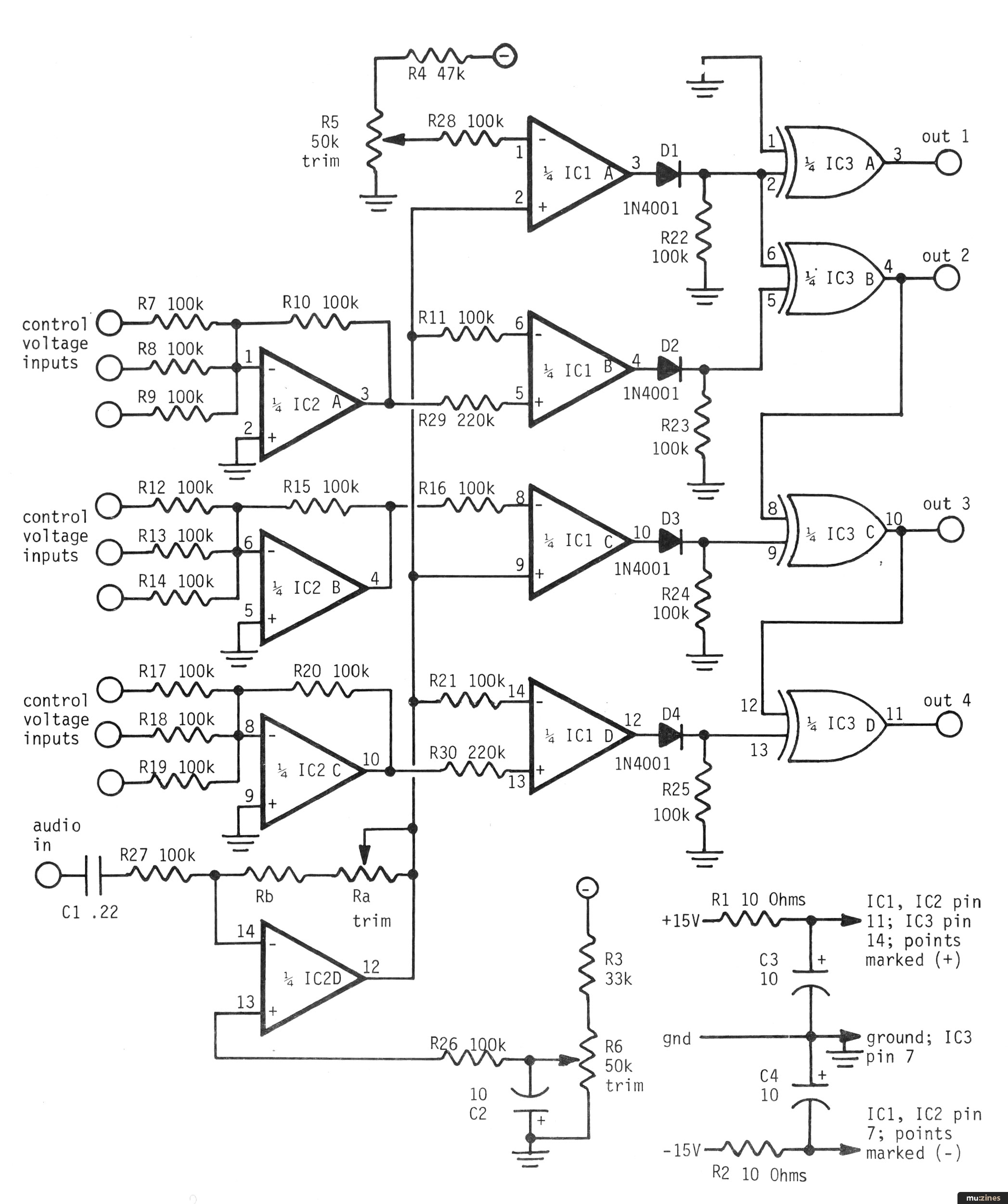
The PW Multiplier uses four comparators, three of which have voltage controllable thresholds, to turn a triangle wave into a number of pulse waves with varying duty cycles. These pulse waves are then mixed together digitally via EX-OR gates, resulting in a very complex composite waveform.
Comparator IC1A converts the triangle wave into a pulse wave; trimpot R5 allows for duty cycle adjustment. Comparators IC1B-D are standard voltage controlled pulse width modulation circuits, whose thresholds are fed from three control summers (IC2A-C). So far, this would be just another pulse width modulation circuit if it weren't for the fact that the outputs of the four comparators are mixed by the EX-OR gates in an interesting way. The output of IC3A (output 1) gives a standard pulse wave output. However, IC3B (output 2) mixes this waveform along with the pulse wave coming out of IC1B. As the control voltages presented to IC2A vary, output 2 varies from a pulse waveform with the same period as the input to a pulse wave that has two pulses per period. When there are two pulses per period, the resulting sound has a strong "octave higher" component; so, varying the associated control voltage smoothly alters the harmonic content from the standard PWM variations to a totally different harmonic structure caused by the addition of the extra pulse in each period.
Mixing output 2 with the output of the comparator IC1C gives anywhere from one, to two, to three pulses per period at the output of IC3C, depending on the control voltages present at CV summers IC2A and IC2B. Similarly, mixing IC3C's output along with the output from comparator IC1D into IC3D gives anywhere from one, to two, to three, to four pulses per period at the output of IC3D, depending upon the voltages present at CV summers IC2A-C. As these control voltages vary, the harmonic structure of the waveform undergoes radical alterations. Interestingly, the sound is very "plucked string" in nature (if you look at a guitar string, you'll note that the harmonic structure is constantly changing and that the waveform is anything but static).
CONSTRUCTION
I used 4136 op amps for IC1 and IC2, although you could just as easily use 741s, 4558s, or general purpose compensated op amps. The circuit is actually quite non-critical, as long as you make sure that you feed the proper op amp inputs. IC3 can be a 4030 or 4070 CMOS EX-OR gate. IC2A-C are control voltage summers that you've probably seen before in dozens of circuits; I would suggest connecting an "initial PW" control to one input of each summer.
CALIBRATION
The PW Multiplier accepts a number of different audio input levels and control voltages, but Ra and Rb must be chosen for a given application according to the following chart:
| AUDIO LEVEL (PK-PK) | CONTROL VOLTAGE RANGE | Ra | Rb |
|---|---|---|---|
| 0.5V | 0 to +5V | 500k | 680k |
| 5V | 0 to +5V | 50k | 68k |
| 10V | 0 to +10V | 50k | 68k |
| 20V | 0 to +10V | 50k | 33k |
Next, Ra and R6 must be calibrated so that the peak-to-peak value of the audio signal at the output of IC2D is the inverse of the control voltage range. For example, if your synthesizer uses 0 to +10V control voltages, then Ra is adjusted to give a 10V pk-pk signal, and R6 offsets the signal so that the top peak of the signal hits 0V, and the bottom peak of the signal hits -10V. With synthesizers using 0 to +5V control voltages, then Ra is adjusted to give a 5V pk-pk signal, and R6 offsets the signal so that the top peak of the signal hits 0V, and the bottom peak of the signal hits -5V. This calibration insures that the control voltage summers will affect the signal in the desired manner.
The only other calibration is to adjust R5 so that the output of IC1A is a square wave. Actually, this is not critical, and you can just as easily have pulse waves coming out of IC1A; but square waves seem to mix well with the other pulse outputs.
Now, hook up your control voltages to IC2A-C. A couple of LFO outputs, combined with an envelope generator output, work well... as do many other combinations. To get a feel for the module, you might also wish to simply connect up some pots to the inputs of the CV summers and see how changing the control voltages alters the overall sound.
Schematic PWM
(Click image for higher resolution version)
CONCLUSION
The Pulse Width Multiplier represents a balance between the old (pulse width modulation) and the new (digital mixing to create interesting harmonic patterns). The circuit is very inexpensive to build, so if you're looking for something a little more interesting out of your VCOs than the standard static waveforms, give this module a try: I think you'll be as pleasantly surprised with the sound as I was.
PARTS LIST
R1,R2 10 Ohms
R3 33k
R4 47k
R5,R6 50k trimpots
R7 - R28 100k
R29,R30 220k
Capacitors (15 or more working Volts)
C1 .22uF
C2 - C4 10 uF, electrolytic or tantalum
Semiconductors
D1 - D4 1N4001 or equivalent diode (1N914 etc. also OK)
IC1,IC2 4136 quad op amp or equivalent (see text)
IC3 4030 or 4070 CMOS quad EX-OR gate
Misc. Circuit board, wire, socket, etc.
More with this topic
 The Spectrum Synthesiser (Part 1) |
 Sample & Hold Modification - Provides Note Bender |
 Electro-Music Engineer - Transistor Power Amplifier Surgery |
 Trigger Converter for the Yamaha SPX-90 |
 Technically Speaking |
 The Syndrom - How it Works (Part 1) |
 An Ultra VCO From The 4720 |
 Eliminating Patch Cords Without Eliminating Capability - A Practical Approach |
 DIY Direct Inject Box - A high quality DI box circuit |
 Keyboard Matrix Interface For EK-3 |
 Constructing A Trigger Delay |
 Workbench - CHECKA |
Browse by Topic:
Electronics / Build
Publisher: Polyphony - Polyphony Publishing Company
The current copyright owner/s of this content may differ from the originally published copyright notice.
More details on copyright ownership...

Polyphony - Jan/Feb 1981
Donated & scanned by: Mike Gorman
Feature by Craig Anderton
Help Support The Things You Love
mu:zines is the result of thousands of hours of effort, and will require many thousands more going forward to reach our goals of getting all this content online.
If you value this resource, you can support this project - it really helps!
Donations for June 2026
Issues donated this month: 0
New issues that have been donated or scanned for us this month.
Funds donated this month: £0.00
All donations and support are gratefully appreciated - thank you.
Magazines Needed - Can You Help?
Do you have any of these magazine issues?
If so, and you can donate, lend or scan them to help complete our archive, please get in touch via the Contribute page - thanks!
Please Contribute to mu:zines by supplying magazines, scanning or donating funds. Thanks!
Monetary donations go towards site running costs, and the occasional coffee for me if there's anything left over!

 @mu_zines
 RSS Feed
 Blog
Blog