


Magazine Archive
Home -> Magazines -> Issues -> Articles in this issue -> View
Grief | |
Article from Music Technology, April 1994 | |
We know something that you don't...
Your technical problems solved. Write to: Grief, MT, (Contact Details).
QPerhaps I should begin by saying what an excellent magazine MT is and you have once again hit the nail on the head by exposing a new medium of expression - multimedia.
May I, however, be the first to gripe in the 'Grief' column? I have recently bought a Video Master and I would like to disagree with your comments in the article in issue 82, August 1993. For those who cannot afford big toys this is a major breakthrough. My gripe is - no MIDI on the Video Master. Having said that, there must be a way around this. Are there any books on MIDI programming for the Atari STE and are there any utilities already on the market that fit into Video Master?
I read in your December issue the 'Where MIDI meets video' article. It was very interesting but not really helpful as my digitiser and software is by Microdeal and in the article David James talks about Rombo. If there is anyway that you can help I would be very grateful.
Tony Canderton
Alkmaar, The Netherlands

Video Master: no MIDI, but new owners HiSoft see a multimedia future.
AThanks for the comments, Tony. We think multimedia and the combination of video and music is the obvious way forward for the musician - and the music industry, come to that. MT boldly goes and all that. Give it a year and we'll see how many more - other than Pete Gabriel et al - have embraced it.
You're not the first to gripe in 'Grief' by a long chalk. Don't know what part of the Video Master review you disagree with unless it's to do with the fact that it's rather low level. If that's so, I can't see how you can disagree because it is. Hell, not even MIDI as you so rightly point out.
Anyway, as regards your questions...
There are a couple of books about MIDI programming, including The MIDI And Sound Book For The Atari ST at £21.24 from IMP ((Contact Details)). It's a few years old now, however, and you may have trouble tracking one down. There was another book with a weird back-to-front title called MIDI (or Music) Programming for the Atari ST by R.A. Penfold. I can't find reference to it anywhere now but I think it was published by Babini. Penfold has published books through PC Publishing ((Contact Details)) so you may be able to get in touch with him through them.
I'm not aware of any plug-ins for Video Master. Microdeal has recently sold out to HiSoft so if you give them a call on (Contact Details) they will tell you if there is anything new in the offing.
Perhaps you should talk to David ((Contact Details)) and ask if any of his software is adaptable to Video Master. In the article he did say he'd be willing to talk to anyone interested in collaboration.
✭ There is a much more effective way of creating non-standard tunings than the tip you suggest in November's issue. However, you do need a synth/sampler that recognises polyphonic aftertouch and, unfortunately, many do not. But if you have one, here's what to do.
Set up your synth with poly aftertouch routed to modulate pitch (a semitone is sufficient). Set up a real-time transform in Notator to re-map incoming note numbers to poly aftertouch and also allow note information to pass.
As it stands this is pretty useless as note 64 generates a poly of 64, note 65 gives a poly of 65 - and so on. It's fine for basic stretch tuning but not much else. What you must do is remap the data via one of the user-definable key maps. You can then set the tuning for each note in turn. It's very laborious but well worth it.
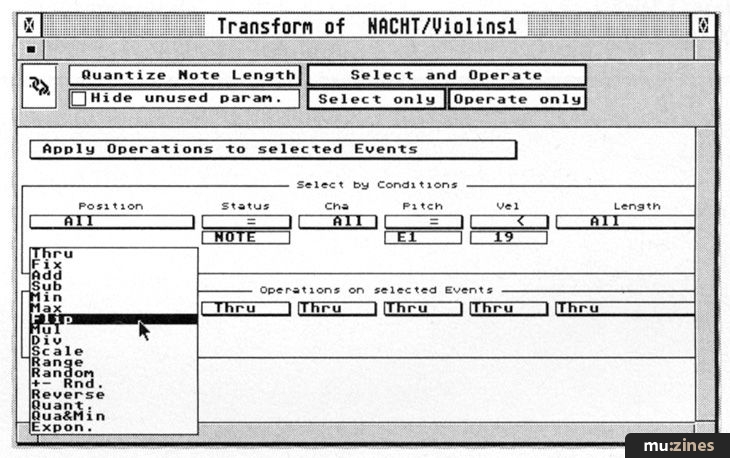
Micro-tuning the Notator Logic way - on the Transform page
The beauty of this approach is that it works in real-time, it is polyphonic (unlike the pitchbend method) and by setting up different key maps you can quickly change between scales. The bad news is that because each note actually consists of 2 bits of data now, you must be very careful when editing not to separate them.
I have not used this setup extensively but I have tested it and enclose the necessary Transform for Notator on disk. It would work better on Logic where you could place the Transform on the output rather than the input of the sequence but I have not had time to try this yet.
When working with custom tunings it is worth creating a sine wave type patch which will aid tuning by ear. With real-world sounds there is always some element of pitch blurring which makes it harder to accurately assess tuning. Incidentally, this is one of the reasons why equal temperament is found, even by people with quite sensitive ears, to be acceptable on the piano.
Any research in this subject is good use of the amazing technology most musicians can afford these days. It beats the shit out of sampling some tired old drum loop from a sample CD, adding a 1-bar bass pattern... the rest is unfortunately not history yet.
Well done MT, for encouraging this sort of experimentation.
Gavin Greenaway
Hersham, Surrey
AAh, you were doing so well up to the end when your music predilections got the better of you. But if it's any consolation I agree entirely.
Your method is an excellent example of the use of technology but you do need a bit of 'the right gear' to do it. Notator Logic, as you say, would be superb for this sort of thing. In fact, it's an absolute trove for power users.
We'd like to keep the microtuning channel open so if anyone else has anything else to say about it, you know where to write. We'd also like to encourage the use of programs like Logic for nefarious purposes, so if you've devised a mega Environment set-up, send it along with a few words of explanation. All we need now is to hear some of this microtonal music. If you've written it, we want to hear it - send it to 'Dare!'.

Preset sounds: are manufacturers giving us too much ROM an not enough RAM?
QA question and a plea from the heart. Starting with the plea; I have two synths - a TG500 and Wavestation A/D. On the whole they are really good but I have a gripe. Like many other musicians, I like some of the sounds but need to give them a little tweak - pitchbend range, remap zones and so on.
In the case of the TG500, the majority of factory sounds are stored in ROM and cannot be altered. I could copy them to RAM but this would overwrite another, possibly useful, factory sound. As I am never certain which sound will fit a song until I am rehearsing it with a band, I like to keep all of my options (sounds) open. What I am saying is - manufacturers, please don't put performances, voices, patches or whatever in ROM. Just put the waveforms there and include empty RAM slots at all levels of the hierarchy.
Korg goes part of the way with the A/D as the RAM 2 bank can be used for your own wave sequences - but you can only get to this level from a patch. As there are no empty patches you have to edit an existing one and this means that other performances containing this patch will be altered, too.
Now onto the question - is there such a thing as a box containing knobs, wheels and sliders that can be assigned to MIDI Controllers? With so much external real-time control offered by modem synths it's a shame that they only have a couple of wheels and sliders with which to control them! It would be nice if this box could take over most of the duties of a Master keyboard such as organising program changes, zone mapping and even playing MIDI sequences (I'm getting carried away!) freeing the keyboard for what it does best - sending Note and Velocity information. How about it guys?
Martin Papier
Finchley, London
AWell... sure manufacturers could give you empty RAM slots. But isn't it better to have them filled with more sounds? That's the idea of having a programmable instrument, after all. All you need is some form of voice storage so you can save the manufacturer's RAM sounds - say to a RAM card, a MIDI Data Filer or a computer-based voice librarian. You can then tweak to your heart's content confident in the knowledge that you can load the RAM sounds again at any time.
I have come across instruments whose RAM banks contain duplicates of the ROM sounds and personally I feel a bit miffed about this. It's like the manufacturers were too lazy to program their own instrument. I'll throw the topic open for discussion among our erudite readership - and any manufacturers who might be reading this.
As regards your question - there are a couple of MIDI box-type gizmos which you might be interested in. Peavey's PC1600 (around £329) contains 16 sliders, 16 buttons and a data wheel. These can transmit virtually any type of MIDI message from continuous controllers and program change data to SysEx messages. You can create up to 50 settings which can be instantly recalled. (See review in MT April '93) There's also Quasimidi's Turbo-Volcon/D - cute name, eh? (around £319 from BCK. Tel: (Contact Details)) which can create eight independent overlapping keyboard zones across two instruments, each with lots of settings such as volume, transpose, velocity curve and so on. It also has eight rotary knobs which can function as realtime performance controls to adjust aftertouch, modulation, volume, pan etc.
You might also consider the slightly cheaper Esmeralda (around £219) which has fewer functions and features, or the Hot Foot Dual Port Programmable MIDI Remote Controller (around £569 from Ablesure on (Contact Details)) which can transmit virtually any type of MIDI message, including SysEx by stomping on a set of footpedals. (Reviewed in MT Aug '93.) And while we're on this subject, remember that although many modern synths can respond to changes in real-time, some will tend to glitch if you throw too much data at them, especially while playing.
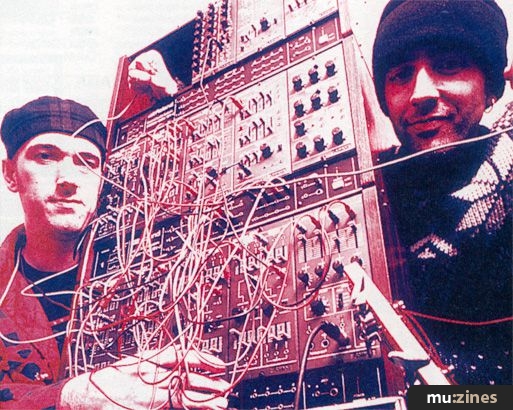
Jack Dangers and Jonny Stephens of Meat Beat Manifesto, making friends with a former member of The Human League: the Roland 100M.
QI recently heard that Meat Beat Manifesto have used a Roland 100M modular synth that used to belong to The Human League. Is this true, and if so, where can I hear the beast in action?
Andy Leibnitz
London
ACertainly is true, Andy - it belonged to Ian Craig-Marsh, in fact, and the best examples of the machine's new lease of life are on the album Satyricon, released by Play It Again Sam Records in 1992. In particular, check out the track 'Original Control (Version 2)' for the full effect of a rasping analogue sequence sync'd perfectly with heavy hip hop beats.
Unfortunately, we cannot answer readers' queries on the phone and we are unable to reply individually by letter. All letters to Grief will be deemed intended for publication.
Publisher: Music Technology - Music Maker Publications (UK), Future Publishing.
The current copyright owner/s of this content may differ from the originally published copyright notice.
More details on copyright ownership...

Music Technology - Apr 1994
Donated & scanned by: Mike Gorman
Help Support The Things You Love
mu:zines is the result of thousands of hours of effort, and will require many thousands more going forward to reach our goals of getting all this content online.
If you value this resource, you can support this project - it really helps!
Donations for June 2026
Issues donated this month: 0
New issues that have been donated or scanned for us this month.
Funds donated this month: £0.00
All donations and support are gratefully appreciated - thank you.
Magazines Needed - Can You Help?
Do you have any of these magazine issues?
If so, and you can donate, lend or scan them to help complete our archive, please get in touch via the Contribute page - thanks!
If you're enjoying the site, please consider supporting me to help build this archive...
...with a one time Donation, or a recurring Donation of just £2 a month. It really helps - thank you!

 @mu_zines
 RSS Feed
 Blog
Blog