


Magazine Archive
Home -> Magazines -> Issues -> Articles in this issue -> View
H/H L100 Guitar Combo | |
AmpCheckArticle from International Musician & Recording World, January 1986 | |
Paul Francis drops his H/Hs

The 100 series by H/H comprises 100 watt combos for keyboards (K100, rrp £342.24 inc VAT), bass (B100 rrp £272.72 inc VAT) and guitar with alternative cabinets for keyboards and bass (the KC115 and BC115 respectively), designed for use with the same amp heads.
Background
H/H have been established as manufacturers of high quality amplification for many years. They were the first company to explore and realise the potential for mass produced amplification with integrated circuits and many of their successes (consistently great power amps; the Studio Bass 60 and the now discontinued VS range) are highly rated by many throughout the industry.
Fluctuations in popularity created financial problems and a year ago H/H were taken over by Carlsbro.
Although influenced by the Cobra 90 range by Carlsbro, the 100 series is really an extension of the 60 series by H/H, with an overall aim of creating a hybrid product capable of revitalising the flagging H/H image. Launched in early 1985, the range has already surpassed the manufacturer's expectations, and the L100 has been especially pleasing for them considering the highly competitive climate of the guitar combo market.
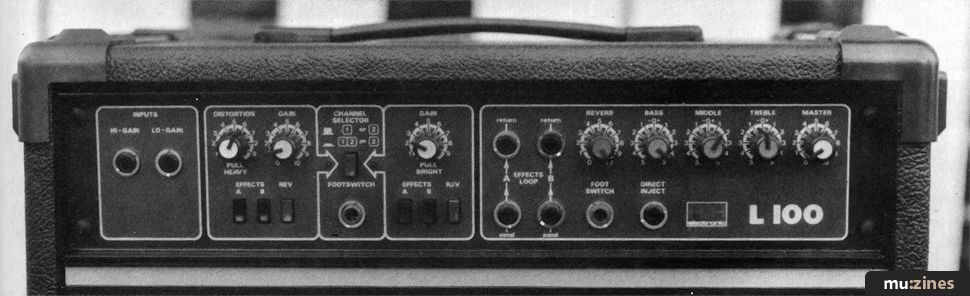
The L100 is rugged, compact and powerful, providing dual channels for clean or distorted sounds and a number of unique features.
Channel 1 is designed for distorted, sustained sounds and the Hi and Lo gain inputs can handle the various guitar pickup/output levels currently in favour.
The Gain pot controls the input level and has the additional facility of a pull/heavy switch which gives a 10 dB boost at 600 Hz.
The distortion control changes the gain and frequency response of that stage, and as the 'dirt' is of a transistor-type, H/H have used waveform shaping circuitry to 'clip' the signal.
My preference has always been for a valve-type overdrive and I have never really liked transistor-type distortion. This sound, however, does have its place as it finds its way onto records often enough, and when considering the myriad of Rock tonal colours available on the market, there is already an established percentage who prefer 'solid-state-dirt'.
Separate push button controls provide the facility for switching in and out two individual and separate effects. This routes the Channel 1 signal to the highly regarded Accutronics three-spring reverb unit.
Channel 2 is designed principally for clean work, although because the Hi and Lo gain inputs may be routed via the footswitch to either or both channels, this provides very wide colour potential as interesting blends employing both clean and distorted tones can be achieved.
The gain pot controls the input level and the pull/bright facility gives a high frequency (6 kHz) boost to the Channel 2 signal. Effects A and B buttons are the same as Channel 1, routing the signal to effect loop A and B. The reverb is the same as in Channel 1.
The channel select facility (positioned between the two channels) has a stereo jack socket designed to accept the RF2 illuminated, electronic footswitch enabling instant on-stage channel selection. As I have already mentioned, the function push button allows either/or, or both channels to be engaged simultaneously. This initially looks complicated but a little investigation does reward in having immediate access to the different channel permutations. With the function button in, the footswitch will select Channels 1 and 2 together or Channel 2 only. Channel indicator LED's illuminate when engaged.
Effects loops A & B are pre-tone and the send and return mono jack sockets provide routing for external effects units. The send functions at 300 mV (-10 dBV) Impedance 50 ohms, and the return functions at 300 mV (-10 DBV) Impedance 220K ohms.
Sensitivity from the reverb pot is good and although the three cut and boost tone pots are adequate, I would have liked to have seen more response from the bass and mid.
The master pot, stereo jack socket for reverb footswitch and D.I. output complete the front panel features.
The rear panel is identical for all the 100 Series and incorporates the power module for the amplifier. There is a double pole mains on/off switch with safety isolation provided by a replaceable primary fuse which is located in the mains receptacle. The mains connector is an IEC type with a fuse holder located underneath the socket.
The stereo jack socket for headphones is suitable for 4 to 16 ohm impedance and internal speaker isolation occurs when a stereo jack plug is inserted.
The mono jack outputs are provided for use with extension speakers, always remembering to isolate the internal combo speaker by using the phones socket.
The rear panel effect loop is post-tone which gives a better signal to noise ratio (for studio work) than the front panel effect loop which is pre-tone. The send output and return input complete the back panel features.
Justification
My first initial concern was the price. The over-three-hundred-quid mark suggests that on the quality ratings the L100 should stand up there with some pretty impressive 'name' product.
A chief determining factor in establishing the price is, of course, the standard and cost of components.
H/H have used a conventional laminated-type transformer and have preferred a bi-polar power amp to, say, the more expensive Mosfet design. The speaker is a Celestion 12" driver (always good and reliable) but the solid state type distortion is certainly cheaper than valve, mainly because it has no output ransformer, a vital ingredient in the 'ringing' often associated with valve overdrive.
Although the reverb is definitely top of the range (Accutronics), the components mentioned so far do not provide sufficient justification for the price. So what exactly did push the price up so high?
H/H have adopted a policy of following the stringent safety standards that the IEC have established. This means that there must be no danger of components causing overheating or explosions and, also, thorough construction methods have to be used in order to eliminate any danger of shocks. A heavier, more robust chassis was used in preference to a lighter, cheaper alternative and not only is it efficient in reducing the risk of shock but, together with the rest of the innards, is really part of a very elegant design.
Conclusions
The safety factor is obviously a crucial one, but how does the price relate to the L100's tonal properties specifically?
Subjective preference apart, I have heard better sounding amps at a cheaper price, and listening to transistor distortion will never rank with my most favourite pastimes.
- Rugged construction.
- Function button/footswitch design.
- Pre and post Eq effects loops
- IEC safety standards adhered to stringently.
AGAINST:
- Inherent tone.
- Transistor distortion.
- Cost.
The arguments for the combo are that the function button/footswitch permutations for channel selection and blending are really very good and the choice of pre-tone or post-tone effects loops offers wide versatility for either gigs or sessions.
The sounds that the L100 offers are not to my taste, but then lots of music favouring those same sounds is not either. The L100 could learn a lesson or two from its relatives, the K100 and B100, which I found to be more than adequate in their particular field, but at the end of the day the most reassuring news regarding the L100 is that it will not throw you into the orchestra pit every time you rest your pint on it.
RRP: £301.24
Publisher: International Musician & Recording World - Cover Publications Ltd, Northern & Shell Ltd.
The current copyright owner/s of this content may differ from the originally published copyright notice.
More details on copyright ownership...

International Musician - Jan 1986
Review by Paul Francis
Ads for Gear in this article:

Previous article in this issue:
Next article in this issue:
Help Support The Things You Love
mu:zines is the result of thousands of hours of effort, and will require many thousands more going forward to reach our goals of getting all this content online.
If you value this resource, you can support this project - it really helps!
Donations for May 2026
Issues donated this month: 0
New issues that have been donated or scanned for us this month.
Funds donated this month: £0.00
All donations and support are gratefully appreciated - thank you.
Magazines Needed - Can You Help?
Do you have any of these magazine issues?
If so, and you can donate, lend or scan them to help complete our archive, please get in touch via the Contribute page - thanks!
If you're enjoying the site, please consider supporting me to help build this archive...
...with a one time Donation, or a recurring Donation of just £2 a month. It really helps - thank you!

 @mu_zines
 RSS Feed
 Blog
Blog