


Magazine Archive
Home -> Magazines -> Issues -> Articles in this issue -> View
Article Group: | |
Home Taping | |
Article from International Musician & Recording World, October 1985 | |
Chris Maillard finds out how to squeeze proper Rock onto eight tracks
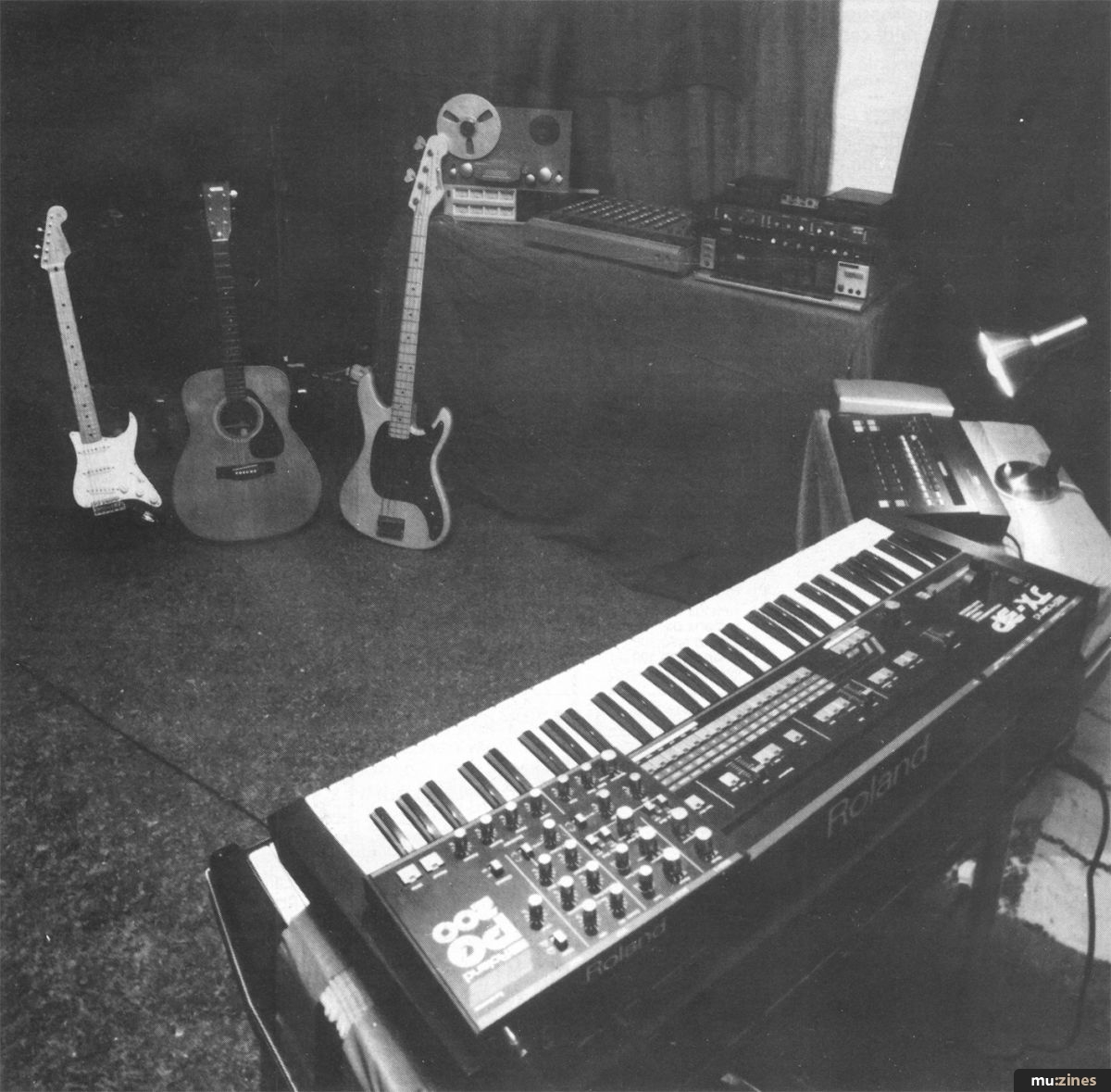
As every A&R man who ever sat next to a tape recorder and winced knows, there is a very identifiable sound about a low-budget demo.
The advent of recording technology for everyman hasn't necessarily made any impact on people's imagination, resources or expertise. The whole problem of painfully clean guitar, one-dimensional keyboard and drums that go, as the delightful Deevoy put it in last month's Demo Corner, "boomf splop", is one that won't go away for many people.
Alan Nelson (with the aid of his brother Peter) has tackled the Boomf Splop Syndrome with a great deal of gusto. He had to really, as his musical metier is one that just won't let you get away with anything less than power, raunch, and more meatiness than Smithfield Market — yes you guessed, it's good ol' Rock with a capital R.
Alan's well-placed to administer some expert advice in this area, because when not fiddling with the Fostex eight-track set-up he's playing guitar and keyboard for one of the brightest new stars in Rock at the moment, Robin George. When away from the melting Marshalls of his employer he writes and records his own stuff; not one iota less eargrinding, despite being put together with less noise than the average Dansette in a single room in Glasgow.
So how do you successfully get sock-it-to-'em power where most get lie-down-and-go-to-sleep lethargy? Take it from the top, Alan.
"Drums are very important these days. Modern production, basically, depends on you being able to do things to the drums. Therefore your drum machine must have individual outputs.
"I've got a Yamaha RX11 which is, I think, the best thing around at the moment. Its sounds are full and you can do a lot with them with the eq and so on. Some machines, you either have to use the sound as it is or forget it, but these have got enough depth so they can be drastically altered and still sound good. You can't tune the drums, though, which, at first I didn't like but they give you a choice of several snares, bass drums and so on so it's not really a problem. And of course it's got individual outputs.
"I usually record the drums last or nearly so, because if you put them on tape early and bounce them down they lose a lot of impact. I put a sync code down and fire them from that.
"So to get that modern big drum sound you use the classic gated reverb. I've got an Accessit noise gate and a Yamaha D1500 digital reverb which is great. The method is; you take the signal from the drum and split it, one side going through the reverb and then into the signal input of the noise gate and then through the desk. The other half of the signal goes to the trigger input of the gate, you adjust the controls to suit, and there you are.
"You really must have good quality reverb, though. The Yamaha was quite expensive, I suppose, in comparison to the rest of the gear, but it was money well spent because the sound that everybody's after today is based on good quality reverb, clean and uncontrollable. You really can't get the same quality of results from a spring unit.
"Other effects we have are the Accessit noise gate and compressor — the gate's useful because it's so versatile and the compressor's handy, though a bit limited. Both can be used to clean up noisy signals, though I seem to get better results in terms of noise by just pushing the levels on the Fostex tape machine.
"I don't know whether it's the Ampex tape they recommend or the machine itself, but you can get much, much more level onto tape than the meters would seem to indicate. I always record with the needles right over against the end pins and it makes the tracks much cleaner and brighter. You do get more print-through, though. Sometimes you can hear the loud bits of a track leaking on to the quiet bits, but if you know that's going to happen then you can just keep your eye on the faders and drop it down at that point."
But the leading edge of the Rock attack, as ever, is the guitars. Alan's got a remarkably good simulation of the multi-stack scream without any noise at all to irritate the neighbours...
"Well, the classic way to record guitar is to DI it through a Rockman, which I used to do, and it's not too bad. However, there are now on the market quite a few Heavy Metal pedals which have one big advantage over a Rockman, and that's bottom.

Alan Nelson — currently playing keyboards for Robin George
"I'd like to record the guitar by just miking up the Marshall stack and playing loud; that's the sound I'm after. That set-up has a distinctive honking mid-range and a lot of bottom end as well, which Rockmans and distortion pedals don't have. You get the top frequencies, but you lose the stuff lower down which is really what gives the guitar all its power. The Heavy Metal pedals have that bottomy sound. They're still slightly fuzzy at the top end, so you do have to do a bit of Equing.
"And the other thing, of course, is compression. The Accessit compressor, with all the knobs full on, to emphasise all those scratches and picking noises that you would get through a stack turned up loud and which stop it sounding too clean and too 'produced'.
The essential thing, like all the things I record, is to have a good full sound in the first place. If the source has a lot of bottom end and midrange you can take it away if you want but you can't add it if it's lacking in the initial signal.
"Talking of source, guitar pickups are quite important. I used Seymour Duncan pickups, American ones, which are very full-bodied without any gaps in their frequency range. Some pickups, like DiMarzios or EMGs, have a very distinctive tone which sounds like one type of guitar and that's it. With the Seymour Duncans you can imitate other things with eq and whatnot but there are no gaps anywhere in their response and they give a very clear, powerful sound.
"I use a Strat at the moment — I bought a very expensive humbucker and had it installed on a guitar but it got stolen not long afterwards. Humbucking pickups are the sound of Rock, though, and I must get a guitar with humbuckers soon.
"I don't use delay on the guitar; I prefer to doubletrack naturally two or three times, or maybe more if it needs it. Mind you, I think that if your guitar part doesn't sound good after seven bounces it's in need of re-recording. If that many overdubs doesn't sort it out then nothing will and your sound must have been naff in the first place.
"And I overdub in a way some people would find strange as well — the main parts, that is the ones I want to stand out most in the mix, I put on last. The reason for this is that every time you bounce down, you lose some of the presence and impact so I do the overdubs first and then put on the basic tracks later.
"I manage to do that by working out beforehand exactly what I'm going to play on another tape. I put the song down on the eight-track first in a rough form, and it usually ends up as a massive, unmixable mess. Then I work out from that what I'm going to have to play and do a second, proper, version. Because it's all planned like that I can be quite certain what I'm going to want to keep and so all the decisions have already been made and I can get on with making it sound as good as possible.
"When I bounce down tracks I try and add another part in the process — for instance, if there are two guitars and you're bouncing them onto a single track I'll add another while bouncing so that instead of ending up with second-generation guitar tracks you've got two second and one first. I suppose you don't really need to do that, but like a lot of the things I do it's down to being a perfectionist. I want things to sound as good as possible."
On that very subject, there are some odd habits which make the Nelsons' studio less than run-of-the/mill; for instance, a lot of mixing was done on headphones.
"The thing is, once you get big monitors and crank them up like everyone does you're in trouble. You can get your room spectrum analysed but that's only one of a thousand and one problems that can crop up when you're trying to listen to a mix in a room that hasn't been acoustically designed from scratch. So at least with headphones you don't have any of those troubles. And it's quiet. Anything will sound good when it comes screaming out of great big monitors. It's a real test if it still sounds okay at low volume."
Any more tips?
"Yes, one. Leads. That's something everybody has problems with, because you make up one lead to go between two non-standard connectors and then when it goes down you're stuck without it, there's no replacement. We've found a perfect solution.
"The secret is to buy loads of phono-to-phono leads; Turnkey sell them, special recording-quality ones, or anywhere else will do them, even hi fi shops, though they're not as good.
"Then go to Tandy and buy lots and lots of phono-to-everything connectors. They make them for every type of plug, XLR, mono or stereo jacks you name it. They're solid plastic and metal, dead reliable and you've only got to put them on the end of your phono leads and they'll connect to anything at all. And of course if a lead goes duff you just unplug the adaptors and put a new one on. Easy, eh? It's saved me so much hassle."
As easy as making good Rock demos on an eight-track, really, I don't know about you, but I'd rather a good solid powerchord than yet another boomf splop.
More with this topic
 Cocteau Construction |
 Home Electro-Musician - Johnny Demestos |
 Studio Sound Techniques (Part 1) |
 Setting up a small studio |
 Home Taping: Tom Robinson |
 At Home in the Studio |
 Getting into Video (Part 1) |
 At Home in the Studio - Living Dangerously with 'Doors' |
 Home Taping |
 Home Taping - The Big Dream |
 Studio DIY |
 Take the Money |
Browse by Topic:
Home Studio
Publisher: International Musician & Recording World - Cover Publications Ltd, Northern & Shell Ltd.
The current copyright owner/s of this content may differ from the originally published copyright notice.
More details on copyright ownership...

International Musician - Oct 1985
Donated by: Mike Gorman, Neill Jongman
Scanned by: Mike Gorman
Recording World
Feature by Chris Maillard
Help Support The Things You Love
mu:zines is the result of thousands of hours of effort, and will require many thousands more going forward to reach our goals of getting all this content online.
If you value this resource, you can support this project - it really helps!
Donations for June 2026
Issues donated this month: 0
New issues that have been donated or scanned for us this month.
Funds donated this month: £0.00
All donations and support are gratefully appreciated - thank you.
Magazines Needed - Can You Help?
Do you have any of these magazine issues?
If so, and you can donate, lend or scan them to help complete our archive, please get in touch via the Contribute page - thanks!
Please Contribute to mu:zines by supplying magazines, scanning or donating funds. Thanks!
Monetary donations go towards site running costs, and the occasional coffee for me if there's anything left over!

 @mu_zines
 RSS Feed
 Blog
Blog