


Magazine Archive
Home -> Magazines -> Issues -> Articles in this issue -> View
KMD Amplifiers | |
AmpCheckArticle from International Musician & Recording World, June 1986 | |
Bill Martin examines a new range of solidly-built, high quality guitar amps which have just arrived here from the States

KMD do it in combos
KMD is a new name to Europe, but the company's range of amplifiers and cabinets have been available in America for some time. The catalogue lists five combos and four amp heads, with various speaker enclosures to suit: on test here are the GV 100 Valve combo, the GS 100HB MOSFET bass amp and the GV 115BSW cab representing the top end of the line.
All of the products here have several things in common, besides the fact that they're designed in America and built in Britain. Tough-looking black vinyl coverings are joined by chunky stackable corners and edge rubbing strips, and speakers are protected by metal grilles. Quality components have been used, at least on these models, like Celestion Sidewinder speakers, Groove Tube output valves and a toroidal transformer in the bass head. I didn't have the tools to hand to dismantle the guitar amp, but the internals of the bass one are well-organised, with all components mounted on circuit boards and plug-in integrated circuits: this should make overhaul easy. There's one important gripe about both amps – these ones are set to run off 115 Volts, not 240. I hope the models in the shops are correctly wired up...
Happiness is a warm bottle
The GV 100 is a hybrid design in the same mould as the Music Man. The preamp is Mosfet, with a matched set of output valves providing the power. This arrangement might seem to be the wrong way round, but there are sensible reasons for it.
Well-engineered Mosfets can sound a lot like valves (as the likes of the Sessionette have proved) and have a large payoff in terms of increased reliability. This means that the valves are used not so much to generate distortion as to add their own life to the sound – giving the signal more life and bounce without those square-wave noises.
You get two channels here, marked clean and overdrive, with varying levels of sensitivity. Both of them have plenty of zing to them, which can be further enhanced by use of the bright switch. The clean side, when pushed, provides a gutsy rhythm sound without losing clarity, while the overdrive delivers a smooth, sustained distortion. It's also flexible, in that the amount of drive can be precisely controlled. Owners of guitars with high-output pickups might feel they run out of clean sound a bit quickly (that'll teach you to buy that quintuple stacked humbucker), but the volume by that stage is quite considerable. The standby switch comes with hi and lo positions to help you to get more distortion at lower levels, but this doesn't mean your neighbours won't still be able to hear it – several streets away!
Treble, middle and bass controls all do their jobs well, though caution is advisable as they can make quite a large difference to the overall volume depending on how they're set.
The reverb, too, is a goodie, being an Accutronics unit sensibly mounted on the floor of the cabinet to make it more shock resistant. It's wide-ranging without being prone to spring noise during attacking play. And there are other nice features too, like an effects loop, socket for external speaker and a line out.
Gripe Juice
Well, it isn't just the incorrect power supply – a puzzling fault, since the beast is supposedly made in Britain (or have we gone over to 115 volts without my noticing?). First off, the design of the front control panel is clear enough from a distance, but standing above the amp means that the top overhang covers up knobs and markings alike. This is often a problem with combos which have a very slim amplifier section, but it could be simply alleviated by dressing the top edge away a little.
Then there are the leads, which are fixed to the amp. This is not so important for the mains one, particularly as it's a good length, but why is the footswitch lead fixed when it terminates in an ordinary stereo jack? Surely it would have been better to have provided a socket for it which would make it far easier for the player to choose the right length for his or her requirements. As it is, modifying this would entail excavations in the amp, which is just the sort of thing that voids guarantees.
All this, however, does not detract from the sound, which is the best I've heard from a combo in a long time. There's also a solid feeling to the GV 100 (something to do with the weight of the input and output transformers, probably) which makes me feel that it makes a lot of sense for the Rock-orientated guitarist. The purchase price of £389.95 reflects the high cost of components like the Sidewinder, which makes a valuable contribution to the sound.
Down to Bassics
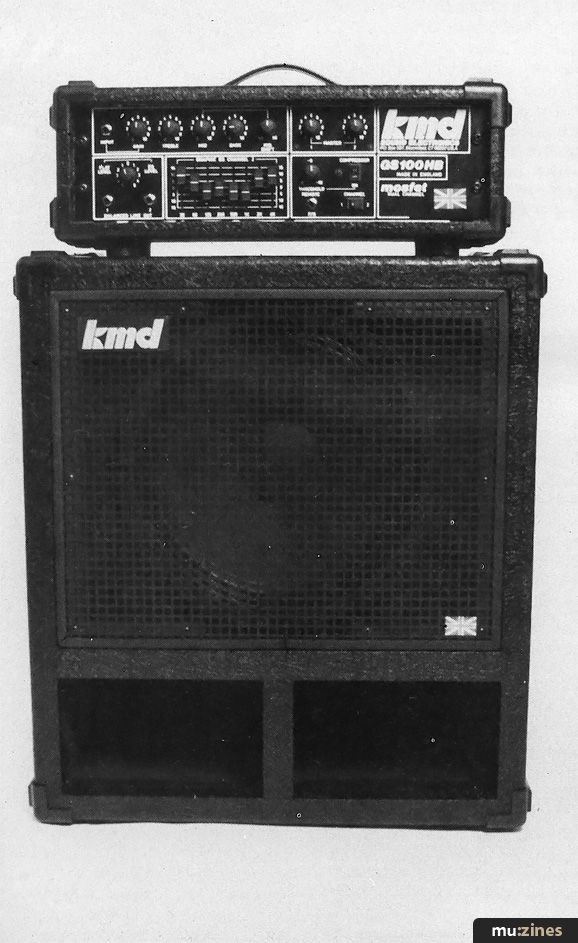
And in components
Unusually for a bass amp, the GS100HB is also a twin-channel design. Channel 1 has bass and treble controls, with a middle knob linked into a frequency selector for a quasi-parametric arrangement. Channel 2 has an eight band graphic ranging from 30Hz to 4kHz, and channels can be changed remotely using a footswitch. Other bits include a variable compressor and a pair of balanced line out sockets. Cleverly, these have a potentiometer above them to control whether the signal comes before or after the eq. Not so cleverly, one of the sockets didn't work. Ho hum.
In fact this particular example was suffering from Frankfurterosis – a little-known complaint which affects electronic devices prepared in haste for trade shows. Hence the channel change switch worked the wrong way round, as did the compressor. There are LEDs to indicate when the compressor cuts in and which channel is operational, so this wasn't as confusing as it sounds.
Like its guitar counterpart, this is a loud beast – all the more so when I inadvertently started using it with a four ohm cabinet when the socket on the back says eight ohms. Apart from the fact that there's only one such socket, this is a bit limiting as many bass cabinets are four ohm impedance these days. But back to the volume: lots of it, without distortion so long as the gain control is sensibly set. The doughnut-shaped toroidal transformer seems to do its job well, and its efficiency means it doesn't need cooling fins – the only fins here were for the output Mosfets.
What about the eq? Its job is made difficult by the dull-sounding flat tone of the amp – as if some treble is missing somewhere (not down to the cabinet, as I discovered when I tried that separately). By contrast, the bass end is positively pampered, with 30, 60, 125, 250 and 500 Hz graphic faders. Great stuff – except that the bottom one did bugger all (must stop using this tech-talk) for the sound, which is not surprising when you consider it is some way below the fundamental E note on the bass.
Despite these moans, many good sounds are to be found here provided you keep the treble on full. Channel 1's sweepable mid control proves handy for enhancing fretless bass, though the graphic is more straightforward when quick adjustments are to be made. The compressor is better than most, though it would benefit from having greater adjustment over half the range.
The GV115BSW cabinet deserves a mention here, with its 250 watt Celestion Sidewinder making it more than capable of handling the power output of this amp. It's a no-compromise design, this one, with large ports helping to make the most of the speaker. This makes it rather heavy and bulky, but at least good handles are fitted and the grille, which stretches the full width of the cabinet, should render it serviceable for a good few years. The price of £229.95 reflects the expense of the speaker but represents a good investment, taken that you like the sound of 15" speakers.
As for the bass amp, it is probably the most competitively priced of the three products. £239.95 is not a lot to pay for an amp with these features, and if the treble deficiency can be rectified (it may even be limited to this Frankfurterosis-stricken example) then KMD have got a winner on their hands. In the meantime, the impression left by this trio is one of solidity and quality of construction. And that can't be bad, can it?
Also featuring gear in this article

KMD's 100 Watt Combo
(IT May 86)
Browse category: Amplifier (Combo) > KMD
Browse category: Amplifier > KMD
Browse category: Monitors/Speakers > KMD
Publisher: International Musician & Recording World - Cover Publications Ltd, Northern & Shell Ltd.
The current copyright owner/s of this content may differ from the originally published copyright notice.
More details on copyright ownership...

International Musician - Jun 1986
Gear in this article:
Amplifier (Combo) > KMD > GV 100 Valve
Amplifier > KMD > GS 100HB Bass Amp
Monitors/Speakers > KMD > GV 115BSW
Gear Tags:
Review by Bill Martin
Ads for Gear in this article:

Help Support The Things You Love
mu:zines is the result of thousands of hours of effort, and will require many thousands more going forward to reach our goals of getting all this content online.
If you value this resource, you can support this project - it really helps!
Donations for June 2026
Issues donated this month: 0
New issues that have been donated or scanned for us this month.
Funds donated this month: £0.00
All donations and support are gratefully appreciated - thank you.
Magazines Needed - Can You Help?
Do you have any of these magazine issues?
If so, and you can donate, lend or scan them to help complete our archive, please get in touch via the Contribute page - thanks!
Please Contribute to mu:zines by supplying magazines, scanning or donating funds. Thanks!
Monetary donations go towards site running costs, and the occasional coffee for me if there's anything left over!

 @mu_zines
 RSS Feed
 Blog
Blog