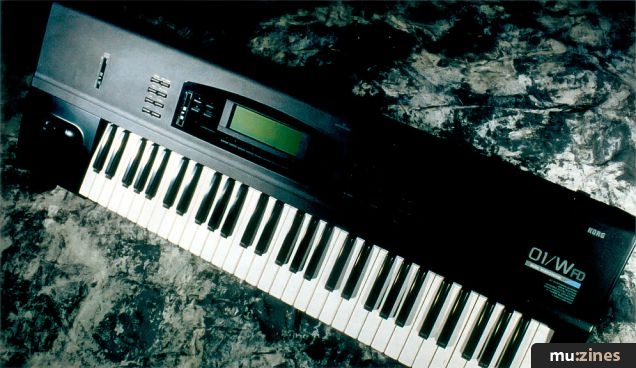
Korg 01/W FD Workstation - Music Workstation
(MT Nov 91)


Magazine Archive
Home -> Magazines -> Issues -> Articles in this issue -> View
Korg 01/W FD Workstation | |
Article from Sound On Sound, October 1991 | |
For three years the korg M1 has been the leading keyboard workstation, and the product that more than any other has made the company's name as a leading force in hi-tech music. But how do you follow an act like that? David Mellor looks at the M1's successor, the 01/W FD.

There I was planning the ideal holiday, including a large helping of each of the four holiday 'S's — sun, sand and a couple of bound volumes of Sound On Sound — when I received a call from the esteemed editor of this magazine. "Can you review the latest workstation keyboard from Korg straight away, and I mean right now?". So this is how I come to be writing about the Korg 01/W FD from my holiday beach — I just couldn't pass up the opportunity to sample the hot new product from my favourite synth manufacturer. I'd just have to go easy on the other entertainments for a few days.
Of course, this isn't what I would normally expect to be doing on my hols, but I am a great fan of Korg's world beating (in its time) M1. Even now, speaking of course before the 01/W FD and its little brother the 01/W have hit the streets, if you wanted to be the owner of just one very high quality synthesizer then the Korg M1 just has to be top of the list; its place might be taken by the expanded version known as the T3 if you have a few more readies to hand. Other manufacturers have developed some truly excellent products — Yamaha with their SY77 (and lately the SY99) and Roland with their JD800 for instance. But these, in my opinion, are instruments which are valuable additions to one's keyboard armoury, not sufficient to be your only keyboard. Having said that, I wouldn't actually want all keyboards to fulfill the same function. Musicians need plenty of variety at their fingertips, to put together different elements in various combinations to produce their own individual styles of music.
Where the Korg M1 (and the rack mount M1R) scores is in the range and richness of its sounds, and in the way it covers all the basic sounds you need for an arrangement as well as being able to produce a wide variety of more exotic timbres. Also, the provision of a full blown effects section of excellent quality was in its time a unique bonus. The M1 was, and still is, known as a 'workstation' keyboard because of the provision of a sequencer which can control eight levels of multi-timbrality within the instrument itself. Unfortunately, the sequencer had a very modest note capacity which limited its usefulness somewhat, as did the fact that it wasn't particularly easy to use.
Following my reasoning, by now — or perhaps since you saw the advertisement on the back page of the September issue of SOS — you must be wondering what Korg can do to bring out something to match the impression the M1 made when it first came out. I hope you are not going to be disappointed if I say that the 01/W FD isn't a radically new step forward in synth technology, but a more modest development of the M1 into a model suited to the needs of 1991 and beyond.
Even if the 01/W FD won't quite make your jaw drop, in a way it represents what may turn out to be a new trend in taking steady but significant steps forward in technological progress rather than trying to revolutionise the universe of musical technology every couple of years. I rather like the idea of a manufacturer developing a good product, making it better after it has been on the market for a little while, and then a couple of years later making it better still in response to consumer demand and improvements in electronic and software techniques. In brief then, the 01/W FD is similar to the M1, but it is a product for 1991 and the immediate future rather than 1988. If you have an M1 now, I don't think you will be trading it in. But if you are not lucky enough to have an M1 yet, the 01/W FD will provide those lovely M1 sounds, and more, in a totally modern package.
QUICK START
Whatever you read in the next couple of pages, don't take my word for it. Go down to your local dealer and ask him to play the demo sequence which can be loaded in from the disk supplied with the 01/W FD. Manufacturers' demo sequences are becoming more and more impressive, not only for the quality of the instrumental sounds that they show off but for the musicianship displayed in the sequence programming. This demo sequence consists of several pieces which play one after another, and you will believe that real musicians are playing real drum kits, real acoustic basses and real electric guitars. After you've had your socks blown off, you'll be ready for a more serious exploration of the instrument's immediate delights.
Once again, a new piece of equipment has confounded the expectations of the original MIDI professors who decided that 128 program numbers would be more than enough. This instrument has 400 sounds immediately available, without recourse to the floppy disk drive. At 10 seconds per sound it will take you over an hour to make a complete grand tour. How long will it take to create that many new sounds of your own when you get the instrument home? Actually, not as long as you might think because the 01/W FD is a very rewarding synth to program.
Let's look at the physical features for a moment. Obviously, the 01/W FD (terrible name) has plenty of all the usual protuberances, but there are a couple of things that deserve mention. The M1 and T-series synths had horrible buttons which gave you a severe case of button pushers' finger after an editing session of any length. The new buttons are finger-friendly, which is a good thing, although the Korg designers haven't bothered to develop a colour scheme which would make the unit as pleasant or easy to use visually as, say, the Akai sampler range.
The display is big. Much bigger than the M1's narrow strip of an LCD, and showing plenty of information numerically and graphically. The floppy disk drive, a double density type, is conveniently sited on the left of the instrument. I believe that floppy drives, even in the days of sequencers which can record System Exclusive data, are so useful as to be essential equipment on virtually all instruments and devices (but I do wish that manufacturers could all use the same format, so you could the same disks in all the drives in your possession).
Sounds on the 01/W FD can be of two types — Programs and Combinations. A Program uses all the sound generating ability of the 01/W FD to produce something which pleases the ear, and then passes it through an effects unit to please the ear even more. A Combination consists of a number of Programs (up to eight), which can be layered, split, or assigned to different MIDI channels, but without their individual effects settings.
An overall effect can be applied to the Combination as a whole. In Sequence mode, you can use up to 16 Programs simultaneously, but once again there can be only one overall effect setting. One of the problems with an instrument like this, which can do so much, is that you wish it could do everything. It would, for example, be great to have Combinations and Sequences use Programs that retained their own special effects, but the world apparently isn't quite ready for this level of sophistication yet, which I imagine would need a good deal of processing power to achieve.
PROGS AND COMBS
As far as I can tell, the vast majority of synthesizer users tend to find a Program they like, and then modify it to suit their ends, rather than start from scratch each time they want a new sound. Obviously the latter course of action has a great deal to commend it, but the synth which is actually easy to program doesn't exist yet. So the first thing a new 01/W FD owner is likely to do creatively with his or her new toy is to investigate the Programs to find a likely candidate for tweaking. Finding the Program you want, out of the 200 in the internal memory (another 200 are stored on card), is surprisingly easy because if you press a number key, a list of 10 Programs will pop up, and pressing another number key selects one of those. There are two such banks of 100 programs. On the instrument as it comes out of the box, the order of the sounds is more appropriate for demonstrations than for practical use, but you can correct that with a little effort.
Once you have a Program you like, then a quick button push takes you into Edit Program mode where nine display pages are available to control all the possible program parameters. It's even possible, as with earlier Korg instruments, to do a good deal of editing in normal Performance mode. I expect this will find favour with a lot of people who need quick results without having to ponder over the editing pages while the musical inspiration is hot. The basic sounds of the 01/W FD are, as on the M1, samples (actually multi-samples) of acoustic and electronic instruments, together with a few synthesised waveforms which can often be useful too. Korg refer to the notional devices which retrieve these samples as oscillators, which I don't think is quite the appropriate term. Whatever you call them, you can use either one or two as the basis of a Program. The 01/W FD can have as many as 32 oscillators on the go at any one time, which means that the maximum available polyphony is 32 voices — plenty for normal playing, and enough for most sequencing purposes too. Owners of Korg's M and T-series synths will be envious. If you use two oscillators in a Program, polyphony is halved, but it's still an impressive 16 notes.
SAMPLES
The multi-sampled waveforms, all 255 of them, are very interesting in themselves. When you're sampling with an Akai S900, or Emax, or whatever, the difference between raw samples and the end product in the form of a program or preset is usually very marginal. But Korg's samples, if you take away all the processing, sound horrible. They tend to be very harsh and trebly with very short loops; but when the power of the synth is applied they change totally into anything from bright and attacking to ultra mellow. There is obviously a lesson in this somewhere. The total sample memory amounts to a specified 6 megabytes, including a very good grand piano, orchestral, jazz and modern instruments, a full selection of drums and percussion (a separate set of 119 sounds, which can be organised as four separate kits), and also plenty of 'texture' type sounds for thickening up an arrangement. Extra samples can be added using optional PCM cards.
My favourite Program editing page is the filter page. The filter has a very sharp cut-off, which means that as you slide it down from the high frequency end, the sound changes in character all the way without ever becoming merely a dulled version of its original self. This applies to the filter envelope generator too, so that amazing changes can be made to the original sample, or multi-samples, with which you started. There isn't much change from the M1 here, and I would have appreciated a resonance control, but the filter is basically a good one, vital on any synth or sampler.

Figure 1. Waveshaping explained. '02) Frequency 3' and '13) Resonant 2' are two of the 60 available waveshaping functions.
I don't think I need to say that a full and familiar range of synthesizer type parameters are available in Program editing mode, but there are some new goodies worthy of mention. One of these is Emphasis, which adds a subtle bite to a sound. The other is Wave Shaping (see diagram), which distorts the basic sample waveforms so as to introduce harmonics that can be totally unrelated to those in the original sound, thereby offering new synthesis possibilities. The Wave Shaping feature also has an envelope generator which should provide a lot of scope for experimentation. Using just this feature, it's amazing how far you can get from the original sounds of the samples — I wish my sampler had something like it.
Moving over to Combination mode, the idea is to put Programs together in layers or splits. If you are more adventurous you can define velocity windows, or play the whole Combination on different MIDI channels from an external sequencer. When you consider that the 01/W FD's Programs are pretty impressive themselves, an 8-layer Combination ought to be, like, Wow City man. Of course, you'll know this for yourself once you have tried out a few of the 200 Combinations which can be held in memory. Layering up different Programs is a good synthesis technique in its own right, and a very fast one if you keep a list of all the available Programs on a piece of paper close at hand. Combination editing is rather more modest in scope than Program editing, but nevertheless you can control the volume, transposition, tuning and MIDI response parameters of each Program in the Combination and also set the overall effect which will be applied to the whole lot.
EFFECTS AND SEQUENCER
The effects section of the Korg 01/W FD really is most comprehensive, with some of the best sounding effects I have ever heard. It can only provide two simultaneous stereo effects, which may not sound very much in comparison with stand alone mega-multi-effects units which can provide a zillion effects all at the same time, but it is certainly very capable, and has a very sweet sound. One thing I particularly noticed is that the effects appear unusually 'strong', as opposed to weak and wishy-washy. If you're wondering what I mean by the strength of an effect, try the phasing/chorusing type effects on the 01/W FD, modifying the parameters to your own taste. I can't remember hearing better.
The sequencer isn't a Cubase or Creator, but it is usable, which isn't always the case with sequencers that come as part of an instrument. The only major drawback is that you tend to spend a lot of time moving the cursor around the screen to access the various functions. Apart from that, the actual spec of the sequencer is quite good: 16-track; 1/96th note resolution; 48,000 note capacity; and virtually all the editing functions you would want. Sequence editing is very easy, with note data scrolling by for you to adjust at will, including the relative timing of the notes.
As far as I can tell at a first meeting (sequencers always take a long time to become fully familiar with) the only thing lacking is a decent locate facility. Maybe there ought to be more buttons to make the sequencer section easier to use, but never mind — I never could see a serious use for the M1's sequencer, but I really do believe you could do proper work with this... albeit while you are saving up for your Atari and Cubase!
In conclusion, I think I can do no better than to give you my personal opinion that the Korg 01/W FD is to synthesizers what Carlsberg is to lager. The T-series synths from Korg do have a bigger sample memory to draw on, and an optional memory board can be fitted for additional samples to be loaded, but if I was in the market for a serious synth and I could only afford to have only one, then I believe that right now the Korg 01/W FD would be the prime contender.
FURTHER INFORMATION
Korg 01/W FD Workstation £1,795 inc VAT.
Korg 01/W Workstation £1,645 inc VAT.
Korg UK, (Contact Details).
KORG 01/W FD AND 01/W SPECIFICATIONS
| Tone Generation Method: | AI Square Synthesis |
| Tone Generator: | 32 voices, 32 oscillators (Single Mode); 16 voices, 32 oscillators. |
| Keyboard: | 61 notes, velocity and aftertouch sensitive. |
| Waveform Memory: | 48Mbits (PCM). |
| Effects: | Twin independent digital effects processors. |
| Programs: | 200. |
| Combinations: | 200. |
| Sequencer: | 10 Songs, 100 Patterns, 48,000 notes (7,000 on 01/W), 16 Tracks, 16 Timbres (with dynamic voice allocation). |
| Control Inputs: | Damper Pedal, Assignable Pedals 1 & 2. |
| Outputs: | 1/L, 2/R, 3, 4, headphones. |
| Floppy Disk Drive: | 3.5" 2DD. (01/W FD only) |
| PCM Card Slot: | PCM Data. |
| Prog/Seq Card Slot: | Program/Combination/Drum Kit/Global Parameters/Sequence Data. |
KORG 01/W
The Korg 01/W is the junior version of the 01/W FD.
The only differences are the 01/W's lack of a disk drive, and its 7,000 note sequencer memory. Sequence data can be stored on RAM cards.
The only differences are the 01/W's lack of a disk drive, and its 7,000 note sequencer memory. Sequence data can be stored on RAM cards.
EFFECTS
| EFFECT | VARIETIES |
|---|---|
| Reverb | 9 |
| Early reflection | 3 |
| Stereo delay | 2 |
| Dual mono delay | 1 |
| Multi tap delay | 3 |
| Chorus | 4 |
| Harmonic chorus | 1 |
| Symphonic ensemble | 1 |
| Flanger | 3 |
| Exciter | 1 |
| Enhancer | 1 |
| Distortion | 2 |
| Phaser | 2 |
| Rotary speaker | 1 |
| Tremolo | 2 |
| Parametric EQ | 1 |
| Combination serial effects | 2 |
| Combination parallel effects | 8 |
| TOTAL | 47 |
Featuring related gear
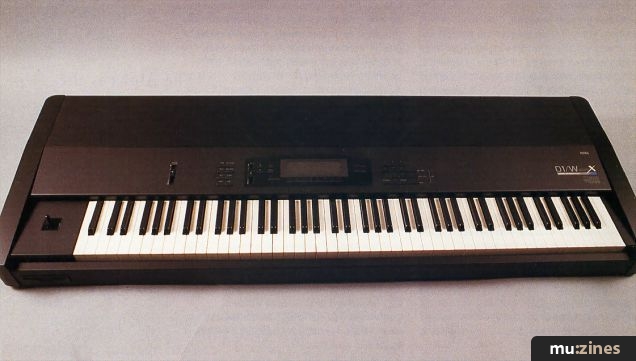

Publisher: Sound On Sound - SOS Publications Ltd.
The contents of this magazine are re-published here with the kind permission of SOS Publications Ltd.
The current copyright owner/s of this content may differ from the originally published copyright notice.
More details on copyright ownership...

Sound On Sound - Oct 1991
Donated by: Bert Jansch / Adam Jansch
Review by David Mellor
Ads for Gear in this article:


Help Support The Things You Love
mu:zines is the result of thousands of hours of effort, and will require many thousands more going forward to reach our goals of getting all this content online.
If you value this resource, you can support this project - it really helps!
Donations for October 2026
Issues donated this month: 0
New issues that have been donated or scanned for us this month.
Funds donated this month: £0.00
All donations and support are gratefully appreciated - thank you.
Magazines Needed - Can You Help?
Do you have any of these magazine issues?
If so, and you can donate, lend or scan them to help complete our archive, please get in touch via the Contribute page - thanks!
If you're enjoying the site, please consider supporting me to help build this archive...
...with a one time Donation, or a recurring Donation of just £2 a month. It really helps - thank you!

 @mu_zines
 RSS Feed
 Blog
Blog