


Magazine Archive
Home -> Magazines -> Issues -> Articles in this issue -> View
Article Group: | |
Korg X3 | |
music workstationArticle from Music Technology, September 1993 | |
Synthesisers - the next generation?
With development in the synth market seemingly at a snail's pace, will the latest Korg inject some much needed life? asks Andrew Jones
Don't you just hate predictable outcomes? Just once, wouldn't it be great for Tom to eat Jerry, for the A-Team to be unable to make a tank out of a Morris Minor, or indeed, to read an unfavourable review of a new Korg synth?
Seriously, the hi-tech music press is often accused of being too eager to give the thumbs up to new products - particularly from the larger manufacturers like Korg. The plain fact is, however, that 'mistakes' from a company with their track record in synth design are pretty few and far between. Most new products deserve a thumbs up - irrespective of whether they happen to rival the DX7 or the D50 for originality and desirability.
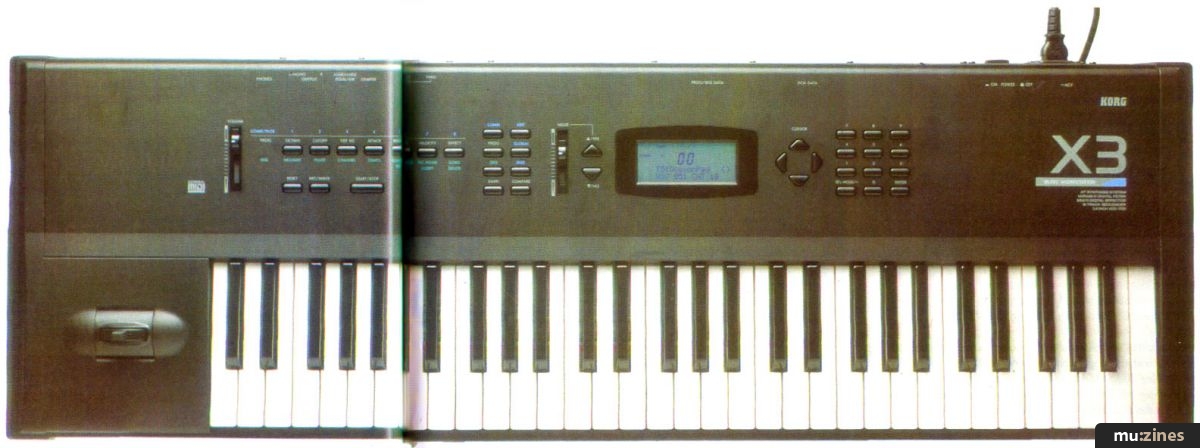
Speaking of which, let me introduce you to the X3 - a new 16-part multitimbral workstation with an on-board sequencer and built-in disk drive. A synth in which Korg have, clearly, invested a considerable amount of time and effort and on which they are now placing a lot of faith. Is it well placed? Well let's see what makes it tick...
The X3 is a PCM sample-based instrument - no surprises there - with 6Mb of waveform memory. In familiar fashion the presets (or programs) are divided up into banks - in this case A, B and General MIDI (GM). A and B contain 100 programs with a further 136 in the GM bank. There are two combination banks (A and B) - the sounds of which combine up to eight programs, each assignable to a specific area on the keyboard. Additionally, there are 164 drum sounds arranged into eight ROM and four user kits.
The 16-track sequencer has a capacity of 32,000 notes, and up to ten songs and 100 patterns can be held in the memory simultaneously. Tracks and patterns may be recorded in real or step time, with a separate track used for entering tempo changes, and sections of each track can be copied to create patterns.
The effects section contains two independent processors each of which can produce 47 effects. The first 37 are single effects, 38 and 39 are serial effects and the remaining eight are parallel. It's possible to edit all effect parameters and store the results along with the preset. Any sequences, edited programs or combinations can be stored to disk (although they're not lost on power off). The drive can read and write Standard MIDI File formats 0 and 1 so it can also cope with song data from other GM sequencers. So far, so good.

Not quite so good, indeed downright infuriating, is the fact that there are only two outputs. That's right, two. The machine boasts 16 tracks and 16-part multitimbrality and we're supposed to be happy chucking the whole lot through two outputs. Even the M1's got four. In fairness, the X3's signal processing is very competent with panning and mixing facilities of a much higher order than you'll find on most workstations. (This is probably due to the fact that the song/program/combination outputs actually exist as four signals before being routed to the two effects processors to be mixed to two outputs.) But what price flexibility? Would it have cost that much more to have included a few more outputs so that sounds could be externally EQ'd and individually processed? Still, on the plus side, the X3 does implement an effects send algorithm which lets you set individual effects send levels for each oscillator within each program part and for each drum sound in a drum kit.
Looking at the spec, apart from a few extra bells and whistles here and there, there are no obvious ground-breaking advances in technology over the X3's predecessors. Indeed, one is tempted to ask why it didn't appear a few years ago. But such questions evaporate quickly when you start listening to the sounds it can make - particularly in areas such as drums and pads, which really do stand out from the crowd. Some of the combinations are quite inspired and indeed, inspiring. A single note played on combinations like 'PowderSnow' or 'Sax Heaven' and you start to feel the creative juices flowing. A couple more and you're left devising ways of holding on to the X3 (at least until the triple album is finished).
The drum setups should keep your average techno/dance raver happy for quite a while. A compelling blend of classics and more contemporary sounds, they demonstrate quite dramatically the importance of including up-to-date kits on this kind of machine. Will other manufacturers follow suit? We'll see.
As regards the individual programs - these, it must be said, aren't quite so engaging. Indeed, one or two are rather disappointing; the piano sound, for example, isn't particularly convincing (go back to your M1 for this) and some of the programs definitely lack originality. But the pads, special effects and some of the bass sounds make up for them, and there are certainly plenty to choose from.
Finding your way around the more general features on the X3 is easy. There's a numeric keypad and value slider for selecting programs or combinations, and a set of cursors for delving deeper. The LCD gives a clear indication of what's going on and what mode you're in. Moving around any of the more complex features, however, is a bit more of a chore. Digital synths of the menu-driven variety require you to search through endless pages of information in order to make any more detailed adjustments. The X3 is no exception, but does offer the option of quickly getting to the page you want using function buttons.
Even so, stepping through all the possibilities presented to you can get quite tedious - though this probably has more to do with how much the X3 has to offer rather than anything amiss in the ergonomics department. For example, editing a Combination could involve a total of 19 different parameter adjustments - plus effects. But hey, it's better to have than to have not. Isn't it?.
Synthesis on the X3 is of the AI variety as implemented on the 01/W - although it lacks the 01/W's Waveshaping feature. In fact editing sounds will be very a familiar process to anyone with a bit of 01/W and/or M1 knowledge. Entering the edit pages of the programs - once again, initially unnerving - soon pays dividends. It's easy to create something different (but not necessarily what you want) simply by changing one of the two internal multisounds (there are 340 to choose from) that make up the sampled part of the sound. The X3's page system - in itself not particularly user friendly - seems well suited to this operation. The LCD doesn't let you see as many of the parameters as you'd perhaps wish, and there's more left and right button-pushing than with, say, the M1. But again, the function buttons help.
Speaking of the M1, I sometimes feel I must be the only person in the world not to have bought one. Apart from having no cash, the main reason for this was because it had no on-board disk drive. Now, my ideal synth (circa 1988) has finally arrived at the right price, and ironically I no longer need the disk drive or sequencer. Oh well, such is life. Perhaps Korg will release a sequencerless version; if so I'll be in the queue, because predictable as it may sound, this is one very desirable synth. Even with the omission of multiple outs and the complexity of the programming system, it's hard not to get carried away over some of the sounds. The X3 can be recommended on the strength of these alone. Of course, the chances are if I like the sounds, you'll like them too - and so will loads of other people. As with the DX7, the D50 and the M1, it won't be long before the X3 starts making its presence felt in the music coming out of our radios, TVs and stereo systems. Jump now while there's still room on the bandwagon. As I said, don't you just hate predictable outcomes?
THE LAST WORD
| Ease of use | Inaccessible in certain areas |
| Originality | Combinations yes; design no |
| Value for money | Very competitive |
| Star Quality | It's a star - or will be |
| Price | £1399 inc. VAT |
| More from | Korg, (Contact Details) |
Sequential circuits

As someone more at home using computer-based or dedicated hardware sequencers, the sequencer on the X3 both surprised and disappointed. Whilst on the one hand it offers many of the facilities common to software-based recorders - like copying sections from track to track to create songs, recording various realtime note events, looping etc - it is, I'm afraid, something a pig to use.
This is due in part to the layout of the X3 itself; whilst the function buttons make it reasonably easy to find the thing you want to edit, the number of button presses and consultations with the manual soon begin to tax the patience. It's a steep learning curve, but one that's worth the climbing given the number of facilities and the sheer flexibility of the design.
That said, you cannot help wonder why the design didn't include individual buttons for each track in addition to global options (like the Roland D20). But I suppose this would have increased the size of the keyboard and probably reduced overall user control. Perhaps the X3, like so many M1s before it's destined to end up connected to a computer in most set-ups. What use the on-board sequencer would then serve I'm not entirely sure. All I can say is if you have the inclination, all the requisite features are there waiting to be discovered.
Hard fax
Polyphony: 32-note in single, 16-note in double program mode
Effects: Two digital processors, each with 47 effect types
16-track sequencer: 10 songs, 100 patterns, 32,000 events
Disk drive: 3.5" floppy
Featuring related gear

Korg X3R - music workstation module
(MT Apr 94)

Three of a kind - Sound module giant test
(MX Aug 94)
Browse category: Synthesizer Module > Korg
Publisher: Music Technology - Music Maker Publications (UK), Future Publishing.
The current copyright owner/s of this content may differ from the originally published copyright notice.
More details on copyright ownership...

Music Technology - Sep 1993
Quality Control
Review by Andrew Jones
Ads for Gear in this article:


Help Support The Things You Love
mu:zines is the result of thousands of hours of effort, and will require many thousands more going forward to reach our goals of getting all this content online.
If you value this resource, you can support this project - it really helps!
Donations for May 2026
Issues donated this month: 0
New issues that have been donated or scanned for us this month.
Funds donated this month: £0.00
All donations and support are gratefully appreciated - thank you.
Magazines Needed - Can You Help?
Do you have any of these magazine issues?
If so, and you can donate, lend or scan them to help complete our archive, please get in touch via the Contribute page - thanks!
Please Contribute to mu:zines by supplying magazines, scanning or donating funds. Thanks!
Monetary donations go towards site running costs, and the occasional coffee for me if there's anything left over!

 @mu_zines
 RSS Feed
 Blog
Blog