


Magazine Archive
Home -> Magazines -> Issues -> Articles in this issue -> View
Kramer Pacer Carrera Guitar | |
Article from In Tune, December 1984 | |
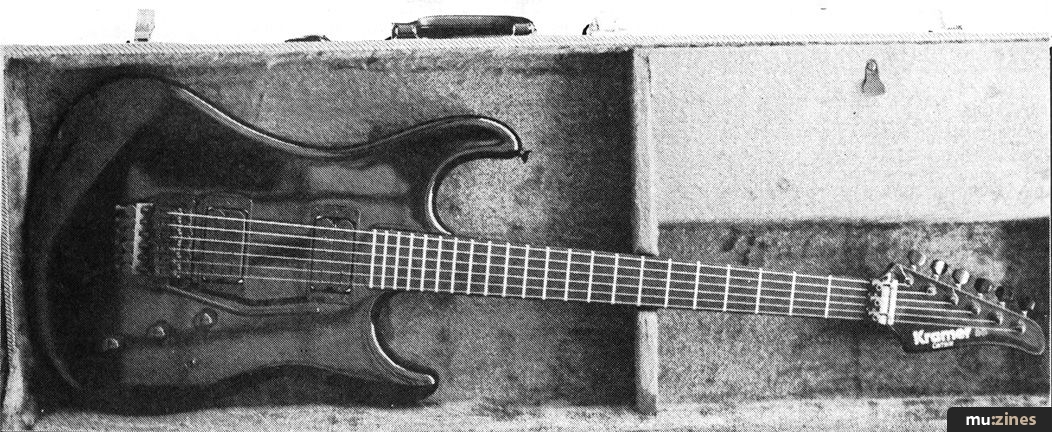
Burning rubber down an autobahn at speeds approaching 150 m.p.h. in a jet black Porsche Carrera, the landscape sweeping by in a blur - it's not an experience you'd exactly call subtle - and neither is the sheer brain- stopping power-kick yoU get when you take a jet black Kramer Carrera out of its case, strap it on, plug into a stack and start spitting fire, blood and fury from what has to be one of the most exciting guitars I've played in a very long while!
Yes, the U.S.-made Kramer Carrera is one of those guitars, feeling perfect from the moment you pick it up, fitting your body and hands like you were born with it: a natural - which it needs to be, as it's an instrument suiting the most aggressive playing styles, and rewarding them with the encouragement to go just that bit further/that bit faster than you'd go on almost any other guitar - but maybe I'd better calm down a while and give you the facts about this exhilarating beast!
Basically, the Kramer Carrera takes the format of the Fender Strat, and pushes it forward to suit the 'heavier' playing styles of the mid-1980s. My sample (jet black - of course!) was extremely well finished, but trying to identify the woods used was impossible. For the sake of accuracy I called Kramer's Tony Costello in New York, who told me that recent Carreras were made of poplar, although some earlier ones had been made with maple bodies. Kramer had decided, however, that maple bodies were really too heavy and that poplar, although exhibiting similar resonant and tonal characteristics to maple, was lighter - hence the switch. Either way, balance on my sample was perfect.
The bolt-on neck (fixed via a standard four bolt arrangement) is fashioned from maple (Tony advised me), and married to that is a dense black ebony fingerboard - a fine sample of this luxuriously hard wood.
Fretting (as befits a guitar meant to be played fast) is very low, a medium gauge of wire having been used. The frets themselves were 100% accurate in both their placement and height - delivering a superbly smooth playing action with the light gauge strings which the Kramer came supplied with.
On the surface, then, the Carrera is pretty much a Strat-like guitar - so what was it that enthused me so much about it?
To start with, the Kramer features the near-legendary 'Floyd Rose' tremolo system - until recently, almost impossible to get hold of in the U.K. (although now available direct from Scott-Cooper Marketing, Kramer's U.K distributors). Over the years the Floyd Rose has won the reputation of being, arguably, the top trem. unit - and the application of it on this Kramer showed just how far ahead of the basic Strat-type tremolo device it is.
In essence, the Floyd Rose is pretty simple - but devastatingly effective in use! The strings fasten in the conventional manner to the machine heads (they look like mini-Schallers; certainly they appeared to be up to that maker's usual exemplary standard), but they are then locked down to the nut with a clamping bar, which uses three allen screws to fasten it. One drawback here, of course, is that - should you break a string - you'd have to unfasten these screws before you could make a change, but that's a complaint against all nut-lock systems, and many players seem to feel that this disadvantage is amply offset by the plusses gained from nut-locks in ensuring tuning stability when whammy bars are leaned on hard. Down at the all matt-black bridge end, the Floyd Rose gets a mite complicated - but it works so well that it can probably be forgiven its complexity. The strings pass over individual saddles, the ball ends being 'trapped' by long allen screws which penetrate right through the length of the bridge unit. Each saddle is adjustable for height and string length, requiring the use of allen keys of the correct size to undertake.
Providing right-hand tuning (essential, given the nut locking bar which prevents the machines being used) is a set of very finely geared micro-adjusters - some of the most accurate that I've tried. So sensitive is this whole tremolo bridge device that you have to be quite careful, when using these micro-adjusters, not to exert any downwards pressure with your hand on the bridge, as it will activate the tremolo and mislead you as to what is correct pitch - it's that light in its action and response! Nonetheless, absolutely precise tuning can easily be achieved with this arrangement, so it's worth developing a gentle touch when making ultra-fast right hand changes to string tuning.
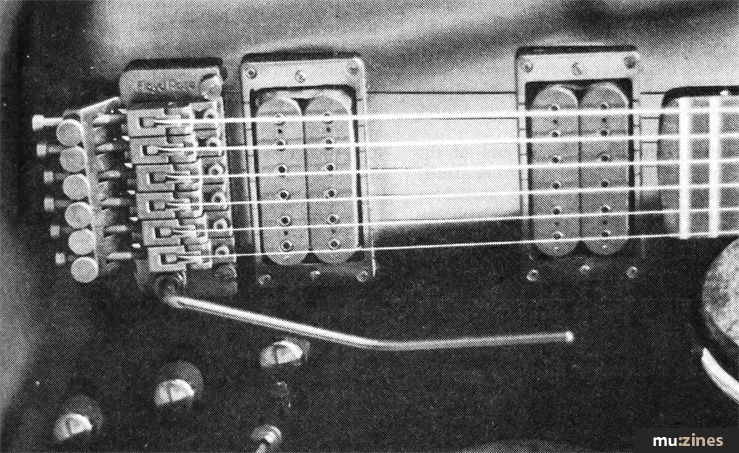
And what of the Floyd Rose whammy bar's action? Well, you've almost certainly never tried anything like it! In fact it's positively disconcerting, the way in which you can flatten a whole chord, right down to where the strings are flapping against the frets like rubber bands - only to have it return to perfect pitch (given decently played-in strings) immediately you release the tremolo arm. No wonder Mr. Van Halen endorses the Kramer/Floyd Rose combination!
Moving away from the engineering to electronics, the Carrera features two fairly high-powered Schaller humbuckers, two tone controls, a single volume (all three of which feature easy to grip, knurled metal knobs) plus a 3-way selector switch. Schaller's pickups, by the way, are curiously under-rated in the U.K. (for reasons which I fail to understand). These worked a treat - but more of that anon.
Playing the Carrera is - as I've probably already impressed on you - something of an experience! The beautifully fretted ebony fingerboard is lightning-fast. Access to the top frets is easy (despite the presence of a bolt-on neck's heel) and the comfortably contoured body feels just 'right', from the moment you strap on the jet-black beast - prepared to do battle with a monster Rock guitar!
Soundwise, the Kramer Carrera is not a gentleman's instrument, and neither should it be. The twin humbuckers pack a sensible punch (but are not over the top 'distortion for the sake of it' types) and the body's sustain is on the high side. Tonal variety is pretty good, but it's not been designed for a Jazz player - it's a lion-hearted, Rock 'n' Roll, unashamed axe of a guitar, and it'll cut you in half if you give it the chance! Treble output on the bridge pickup is pretty high (but not unusable) and there's quite a surprisingly fat sound from the heck mounted pickup. Blend the two together and you can get superlative fat chords chugging out, with blistering lead lines to follow - all at the flick of a switch!
Possibly the only reservations I have about this guitar are concerned with the time it could take to change a broken string in mid-set. But, I suppose, if you can afford the price of one of these firebreathing Kramers you can probably afford a spare - not to mention a roadie with a full set of allen keys and a good torch!
Meanwhile, do try the Kramer Pacer, if only for the sheer kick of playing such a relentless piece of heavy metal hardware. I should warn you that you could well end-up wanting one - but that'd make two of us, wouldn't it!
Certainly, at an RRP of £586.74, the Kramer Carrera isn't cheap - but it's a pro's guitar and an instrument, once owned, which you'd part with about as easily as you'd accept losing an arm or a leg.
Incidentally, if a genuine U.S.-built Kramer seems to be beyond you, Kramer (very sensibly) have launched a less costly series, the Focus range, which are made for them in Japan to their specs. These too, by all accounts, are among the fastest selling guitars on the U.K market right now (they range in RRPs from £309.62 to £329.74) and are, by repute, very hot stuff. 'IT' hopes to be able to try a sample soon.
In the meantime, if razor-sharp Rock guitar work is your scene and you want the best, start saving those pennies now - the Carrera awaits you!
(With Floyd Rose Trem.) RRP £586.44 inc. VAT.
More details of all Kramer guitars and Floyd Rose trems from Scott-Cooper Marketing Ltd., (Contact Details).
Publisher: In Tune - Moving Music Ltd.
The current copyright owner/s of this content may differ from the originally published copyright notice.
More details on copyright ownership...

In Tune - Dec 1984
Donated by: Gordon Reid
Review by Gary Cooper
Previous article in this issue:
Next article in this issue:
Help Support The Things You Love
mu:zines is the result of thousands of hours of effort, and will require many thousands more going forward to reach our goals of getting all this content online.
If you value this resource, you can support this project - it really helps!
Donations for October 2026
Issues donated this month: 0
New issues that have been donated or scanned for us this month.
Funds donated this month: £0.00
All donations and support are gratefully appreciated - thank you.
Magazines Needed - Can You Help?
Do you have any of these magazine issues?
If so, and you can donate, lend or scan them to help complete our archive, please get in touch via the Contribute page - thanks!
Please Contribute to mu:zines by supplying magazines, scanning or donating funds. Thanks!
Monetary donations go towards site running costs, and the occasional coffee for me if there's anything left over!

 @mu_zines
 RSS Feed
 Blog
Blog