


Magazine Archive
Home -> Magazines -> Issues -> Articles in this issue -> View
Larry Macari | |
Dealer Of The MonthArticle from International Musician & Recording World, April 1975 | |
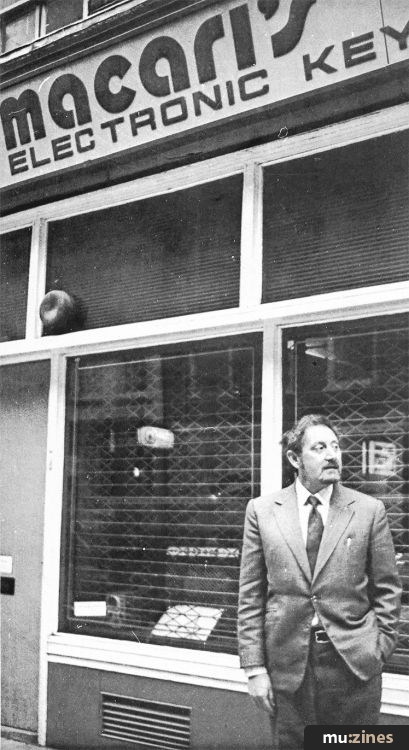
In a street that Harry Hyams is trying to knock down, Larry Macari is building up a company unique in the music trade. The street is Denmark Street — traditional home of the music business — and the company is Sola Sound, an organisation growing faster than any Hyam's high rise.
Larry Macari is probably the best known musical instrument dealer in the West End. His name dominates Charing Cross Road and musicians from all musical streams have reason to be grateful to Larry.
Larry Macari started in showbusiness when he was six. His father and uncle had a famous music hall act called the Macari Brothers and Larry joined the show playing accordian.
The first part of Larry's career was spent touring the U.K. and the world and it wasn't until he was 32 that he quit the stage and joined the music industry.
"I quit when I got married", smiles Larry. "Not because my wife wanted me to, but because I wanted to settle down and think about children".
Larry joined Vox in the late fifties, just before the beat boom began.
"At that time we were dealing with people like Cliff Richard and Marty Wilde. I remember Cliff coming in and begging to borrow some gear for a gig he had at a coffee bar called the 2 I's. We had very little money at that time and we just couldn't afford to take the risk, so we said 'If you could just leave a deposit...'
'Then things started going well for us. We realised that we had to have publicity for the equipment so we started doing deals with some of the bands. The way we worked was that we used to go and see a band that was getting a good name. They'd probably use Selmers and something else, so we'd say 'What you need is a completely new set of Vox equipment'. We'd demonstrate the AC30 to them and they loved it. We usually took all their gear in part exchange, did it up, and flogged it down the Charing Cross Road. That way we'd sold Vox gear at a better than trade price and we made a useful publicity move because a good many of those groups made it.
"The big one for us was the Beatles. I remember this guy called Brian Epstein ringing me and saying that he was the owner of record shops and so on and that he was managing a group called the Beatles. He said that he was coming to London the following week and could he meet us for lunch.
"We'd already heard of the Beatles because people were telling us how well they'd been doing in Germany so when Brian came down we knew what he was talking about. He suggested that we might get a publicity contract together with the Beatles if we would supply them with some equipment. We agreed, and from then on wherever the Beatles went in the world we'd have a new Vox outfit waiting for them. At one time we had about 80 percent of the top bands using our equipment".
In 1965 Larry felt it was time to go it alone. He set up business away from the centre in North London, but within a year he was back in Denmark Street offering a wide range of musical goods, with a special emphasis on keyboards.
It was here that Larry developed his speciality. Gary Hurst was a technician working for Larry and he developed an improved version of the new invention — the fuzz box. Larry called it the Tone Bender and before long everybody was using this new sound.
"Because we were in Denmark Street we were able to nip into all the studios and let them hear the fuzz box, within a few weeks almost every record in the top ten had fuzz on it. All the fuzz boxes that had come out before just put a sort of buzz on the notes, ours had a sustain effect that was what everybody wanted".
Finding what everybody wanted was the key to Larry's success in developing the widest range of effects pedals available today.
"The most important thing of all is talking with musicians and discovering what they want. I'm in the shops whenever I can find the time and if I see someone trying a pedal I go up to them and say 'What do you think?' I'm sure they often wonder who the geezer is that's poking his nose in, but I learn a lot by doing it. They say, 'I don't like this sound' , or 'I don't like the feel of the pedal' and I get to know what musicians really want".
By knowing what musicians want, Larry has built himself a business unique in the industry. Colorsound pedals, amps and accessories are exported to countries all over the world and musicians and dealers alike are constantly turning to Colorsound when a new effect is desired.
The Frankfurt Fair was the best ever for Larry this year. He's been trying to break into the South American market but because of a peculiar control that the government imposes, it has been a long and unrewarding slog.
"There's a very big music market in South America, especially in Brazil. This show, we managed to land a big order for Brazil and we've already started despatching the first part of their order.
At the moment we export to 47 different countries and the majority of items we manufacture go for export.
"The home market has also grown however. In the last two years things have really taken off in the U.K. and the demand for our stuff is greater than ever before".
Larry's company that looks after all the various sides of his business is called Sola Sound Ltd. and the division includes the retail shops, the manufacturing section and the export section.
"At the moment we're manufacturing in different places. We've got one factory in Harrow, another on the North Circular Road and another in South London, but we're hoping to pull all our manufacturing together under one roof before long. It would make things much easier".
More from these topics
 Talking Shop - Life behind the counter |
 Pianos You'll Feel At Home With |
 Punter At Large |
 SDE-2500 - A MIDI Delay |
 Cover Publications Pullout - Stability, Care and Attention 1975-1985 |
 The Sync-ing Feeling |
 The Boss Micro Rack |
 Feelers On The Dealers |
 Company Report - Sequential |
 The Inside Story |
 Jammin |
 JX-8P: A Player's Guide |
Browse by Topic:
Advertisement Feature
Retail
Publisher: International Musician & Recording World - Cover Publications Ltd, Northern & Shell Ltd.
The current copyright owner/s of this content may differ from the originally published copyright notice.
More details on copyright ownership...
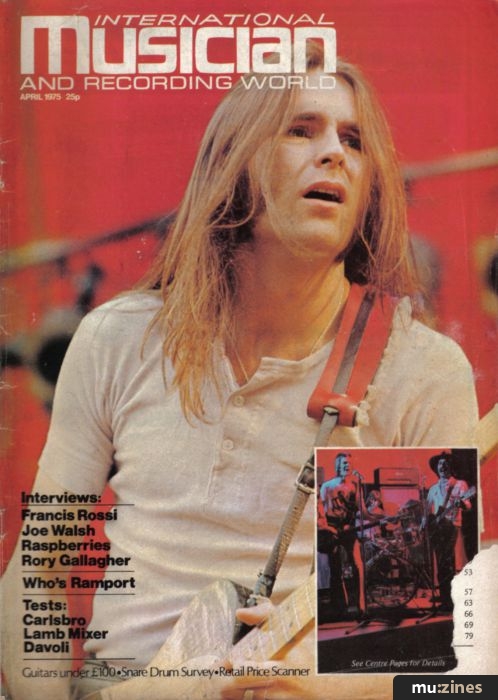
International Musician - Apr 1975
Donated & scanned by: Mike Gorman
Feature
Help Support The Things You Love
mu:zines is the result of thousands of hours of effort, and will require many thousands more going forward to reach our goals of getting all this content online.
If you value this resource, you can support this project - it really helps!
Donations for June 2026
Issues donated this month: 0
New issues that have been donated or scanned for us this month.
Funds donated this month: £0.00
All donations and support are gratefully appreciated - thank you.
Magazines Needed - Can You Help?
Do you have any of these magazine issues?
If so, and you can donate, lend or scan them to help complete our archive, please get in touch via the Contribute page - thanks!
If you're enjoying the site, please consider supporting me to help build this archive...
...with a one time Donation, or a recurring Donation of just £2 a month. It really helps - thank you!

 @mu_zines
 RSS Feed
 Blog
Blog