


Magazine Archive
Home -> Magazines -> Issues -> Articles in this issue -> View
Article Group: | |
Matamp RCGT 100 Amp | |
Article from International Musician & Recording World, December 1975 | |
TEST ON: Matamp RCGT 100 Amp
DATE November 1975
PRICE £129.60 Ex VAT
INTRODUCTION
Mat Mathias is a man who has been designing and building amplifiers for the entertainment industry since the early 'fifties. Apart from the products of his own company, which carry the matamp trade work, he has produced designs for other manufacturers, including those for some of the early Orange equipment. The addition of some fully solid-state systems to the Matamp range extends the long experience gained on valve amplifiers by another step. However, the subject of this test report is one of the "all valve" designs.
The RCGT 100 is a 100 watt general purpose valve top which is suitable for guitar, bass, organ or vocals. The full output power can be fed into 3¾ ohm, 7½ ohm, or 15 ohm speaker systems by selecting the correct top on the output transformer. There is no loss of power when 15 ohm speaker systems are used, as occurs with many transformer less amplifiers. Using 8 ohm speakers in place of 7½ or 4 ohm in place of 3¾ makes no significant difference.
There is also a 100 volt line output which is useful if very long speaker wires are required. However, a transformer must then be fitted in each speaker box.
As is common with many valve amplifiers, only one input channel is provided. This has a volume control, presence, treble and bass tone control, an additional switched six step base boost control and a four position switch labelled "drive". The "drive" switch gives a choice of normal signal or treble boost at either low or high level. The remaining facilities include two input sockets of different sensitives, mains switch and pilot light, echo input and output sockets, speaker impedance selector, mains voltage selector and two fuses.
The main transformer allows the system to be used on 110 and 118 volt A.C. as well as 220 and 240 volts A.C.
CONSTRUCTION

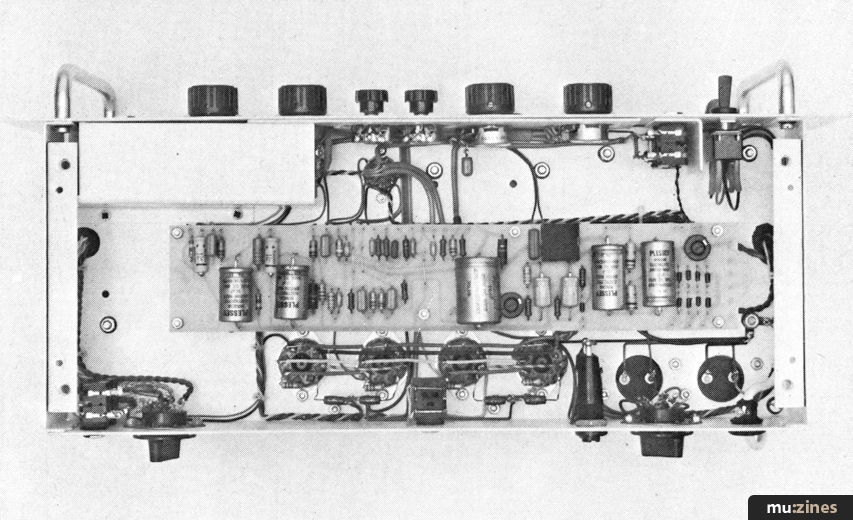
There is nothing exciting or revolutionary about the style of construction, apart from having chrome plated handles on the inside of the chassis and on the front panel! The quality of construction is very good and well above normal standard. All the components are of the very best quality and of ample rating for their jobs; including the expensive items like the transformers.
One medium size glass fibre printed circuit board carries the majority of small items and everything is well secured so as to withstand vibration.
Access for servicing is very easy. Valves may be changed by removing four screws and lifting the back cover off or the whole chassis can be taken out of the box by removing four screws in the base. Almost any component could be replaced without having to first dismantle other bits.
PERFORMANCE
| RESULT | TEST CONDITION | COMMENTS | |||
| Power Output | 126W | Into 15 ohms. | RMS power at 10% | ||
| 132W | Into 7.5 ohms. | total harmonic | |||
| 117W | Into 3.75 ohms. | distortion | |||
| 112W | Into 15 ohms | Power at | |||
| 114W | Into 7.5 ohms. | onset of | |||
| 110W | Into 3.75 ohms. | clipping | |||
| Distortion | 5.4% | @ 100W into 7.5 | Total harmonic | Distortion levels are | |
| 0.26% | @ 10W into 7.5 | distortion | high but reasonable | ||
| 0.3% | @ 1W into 7.5 | measured at 1 KHz. | for a valve amplifier. | ||
| Sensitivity for 100w O.P. | 13 mV. | i.p. 1 | Tone controls set for best | Quite high sensitivity | |
| 5.6 mV. | i.p. 2 | square wave response and | which is more than | ||
| "drive " in 3rd position. Measured | enough for guitars | ||||
| at 1 KHz. | and microphones. | ||||
| Tone Controls | 28 dB. | Bass Switch range at 50Hz. | Good | ||
| 25.5 dB. | Bass range at 50Hz. | Good | |||
| 28.1 dB. | Treble range at 10KHz. | Good | |||
| 6.7 dB. | Presence range at 1.7KHz. | Should be better | |||
| Noise referred to i.p | -84 dBm. | i.p 1 | Reasonable for a valve amplifier. | ||
| -91.3 dBm. | i.p 2 | The "noise" is mostly mains hum. | |||
| Echo send | +1.8 dBm. | ||||
| Output Protection | OK | Short circuit | Did not blow fuse on | ||
| OK | Open circuit | short circuit test but | |||
| the valve anodes became red hot. | |||||
| Capactive load test | OK | 2 uF and 8 ohm. load |
CONCLUSION
Matamp have reason to be proud of the quality of the RCGT 100. The construction is beautiful and the performance is good for a valve amplifier. I would have liked to see more range on the presence control and less background mains hum, but even so, the achieved performance is not unreasonable.
The input sensitivity is higher than normal. This could be very useful if you have low output mics but otherwise has no significance.
In every other way the amplifier is very ordinary and unlikely to attract attention to itself. It is the sort of work horse which can be put into service and forgotten about; apart from an occasional change of valves.
The provision of socket for connecting an echo chamber or reverberation unit is obviously very worth while. However, putting plugs in these sockets does not interrupt the direct signal line. Consequently, one must be careful to choose an echo unit which will provide a "reverb only" output because the mixing with the main signal is done in the amplifier. The echo unit must also have its own "echo send" level control.
Publisher: International Musician & Recording World - Cover Publications Ltd, Northern & Shell Ltd.
The current copyright owner/s of this content may differ from the originally published copyright notice.
More details on copyright ownership...

International Musician - Dec 1975
Donated & scanned by: Mike Gorman
SoundCheck
Review by Bruce Gibbs
Previous article in this issue:
Next article in this issue:
Help Support The Things You Love
mu:zines is the result of thousands of hours of effort, and will require many thousands more going forward to reach our goals of getting all this content online.
If you value this resource, you can support this project - it really helps!
Donations for April 2026
Issues donated this month: 0
New issues that have been donated or scanned for us this month.
Funds donated this month: £0.00
All donations and support are gratefully appreciated - thank you.
Magazines Needed - Can You Help?
Do you have any of these magazine issues?
If so, and you can donate, lend or scan them to help complete our archive, please get in touch via the Contribute page - thanks!
Please Contribute to mu:zines by supplying magazines, scanning or donating funds. Thanks!
Monetary donations go towards site running costs, and the occasional coffee for me if there's anything left over!

 @mu_zines
 RSS Feed
 Blog
Blog