


Magazine Archive
Home -> Magazines -> Issues -> Articles in this issue -> View
News - Keyboards | |
Article from In Tune, December 1984 | |
Low-Cost MIDI from Siel & Much More...
Claimed to be the first low-cost MIDI-equipped keyboard on the U.K. market, the new MK900 keyboard has begun to arrive with U.K. retailers from Italian-based synth. wizards Siel.
The MK900 has dual voice generation which allows two sounds to be layered together or split from 3-way 'split points'. Voices may be de-tuned and there's a special extra feature ('Left to Mono') which allows the tone of the left hand to be placed on the top right hand voice. With manual and programmable rhythms, plus chord, bass and melody sequencing, the MK900 transmits MIDI data related to note, program change, 1-finger chord, Help and Counter melody, allowing two or more expander units to be connected and allocated to MIDI channel 0 and channel 1 when using programmable split. Complete with a Demo song internally set, stereo output (6.5 watts per side) stereo headphones 'out' plus line 'outs' and a volume pedal facility, the Siel MK900 has an RRP of just £449.
Also new from Siel is a MIDI computer interface for the BBC-B computer, added to their existing Commodore 64 and ZX Spectrum units. The BBC-B version enables direct connection of any MIDI-equipped instrument to the 6502 CPU. The interface has MIDI IN-THRU-OUTx3 plus an IN control for external triggering from rhythm units or pedals. Composer/Arranger software is also now available for the BBC-B in both disc and cassette form, with many other programmes (Siel say) shortly to be released. The Siel MIDI computer Interface has an RRP of just £99.00.

More goodies from Siel include the MIDI 16-track Live Sequencer. A 16-track realtime sequencer, the programme is capable of real-time polyphonic recording complete with full monitoring of previously recorded tracks. The software will, apparently, handle approx. 9,000 MIDI events on a Commodore 64. Once the sequence is recorded it can then be placed in the Songs section which which will allow more control, Siel say, over the memory availability, so that songs can be 'dumped' onto disc or tape with instant recall of a selection of songs.
Software facilities for internal/external and MIDI triggering are available on either cassette or disc at £64 or £69.50 respectively.
Yet more new gear from Siel includes the Siel CMK94. This computer music keyboard interfaces direct with the Commodore 64 and offers a 49 note keyboard employing the computer's SID chip for all musical synthesis. The software allows mKk polyphonic sounds to be created and stored on either disc or cassette. The Creation pages offer full ADSR, DCO and modulation parameters, the sound can be played on the keyboard and changed as you create new tones.
The CMK has a MIDI master keyboard, allowing Siel's MIDI Computer Interface to be fitted, thus to handle MIDI equipped instruments in layering split modes and programme changes as required. Offering a user guide, 49 note full-size keyboard, software on disc or cassette, RRP of this Siel package is £125.
As if all this wasn't enough, Siel have obtained distribution rights on the Commodore 'Music Maker" and 'the Music System' from Island Logic Ltd.
The Commodore Music Maker comprises a mini 2-octave keyboard designed to sit on top of a Commodore 64 computer. The first programme in the package uses the SID chip potential to produce sounds and rhythms which may be both relayed and sequenced. 8 sounds may be recalled at any time and they can be edited via the programme's synth. action. New sounds can be stored onto disc or cassette - as can the sequence.
The sequence module is capable of note storage without the timing being of importance. This may then be 'tapped-out' to input the time value of each note. There are 3 pre-programmed songs on the software.
The Music Maker package includes an SFX songbook and music tutor, plus keyboard stickers & user guide. RRP is £29.95 on either disc or cassette.
The Music System, Siel claim, is the most advanced micro-based system currently available. It incorporates 5 distinct elements. the Editor, Keyboard, the Linker, the Printer and the Synthesiser.
The TMS control screen is a complex collection of subroutines managing everything from the unique icon graphics to the Macintosh-type pop-up message windows. Siel also say that, despite the musical potential of the package, all the screens have been developed for simplicity and friendliness.
The Music System disc package retails for £24.95 and comes with two discs including a 'Song & Sound' library containing musical examples, backing tracks and predefined sounds to be used in conjunction with the Editor and the Keyboard.
The cassette version is available as two packages, each selling at £12.95. Cassette 1 features the Editor and the Printer. Casette 2 features the Synthesiser and the Keyboard. Both have Song and Sound libraries on their B-sides.
Details of this latest mass of keyboard and computer-orientated software from SIEL (U.K.) Ltd., (Contact Details).
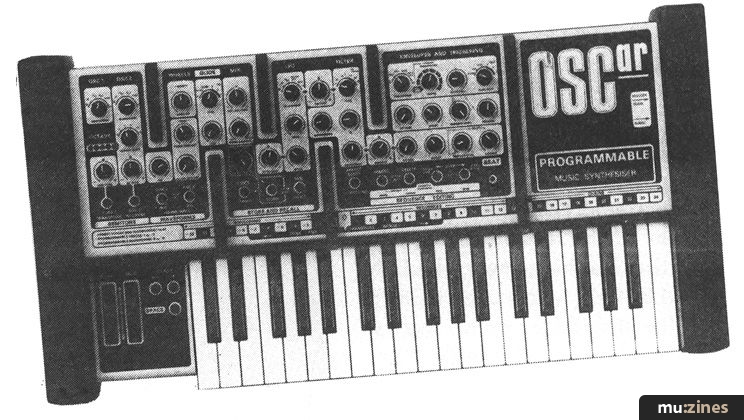
OSCAR GOES MIDI
Synth players are unlikely to have missed out on the highly-regarded British-made Oscar synth (which has received some of the best reviews in print in its relatively short life), but now comes the latest news from its makers, the Oxford Synthesiser Co. that a fully spec'd. MIDI system is to be fitted to new versions. Even happier news (in that it says a great deal about the makers' commitment to existing owners) is that older Oscar synths can have an upgrade pack fitted very cheaply indeed. The newly MIDI-equipped Oscar (retailing at £549 inc. VAT) features a full MIDI system, with channel assign, programme information etc. It will also send sequencer data, and the number of sequencer 'events' available has been increased from 580 to 1,500. All 36 voices on the Oscar are now user-programmable.
Existing Oscars can be returned to retailers for the fitting of an upgrade pack; alternatively, the upgrade is available in kit form, direct from the manufacturers who say it is 'amazingly simple to fit'. More details direct from The Oxford Synthesiser Co. at (Contact Details).
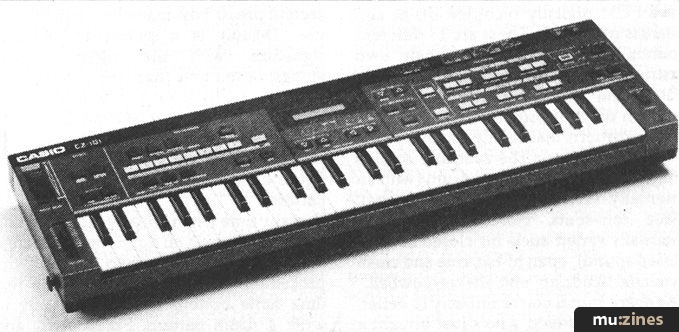
GO PRO WITH CASIO!
Well regarded for smaller, home or semi-pro keyboards as they are, 1985 is set to be the year when Casio unleash a full-blooded assault on the pro. keyboard market; a drive which will be taking them into a head-on fight with the established 'pro' keyboard makers.
Spearheading Casio's move up-market will be a brand new synth. - the CZ-101, which was unveiled to members of the Press and retailers at a recent Casio preview. By the time you read this, expect the Japanese wizards to have arranged for your local Casio dealer to either have the CZ-101 in stock, or be anticipating it pretty soon.
What's so hot about the CZ-101? Well, try this on for size! Imagine an 8-note polyphonic synth with 16 programmable digital voice memories (storable on RAM cartridges for 'library' use), 32 mixable waveforms, 3 envelope generators, 2 keyboard followers, octave shift, pitch bend wheel, programmable portamento, solo voice mix and transpose functions. Put all that together with MIDI, a dot matrix display and a unit small enough to be strapped across the shoulder and both worn and played like your lead guitarist does his Strat- now you have a fascinating performance keyboard. The price? It's a quoted RRP of £395 inc. VAT. The sound? Casio's demonstrator, Hans Dreyer, made it sound like it was worth three times the price - watch out for it!
But Casio's attempt to wrest keyboard players' attention from the 'big name' synth makers isn't about to end with the CZ-101. Apparently (ITs spies learned) this is just the first of a whole new family of Casio keyboards aimed squarely at the performing player.
Yet more newcomers from Casio unveiled at the launch included the CK-500 (RRP £345 inc. VAT), a keyboard unit in more traditional Casio style, but still with handy features like a 4-track double cassette recorder and stereo radio (no less!). The CK-500's keyboard is an 8-note polyphonic job with 49 keys, 12 pre-set sounds and auto rhythms, auto-accompaniment and sound effects.
Back on the performance side again, Hans Dreyer gave a convincing demo of the new Casio CT-410V, a portable keyboard unit fitted with a nifty 'breath controller'. The CT-410V has 49 keys, 20 pre-set sounds, 12 auto-rhythms, reverb, stereo chorus and sounded pretty good to us. RRP of this keyboard unit will be £345 inc. VAT.
Also on the way are two further keyboards - the CT-6000 (RRP £695 inc. VAT) and the CT-810 (RRP £395.00 inc. VAT). The CT-6000 offers 20 voice, 5 octave, 8 note polyphonic functions along with touch-sensitive keys, and Casio's 'after-touch' facility. Cleverly, the CT-6000's accompaniment facility not only backs the player's melody with chords, bass patterns and rhythms, but actually varies them according to the 'feel' of the melody line and the player's touch timing. MIDI'd, with pitch bend, glissando, transpose and other features, this is yet a further full package from Casio.
Finally to the CT-810. This is a 4-octave keyboard unit with full-size keys and 12 pre-set sounds and rhythms. A ROM pack facility is provided, together with 'memory guide' auto memory (allowing players to record both melody and chords), stereo chorus and a mike input, allowing you to squawk along with your Casio!
Do keep your eyes open for the fabulous new CZ-101. It remains to be seen whether Casio can shake off their 'home keyboard' image in 1985 with such aggressively-priced pro keyboard products as this, but they're out to try - and they're not used to losing!
More data on all Casio products from Casio Electronics Ltd., (Contact Details).
Publisher: In Tune - Moving Music Ltd.
The current copyright owner/s of this content may differ from the originally published copyright notice.
More details on copyright ownership...

In Tune - Dec 1984
Donated by: Gordon Reid
News
Help Support The Things You Love
mu:zines is the result of thousands of hours of effort, and will require many thousands more going forward to reach our goals of getting all this content online.
If you value this resource, you can support this project - it really helps!
Donations for May 2026
Issues donated this month: 0
New issues that have been donated or scanned for us this month.
Funds donated this month: £0.00
All donations and support are gratefully appreciated - thank you.
Magazines Needed - Can You Help?
Do you have any of these magazine issues?
If so, and you can donate, lend or scan them to help complete our archive, please get in touch via the Contribute page - thanks!
Please Contribute to mu:zines by supplying magazines, scanning or donating funds. Thanks!
Monetary donations go towards site running costs, and the occasional coffee for me if there's anything left over!

 @mu_zines
 RSS Feed
 Blog
Blog