


Magazine Archive
Home -> Magazines -> Issues -> Articles in this issue -> View
News - Show Special | |
Article from International Musician & Recording World, September 1986 | |
This month, we've devoted all of our news pages to two special show reports; from Chicago's NAMM fest, and London's APRS — the products which'll be making next year's news...
In place of our regular news reports this month, we have two special show reports. First up, and extending this months Recording World coverage, we focus on this year's APRS show from Olympia...
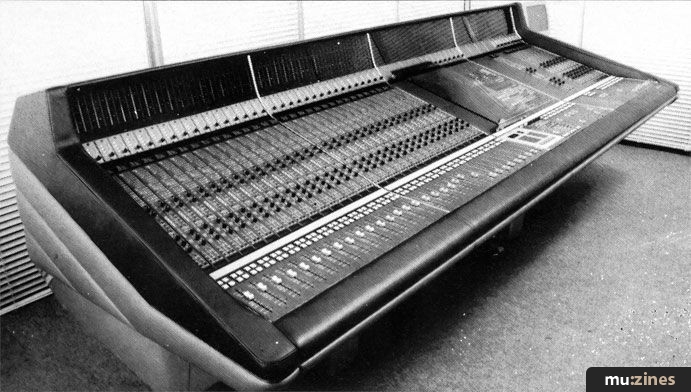
Harrison Series 10; analogue controlled digitally
APRS
Though there were a number of very interesting new products in the home recording sector this year there were no mind blowing disclosures or totally new concepts to be had. For the real headline-making stuff it was necessary to move right upmarket where, for sheer glamour and state-of-the-artness, the star prize had to go to the new totally automated mixing console from Harrison going by the name of Series 10. It was part of a trend at the show from major mixing console designers, with Amek, Audix and Trident, towards digital control of analogue signals through the use of assignable controls, and it's a trend that undoubtedly ends the reign of superiority enjoyed by SSL over the last few years. For their part SSL have published a paper explaining that they are going all-out for a fully digital system and intend to avoid what they consider to be the interim technology of assignable analogue consoles — so maybe they'll be back on top again soon, who knows?
Currently, even with the most sophisticated SSL only a certain number of control settings can be logged on disk at the end of a session for future automatic reset, most of those being switched functions such as mutes, eq in/out etc. Though the position of other settings using continuously variable controls, such as equalisation, auxiliary send levels and pans, are logged and stored graphically, they actually have to be reset manually which is relatively laborious and time consuming. Assignability means that instead of having a separate complete set of controls, ie eq, aux sends, pan etc, on each channel, many or all of these functions are taken care of by a digital centralised system — a single set of controls which can be assigned to any module or group of modules at a time. Synth players might like to see it as being similar to the centralised digital access system of editing on modern synths where you have a single 'incrementor' wheel with which to change values and you have to select the parameter to which you wish to assign that incrementor. In the case of a desk, the benefits of this are that a great deal of space is saved and also that all or many of the console's functions are actually digitally controlled rather than simply digitally logged, and thus they can be remembered and very quickly reset at the touch of a button or two. In this way the new consoles are similar to the Neve all-digital DSP console, with the difference that the audio passes through them in analogue form. But even with the DSP, it isn't possible to write changes in eq, auxiliary sends and pans into a computer controlled mix, and this is where the Harrison Series 10 is unique and revolutionary — every channel and group function is dynamically automated providing a new level of creative control and repeatability. This automation has been made possible by the use of a proprietary Harrison 'digital audio attenuator' (DAA) which is a passive attenuator responding directly to a digital control signal, thus avoiding the low-level noise and distortion inherent in VCAs. Also, being in digital form, this information is very easily manipulated, and thus a number of often-used channel, group or board presets can be stored and recalled, copied, transferred or inserted anywhere at any time providing a very fast, flexible production tool — and a bill for around £340,000. It isn't cheap but it is the most sophisticated. And so on to the rest of the show...
Adam Smith (Marquee Electronics) had their new Zeta chase synchroniser on display. Costing £2,250 it offers single machine lock, an RS232 port for computer control, an RS422 port for controlling machines, an internal time-code generator and MIDI interface. There is no remote as yet though one will soon be available. Akai have brought out a little brother to the MG121212-track in the form of their MG614 which is basically a sophisticated six-channel, four-track portastudio with automatic drop-in/out, dual speed, two-band sweepable eq, auxiliary send/receive, two balanced mike inputs, in/out switchable dbx noise reduction and a notably classy appearance all for £899. Also from Akai, the DP1600 16x16 Programmable patchbay using a card-based memory system to store any number of patches. Via a VDU patches can also be given names for reference. Price: approx £800. A 32x32 version will also be available. As well as a major cosmetic overhaul AHB's System 8 mixer range has benefitted from electronic balancing on its outputs, and fader reverse on its eight groups allowing them to be used as extra inputs during mixdown. However, this MkIII version still costs the same at £1,760 and £2,220 for the 16 and 24 channel versions respectively. AHB also launched a completely new range of 24 bus consoles called Sigma 24 with four-band sweepable eq, six auxiliary sends, solo-in-place, and fader reverse on the groups for extra inputs on mixdown. Formats are available to cope with eight to 32-track applications. Options include VCAs providing 8 DC subgroups, programmable mutes, and MIDI interfacing using the Sigma Series remote. Prices start at under £10,000.
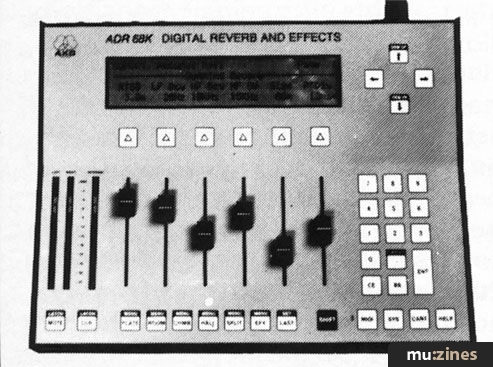
AKG ADR 68K
Following AKG's recent acquisition of Ursa Major they have brought out a new two-in, four-out digital effects unit called the ADR 68K. This snappy title is derived from the fact that it is based on the 68000 microprocessor, as used in various micro computers such as the Macintosh. It has dynamic MIDI parameter control (control filters, reverb time, gated reverb effect, etc, all from your MIDI synth via keyboard touch or performance wheels), eight seconds sampling time splittable into four separate two second sections... and much more, for under £4,000. It is similar to the Eventide SP2016 inasmuch as its functions are software controlled, with 60 programmes stored in internal RAM and a further 60 on a plug-in RAM cartridge. This 'open architecture' means that AKG will be able to continually offer new software packages to keep up with technical developments or new trends in effects. Stage Two software, available in October, will include compressor, gate and parametric effects all of which will be usable simultaneously. Price: approx. £4,250.
Amek, already well established for both their studio and live mixing consoles, were offering a somewhat less expensive assignable console option in their new APC1000. In this case, unlike the Harrison desk already mentioned, just the switchable functions are assignable whilst a graphical record of the rotary controls is stored providing a reference for the manual resetting of those levels. A 64 input format with the excellent GML automation would cost in the region of £190,000. Audio Kinetics, home of the Q.Lock, were showing a new low cost chase synchroniser called the Pacer costing £1,995 plus £495 for a controller which gives a visual display and provides a record in/out point for the slave and access to the timecode on both slave and master machines. Without the controller, all transport functions are controlled from the tape machine's remote. The basic system allows two machines to be locked together. More machines can be locked by simply paralleling-up more than one Pacer. Each unit has its own timecode generator, sub-frame accuracy adjustment, and auto-offset.
Though primarily designed for the broadcast market, the new Assignable mixing console (that's actually its name) from Audix offers a 32:8:2 format with 32 direct outputs each with its own separate fader in addition to the normal channel fader. This console provides 'snapshot' automation of all functions (see Trident Di-An entry below for explanation) and would cost somewhere between £100,000 and £120,000 plus fader automation. At the other end of the overdraft facility, new and reasonably priced boom mike stand from Konig and Meyer is available through Beyer in four colours at £28 each.
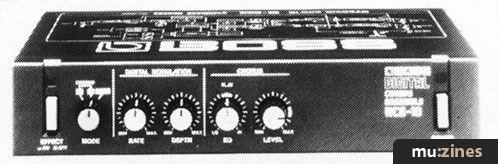
A new Boss in town
An inexpensive pitch shifter and delay line at £199 and a chorus ensemble unit in the same range was forthcoming from Boss for their MicroRack system, (see review elsewhere in this issue.) Not shown at the show but soon to be released from Roland is the DEP 5 digital multieffects processor at £625. This is intended to be direct competition with the Yamaha SPX90, although it seems that there is no final word on exactly what it's going to be able to do yet, although certainly reverb, echo and chorus will be central. Watch these pages for details.
Fancy interfacing your MIDI system with your Lexicon 224XL, your outboard gear and your multitrack machine? Then the Clarity MIDI XLV may be just the thing. Not only does it allow dynamic control of the 224 from a MIDI sequencer or instrument, but it also has eight analogue outputs to allow MIDI control of outboard gear etc, with CV (control voltage) inputs. It's totally simple to plug up and costs a mere £1,200 from Scenic Sounds. Following the success of the dbx 163 compressor/limiter there are a couple more low cost units from the company — the 263 de-esser and the 463 gate, both taking up half a 1U 19" rack space and costing £132. In the same range is the 150X low cost noise reduction system offering two channels of simultaneous encode/decode, in the same size package and costing £153.
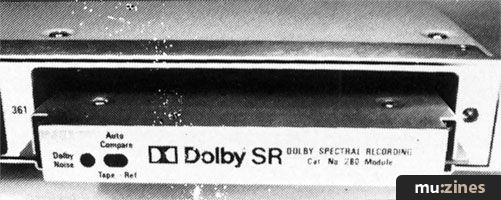
Dolby SR; Analogue bites back
Dolby were of course showing their new SR (Spectral Recording) noise and distortion reduction system which supercedes Dolby A and threatens to create even more indecision concerning the change over to digital by making analogue sound so good. Drawmer, from whom stemmed the frequency-conscious gate revolution, had their two-channel M500 programmable, MIDI compatible, dynamics processor offering frequency-conscious gating, expansion/compression/limiting, de-essing and auto-panning, all usable simultaneously. There are 128 factory presets plus 128 user definable patches stored in non-volatile memory. Price: £575. Also from Drawmer a very simple stereo 'over-easy' type compressor, the LX20, (approx £259) and the E101 stereo passive auxiliary eq modules intended to provide a more musical source of eq using mainly coils rather than lots of active circuitry. Price: approx £374.
The Dynamix range of mixing consoles has been expanded with the addition of the D4000 series with formats expandable up to 32:16:2. Input channels include switchable 48v phantom, phase reverse and three-band Eq with sweepable mid and switchable high-pass filter. From Fostex there was the new 'E' range of tape recorders coming slightly upmarket of the 'B' series and all featuring a phase-locked loop capstan which provides better wow and flutter and which has been optimised too for timecode synchronisation. There are two stereo mastering machines, the E2 and the E22 (¼" and ½") with centre track timecode — (price approx £2,600 and £2,900); and the E8 ¼" eight-track which can take 10" spools and thus an extended play time as compared to the Model 80 — (price approx £2,800.) The E16 actually replaces the B16 and has slightly improved audio electronics plus microprocessor-based function controls — price approx £3,700.
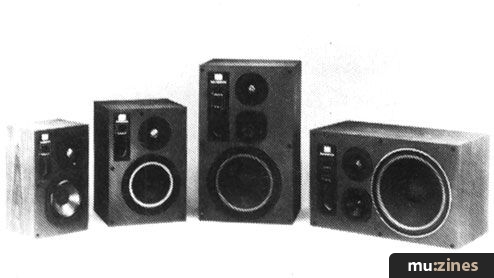
JBL 4100 series monitors
JBL were flaunting a new range of near-field monitors the main feature of which was the use of titanium for the HF dome tweeters. Going still smaller, the Control 1's are 2-way mini speakers intended for any application from very small PA, to home studios etc, and have a variety of mounting attachments including those for photo tripods, mike stands and G clamps. These desk top monitors have a frequency response of 100Hz-18kHz. Price: £149 per pair. JHS have a new digital delay line that actually seems to offer more than their already successful S1024 for £20 less. At £229 the PDD3000 keeps such features as 124ms maximum delay, modulation and 16kHz bandwidth, and replaces the two switchable tone settings with a continuous control and also adds the facility of being able to switch to the 'Hold' mode from any delay setting. This seems jolly decent of them, and they're still selling the S1024 alongside for those who prefer it. Klark Teknik were showing their new multioutput DDL DN716 and the new generation two software for the DN780 digital reverberator. The 480L from Lexicon is basically a 224XL with digital outputs so that effects can be recorded directly to a digital tape machine without having to go through any A/D/A conversions, and that, I am assured, makes it unique. It should be comparable in price to the 224XL and can be controlled from a standard Larc.
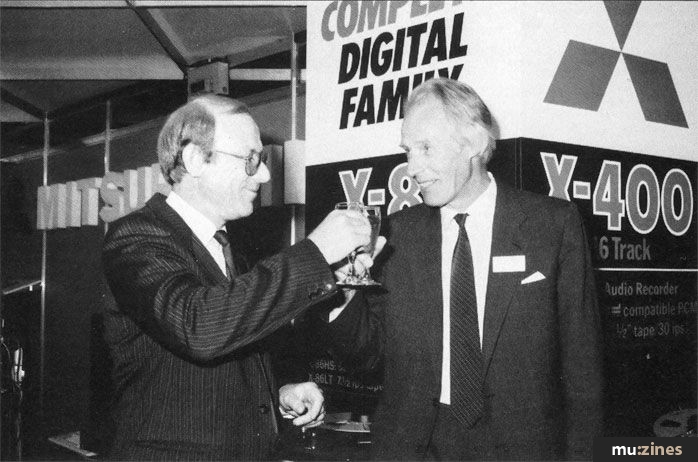
George Martin toasts his new Mitsubishi
George Martin made an appearance on the Mitsubishi stand to tell of the acquisition of two X-850 32-track and two X-86 stereo digital tape recorders by Air Studio in Montserrat. They're definitely starting to catch on.
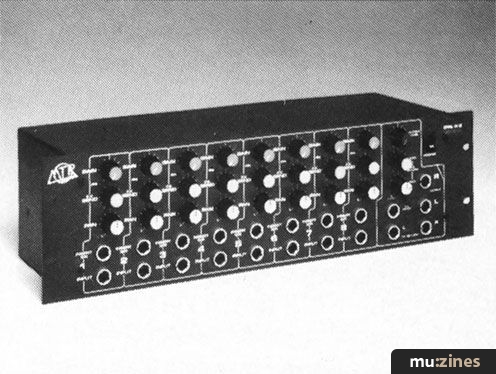
MTR SLM82 Stereo Line Mixer
MTR launched a nifty little low cost rack mounting sub-mixer called the SLM 82 intended for use anywhere that extra inputs are required, for instance as a submixer for a drum machine or if you have a large number of keyboards and a limited number of inputs on your mixer. It's an 8:2 line level only mixer featuring gain, auxiliary send and pan controls, plus insert points on each channel. Price: £253.
There were a number of new tape machines from Otari this year including what amounts to their version of the Mitsubishi 32-track digital tape recorder costing £129,000 as compared to Mitsubishi's £125,000. Their argument is that their DTR900 is more user friendly, it has a meter bridge, a more sophisticated remote and 32 balanced outputs. It might also be argued that in buying the Otari you are getting the after-sales support of the company's well established British base. Coming back downmarket, Otari have a new two inch 24/32-track machine in the MX80 retailing for around £20,000 and £24,000 respectively. Also new was a very upmarket ¼"/½" two-track machine, the MTR20, with optional centre track, timecode, and eight tape alignment memories for around £8,000. As if to balance this extravagance, the MX5050 at around £3,000 is a very reasonably priced ¼" centre track timecode machine. Apart from some sub-bass bins, Quested, whose products appear to be taking over as the studio monitors, were showing their H405 4x5" near-field monitor with single central HF tweeter. Ramsa were showing a range of four new mini clip-on mikes for a number of applications from an extra-stable headset vocal mike to the miking up of drums and sax. Prices from £89.99 to £119.99. There was also a new addition to their Pro Loudspeaker range with the WS-A80E, a small two-way high powered 80 watt system intended to challenge the Bose 802 market for compact PA applications — and I must say they sounded very good.
A new and highly sophisticated dual channel gate from Rebis, the RA701 has two-band eq plus eq in/out switch per channel, decay, attack, hold and release controls, ducking, envelope mask and a 'fixed envelope', setting that allows you to superimpose the gate's envelope on any sound regardless of its duration. Each channel is also individually MIDI interfaceable with velocity sensitivity, allowing the outputs of the two channels (eg gated bass drum and snare) to be used to trigger a MIDI instrument enabling replacement of the original sound. Price: £395. On the recording side Soundcraft unveiled their new TS12 in-line mixing console aimed at musicians and synthesiser studios and offering many of the facilities of their existing TS24 but at a lower price. On the PA front, the Series 8000 was launched, which is a dedicated live sound console based on the 800B series. Slightly downmarket of the 8000 is the 200SR stereo PA console derived from the 200 and with the addition of four dedicated effects returns. Soundtracs, who have recently gone public valued at around £4m, were showing their new 32:10 MC stage monitor console with two auxiliary sends and returns, four-band eq with two sweepable bands on the channels and two-band parametric on the outputs. Price: a little under £5,000. Studio Magnetics is the slightly upmarket sister company to Aces. They were showing a 16-track 1" at £8,000, a 16-track ¼" (with a staggered head thus reducing cross talk) at £2,800, and the ½" stereo machine at £1,400. Considering this is the upmarket side of the operation these are very low prices.
Paul Hardcastle, one of the approximately 450 Synclavier owners worldwide, has just spent about £170,000 on four Synclavier direct-to-disk recording systems to add on to his existing synthesis package, and this gives him up to 16-tracks of tapeless digital recording facilities. Trident have also entered the assignable console market with their Di-An system which, in terms of automated recall, comes somewhere between the Harrison and the Amek in that it can take up to 512 'snapshots' of every setting on the desk and practically instantly (20ms) switch between them. This means that recalling the settings from the previous session would be very simple, as would simple control resets during a mix, but that any 'dynamic' changes of eq, pans etc during a mix would be a little tricky and would require a kind of 'joining the dots' approach of sequencing through a number of presets. It obviously wasn't designed for that purpose, its main attraction being that all of its variables can be stored and automatically recalled from disk. A 40:32:2 board without automation would be £123,000. There is a choice of automation systems but Trident's own moving fader system (no VCAs) would be an additional £600 per channel for the faders plus £12,000 for the computer to run them, bringing the total cost to around £159,000. The Urei 813Bs have been upgraded to the 813Cs with higher power handling, lower distortion and no bulbs or fuses.
The APRS were pleased to report somewhere in the region of 5,250 visitors of whom over 500 were from overseas. This is up by well over 1,000 on last year's overall attendance and is generally encouraging to the industry and to the importance of the APRS on the world exhibition circuit.
NAMM
In the second of this month's News specials, we take a look at the new products at the NAMM show in Chicago. Gripping stuff...
Twice a year the Americans have their equivalent to Europe's Frankfurt Music Messe — the NAMM (National Association of Music Merchants) show. The winter show takes place in Los Angeles, Anaheim to be precise, and this summer's show was to be found in Chicago. It is usually at NAMM that the first glimpse of the latest wonders of the musical world are to be had, and this year's show was no exception.
First off, new and cheaper samplers were to be found in most corners of the huge exhibition halls. In addition to their superb new S900 sampler Akai were showing their first sampling keyboard, the X7000. This is based on their very successful S612 sampler, ie with a built-in 2.8 inch disk drive which is compatible with the S612's disks. The X7000 can store up to six different samples internally which (in the MIDI mono mode) can each be played individually and assigned to different MIDI channels. The six samples can also be split over the keyboard for multi-sample programs. The X7000 will be in the shops in August and will sell for only £999.
In the effects department, Akai have a range of effects similar to the Boss Micro Rack series. Called the Compact Effector Series, these consist of a digital delay, a compressor/gate, a parametric equaliser, noise reduction and an enhancer. These should be in the shops any time now.
Akai also have a very posh looking four-track portastudio called the MG614. This uses standard chrome cassettes, dbx noise reduction, and can be switched between standard and high speeds.The MG614 also has a computerised auto-locator/tape transport as well as computerised and programmable track routing system as found on their larger MG1212 and MG1214 mixer recorders. The MG614 has a very good spec — the deck will record from 30Hz to 20KHz at high speed and a S/N ratio of 90dB. The MG614 should be available in August and will have a very reasonable retail price of £899.
Alesis have a new effects unit to match their excellent Midiverb. Called the Midifex, this unit is the same size and shape as the Midiverb, except that it is more of an all-round effects unit. It contains 63 preset programs of chorusing, digital delays and digital reverbs, some of which are quite unique. The delays and reverbs are highly animated through panning, stereo imaging and multi-taps, and the Midifex is going to be a real bargain with a retail price of under £300!
Emu Systems have a new keyboard sampler called the Emax. This is similar in quality to the Emulator II, but has only a single disk drive, a relatively basic sequencer/arpeggiator and no SMPTE. What it does have is 17 seconds of sampling time at the standard 28kHz sampling rate, with eight different sampling rates available from 15kHz to 40kHz. The samples can be digitally combined with other samples and parts of samples can be combined to form completely new sounds. The Emax also uses Emu Systems' new Crossfade Looping technique to ensure glitch free loops. It has five-stage envelopes, VCF, VCA and LFO and each Emax voice can consist of two individual samples with no decrease in polyphony. The Emax will be available in this country by the end of the year in a keyboard as well as a rackmounting format, and will sell from between £2,000-£2,500.
Fostex have a complete new range of multitrack machines called the E-Series. These are the most professional machines we have yet seen from, Fostex, most exciting of which is the top of the range E-16. This is a 'posher' version of their enormously successful B-16. Did you know that more records have been made in the last two years on B-16s than any other multitrack... Well the new 16-track on ½" machine has an improved spec all round. It has a more sophisticated tape transport, direct drive motors, a frequency response that extends right up to 20kHz, better crosstalk and signal to noise figures, and a very attractive all-black facia. The E-16's retail price should only be a little more expensive than the B-16, which should guarantee that machine a good few more years of healthy sales.
Also in the range of E-Series machines is an eight track machine on ¼" called the E-8, as well as two 2-track machines with centre track timecode. These are the E-2 and E-22, the E-22 being the ½" version. These are very similar in size and shape to the B-16 recorder — ie much bigger and more professional looking than the smaller semi-professional Fostex recorders such as the A8. The E-8 should cost around £2,800, the E-22 ½" 2-track about £2,600 and the E-2 ¼" 2-track about £2,400.
Korg have two new sampling digital delays and a 16-bit digital reverb. The DDLs are the SDD3000 and SDD1200 multi-tap delays, and the DRV-1000 is their first digital reverb.
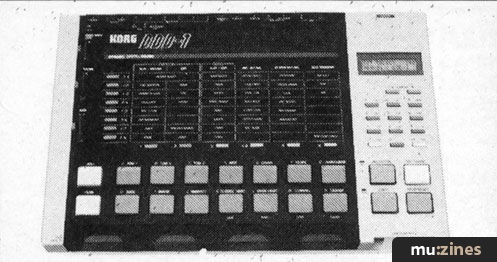
Korg's DDD1 has optional onboard sampling
In the drum department, they have an excellent new digital drum machine called the DDD1. This will have a retail price of just under £800 and has some rather special features which until now had only been seen on machines such as the Linn 9000 and SP12. Each of the DDD1's pads is velocity sensitive to enable you to alter the loudness of each drum as you are programming. This is a very powerful feature which goes a long way to making for a real-sounding drum machine. Each drum is tunable over an octave and each drum's decay is variable too.
On the DDD1, it is also possible to assign, say, seven different tunings of toms to different pads thus enabling tunes to be played, etc. The DDD1 can have an optional sampling board for approximately £200 that offers 32 seconds of sampling time splitable over two voices. You can also have up to four additional ROMs inserted at once for different sets of sounds.
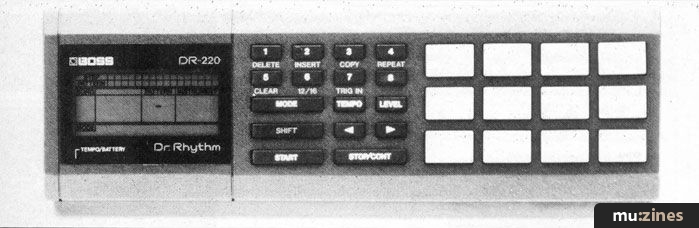
The Doctor's gone digital
Still in the drum department, Roland have two new additions to the Dr Rhythm range from Boss. These are the DR-220A (Acoustic version) and DR-220E (Electronic version). These units feature 11 different digital sound sources which are comparable to machines twice their price. The DR-220 is also very small. It is only a little larger than Boss's own TU-12 tuners, and runs on batteries.
Also new from Boss is the Dr Pad DRP-I, II and III. These are small electronic percussion pads each with six digital sound sources. The Dr. Pads are mountable on mic stands or amongst a drum kit, and are well worth checking out when they arrive in this country.
Roland have also brought out a 19" rackmounting effects processor to compete with Yamaha's SPX-90. The DEP-5, as Roland have christened it, has all the features found on their SRV-2000 digital reverb (except for the further level controls) as well as a digital delay equaliser and chorus unit. More interesting though is that all these functions can be used at once, greatly increasing the DEP-5's versatility. It sounded pretty good from what I could hear from the demo, although it was quite hissy on some settings. Perhaps of more interest is the DEP-5's price tag of around £600.
Roland also had on show their guitar to MIDI converter, the GM-70. This converts the G-24 BUS output of their earlier guitar synths (the G-707, G-808 etc) to MIDI. They were also demoing their two new sampling keyboards which we first saw at Frankfurt. The S-50 and S-10 look and sound very impressive, and by the time they are in the shops, Roland promise to have a library of over 8000 sounds to back them up. Roland are also developing their own version of the CD-ROM for sample storage which they say will be faster and more powerful than that used by Emu Systems...
Another new Roland product was their modular super JX MKS-70 module. The Super JX is one of the best synths to come from Roland in a long time, and the rack mountable version is bound to be met with a good deal of interest from many people.
Trace Elliot had a prototype on display of their new programmable bass pre-amp. It has ten memories in which can be stored front panel settings of the 10-band graphic EQ and input gain. The memories can then be recalled from an AMS-type keypad mounted on the front panel or on the scratchpad of a bass guitar, which would then connect via a single cable to the main unit. In addition to this major function, this as yet untitled preamp has other features we have come to expect on Trace Elliot tops — noise gate, XLR connections, DI out and effects send and return. Looks like a winner, but it also looks expensive.
Although we had hopes of seeing some major new advances in the Yamaha range of keyboards in Chicago, we had to be satisfied with yet another permutation of their FM sound generators.
Of most interest there was the new FB-01 FM sound generator. This has a retail price of around £250 and is simply a small black box in which are 240 pre-programmed FM voices and 96 user-programmable voices. These voices are of the CX5's 4-operator variety, yet can be played as a single polyphonic sound, or eight different monophonic sounds, or any permutation in between. The voices can be panned over the stereo outputs and it sounds like quite a bargain for the money.
The other new product to be found in Yamaha's keyboard department was the DX27S. This is simply a version of the DX27 with speakers built-in, and a price tag of around £550.
Yamaha were also showing their first range of microphones in Chicago. Called the MZ series, these consisted of five dynamic microphones which ranged from between £80 and £160 in price. Further details of these mics can also be found in our APRS report elsewhere in the mag.
Summing Up
As could be predicted, there were a lot of exciting new developments in the world of hi tech. Companies like Akai and Fostex are coming up with some really superb new products — Akai's latest samplers and Fostex's new E-Series of multitracks proved to attract a great deal of interest in Chicago, as did some of the new products on the Roland and Korg stands.
In the meantime, all that was to be found on the guitar manufacturers' stands were a few new colour schemes and lots of tremolo arms...
Publisher: International Musician & Recording World - Cover Publications Ltd, Northern & Shell Ltd.
The current copyright owner/s of this content may differ from the originally published copyright notice.
More details on copyright ownership...

International Musician - Sep 1986
Show Report by Jim Betteridge, Curtis Schwartz
Previous article in this issue:
Help Support The Things You Love
mu:zines is the result of thousands of hours of effort, and will require many thousands more going forward to reach our goals of getting all this content online.
If you value this resource, you can support this project - it really helps!
Donations for June 2026
Issues donated this month: 0
New issues that have been donated or scanned for us this month.
Funds donated this month: £0.00
All donations and support are gratefully appreciated - thank you.
Magazines Needed - Can You Help?
Do you have any of these magazine issues?
If so, and you can donate, lend or scan them to help complete our archive, please get in touch via the Contribute page - thanks!
If you're enjoying the site, please consider supporting me to help build this archive...
...with a one time Donation, or a recurring Donation of just £2 a month. It really helps - thank you!

 @mu_zines
 RSS Feed
 Blog
Blog