


Magazine Archive
Home -> Magazines -> Issues -> Articles in this issue -> View
News | |
Tape machines, handsaws, welcome to Concept CornerArticle from Sound International, March 1979 | |
Lead Tester in Crossover Saga?
For some unearthly reason, we've never mentioned Midas, the London-based manufacturers of a wide range of consoles for PA and studio use. They have an extensive range of top-quality products, notable for their excellent construction and ergonomics: check them out next time you need a console, whatever the application.
This month, BSS, one of Midas' affiliate companies, have released two new products; the first being the MCS 200 electronic crossover. This modular-based unit is now available in a new version; the earlier model having been in use for over a year with some of the top PA hire companies and bands such as Frank Zappa's and Supertramp. The unit's modular construction makes expansion from 2- to 5-way straightforward, and integral limiters and balanced outputs are standard. LED column peak indicators are optionally available. Prices depend on exactly what you want from this versatile system, but as an example, a price of £523 is quoted for a 3-way stereo unit.
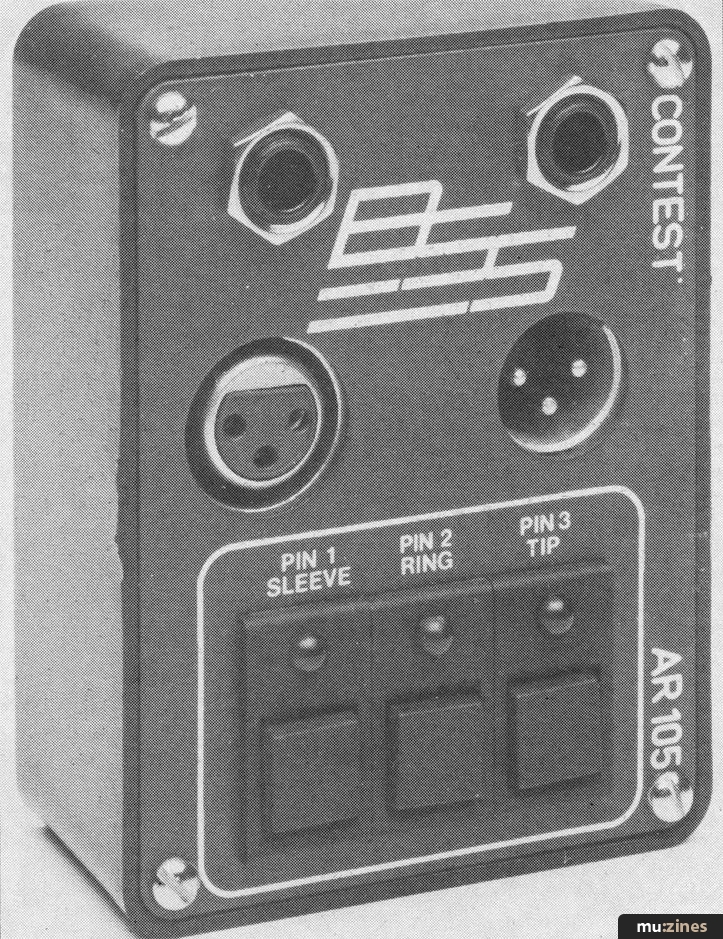
More mundane at first sight, but exceptionally useful to have around, is the BSS Contest leads tester. Leads testers are definitely one of those simple little boxes that are invaluable on the road or in the studio, but are equally things you never get round to building. There are a few on the market but this one is very robust, cheap and simple to use. The unit can be used to test double-ended leads with either 3-pin XLR or standard ¼in PO jack connectors in any combination. Three buttons, labelled according to the pins on the XLR and sleeve/ring/tip for PO jacks are pressed individually to indicate continuity, open- or short-circuit conditions. The appropriate LED lights up above the button to indicate continuity; no light indicates open; while the wrong LED(s) illuminating tells you that there's a short-circuit.
A useful little box to have around in the studio, on the road, or on the workbench, and supremely cost-effective when you consider how much a duff lead can cost at the wrong moment (and leads always go duff at the wrong moment: Murphy's First Law of Professional Audio), bearing in mind that the Contest AR105 will only set you back £18+VAT.
Further info on these and other Midas products from: Midas Audio Systems Ltd, (Contact Details).
ITA's New Tape Machine
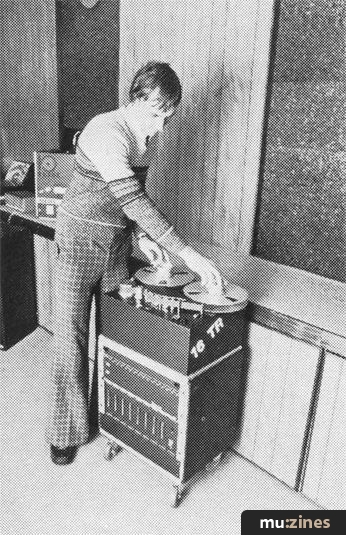
In a piece I wrote for the August issue of SI, I lamented the fact that at the time of writing there was only one British multitrack in volume production: the Brenell Mini-8 8-track on 1in machine. Although the point of the news story was that Soundcraft Magnetics were developing a similar format machine (and which, incidentally, I now hear should be marketed very shortly) it's still a sad fact that British industry hasn't responded very quickly to the growing market for budget-priced multitracks. Wouldn't you know it though, because no sooner had the ink dried on the August issue than I heard that Industrial Tape Applications, better known perhaps as ITA, the London- and Paris-based equipment supply house and manufacturer of the Itam range of tape machines, mixers and accessories, had been quietly working on their own 16-track on 1in machine, no less.
The new model 1610, as it is to be known, was unveiled to a stunned crowd at the recent AES exhibition in New York and attracted a considerable amount of interest. Which is not altogether surprising, considering the very healthy technical spec, good tape-handling manners and last, but by no means least, the price: how does £5700 for a 16-track grab you? Plus other, even cheaper, formats based on the same transport and electronics that will be available later: £3900 for an 8-track on 1in, or £3000 for an 8-track running on ½in tape. And at those prices, low-cost 16-track recording should now be able to take off in the same way that 8-track did several years ago when the first Teac and Otari 1in machines became available. Compatibility shouldn't be a problem, remembering that you don't necessarily have to record in one location, overdub in another and possibly mixdown in yet another.
To find out more about the machine's development, and have a hands-on, close-up feel of the 1610, I invited myself down to ITA's Marylebone HQ, where Martin Parmiter, guiding light behind the project, mechanical engineers John and Paul, and electronics wizard Costos Papas explained all. Over a leisurely lasagne at a local Italian restaurant, they explained that the new machine has been some 2½ years in development, the early prototype being based on the well-known Revox A77 also used in the company's 805 and 806 8-track on ½in machines. Although Paul conceded that this was done more as an experiment than anything else, it did show that using the A77 deck would involve too many changes — including new spool motors and beefed-up tape handling components — for it to be economically viable. (If all you are left with in your new machine is the deck casting and very little else, it may be time to reconsider the cost of all the parts you have thrown away in the process.) In fact, price was a very important consideration because, as Martin Parmiter explained, the cost of the final machine had to be well below that of a second-hand 16-track on 2in machine if it was to prove competitive. (A fact, incidentally, that is almost certainly hurting sales of the only other 16-track on 1in machine presently available, the Teac Tascam 90-16 which, at a price of around £7500, is proving to be too expensive for the UK market.)
Once it had been decided that an all-new, ITA-designed and built machine was to be the order of the day, the first problem was where to find the necessary expertise — after all, you don't exactly fall over tape machine designers these days; not in Britain anyway. Fortunately, both Paul and John had been working for several years on the manufacture of the Revox-based 805 and 806 and, as a result, knew more than a thing or two about what makes tape machines do their stuff. Costos Papas was able to come up with a very sophisticated, virtually foolproof logic control system for the transport, as well as designing the very elegant electronics package. One of their biggest difficulties, I was told, was tracking down suppliers of suitable parts — in particular, the case of a company making motors who quoted a year delay in just getting samples, let alone production units — which often meant going back to the drawing board and looking for alternatives.
But the final machine, as I found out when we returned from lunch to ITA's workshops, was well worth the delay. The 1610 has been designed as two separate units — the transport and the electronics module — both for portability and ease of servicing. It can also be powered from a pair of ordinary car batteries, which should really open up the possibilities for mobile recording. Each separate unit is based on the standard 19in rack spacing, which not only means that the deck is pretty compact, but also that the electronics can be mounted up to six feet away in a rack frame if that's your requirement.
The backbone of the transport is a very substantial top casting on to which are mounted the two spool motors and the servo-controlled DC capstan motor. A belt drive system links the motor to the capstan and flywheel assembly, ensuring very low wow and flutter. A choice of four operating speeds is offered: 3¾ to 30in/s. But, to be realistic, such a wide range has only been incorporated because the transport will be used eventually in other Itam tape machines, some of which will run at lower or higher speeds than the 'optimum' 15 in/s for 16-track work. And with the built-in, and very useful +30% varispeed, courtesy of the DC servo motor, special effects should present few problems.
The tape path is rather interesting, and one that has obviously been carefully thought out. From the supply spool tape passes round a spring-loaded arm, to the bottom of which, below the deck, is attached a potentiometer that controls the back-tension applied to the supply spool motor. The tape then wraps around a large-diameter roller, which helps to dampen out minor vibrations in the tape's motion, before passing around another roller that connects to a tachometer beneath the deck, and then on past the head block. The tachometer attached to the second roller provides pulses for the motion-sensing circuitry, as well as driving a remote-located tape counter, which has a range of up to 99min and 59sec (hurrah for a unit that displays minutes and seconds rather than decimals). The 'conventional' tape guides that lift the tape off the heads during tape spooling have been replaced by a pair of elegant twisting guides located between the three heads. Mounted about ⅛in off their centres they twist around to lift the tape off the heads. In this way very accurate and stable tape movement along the required path is assured, since the tape is always being held in place by these twisting guides. Bloody clever, I call it. From the head block the tape passes between the rear-mounted pinch wheel (to keep it out of harm's way) and capstan, then around a spring-loaded tension arm and on to the take up spool.
The transport is controlled by the normal complement of pushbuttons for rewind, fast-forward, play, stop, record and dump-edit (in that order) with the very useful feature of being able to drop out of record by simply pressing the play button again. The printed-circuit board housing the electronics for the deck functions has four pre-set controls for setting maximum tape winding speed, braking tension, take-up tension and pre-torque to the take-up spool, allowing a wide range of tape types and formats to be accommodated. Not a single mechanical relay is to be found in the transport (or electronics package for that matter), all switching being provided by solid-state electronic latches. Braking is also entirely electronically controlled by applying variable voltages to the spool motors, the solenoid-operated parking brake pads only operating when the spools finally stop turning — or the power supply is suddenly turned off. All in all a very attractive and well-behaved transport, and one that I'm sure we'll be seeing a lot more of in numerous guises over the next few years.
But if the transport is a work of art, wait 'til you see the electronics package on which it sits and to which it connects with one multiway cable. The package comprises an array of 17 edge-mounting PCBs — one for the capstan servo circuits plus 16 identical channel record and replay amplifiers. Along the front edge of each channel amp, normally hidden by a hinged front panel, are the preset adjustments for setting up the sync, replay and record gain and eq, bias level and input level. A particularly useful feature is the fact that these controls are contained on a small PCB that simply plugs into the 'mother' board. Think about it for a moment: if you want to change tape stock, all you need to do is have a spare set of PCBs pre-adjusted to suit the bias, record levels etc of the new tape, and simply swap them over. Also, if you want to run at a different operating speed for some reason — 30in/s without noise reduction being one possibility — then it's much easier to replace 16 small pre-set PCBs than to completely re-adjust the record and replay equalisation.
The status of each track is controlled by a 'safe/ready' record button and associated LED fitted to the top of each channel amp, which protrudes through the front panel, plus two master pushbuttons. These latter select either 'input' or 'tape' for all the tracks, the second mode being dependent on the setting of the other 'play/sync' button. Let me explain how they work. Press 'input' and, not surprisingly, the output from all tracks is the input, with the record mode being inhibited. Select a combination of 'tape' and 'play', and the output from each track is switched to the replay head for mix down. During overdubbing, however, selection of 'tape' and 'sync' will ensure that the output from tracks set to record/ready will be from the input, while the output from these tracks not being recorded will be off the sync head. Which is just how it should be, right? Drop-ins are claimed to be entirely silent and 'click-free' (courtesy of the solid-state switching) and can be carried out on the record/play buttons or on the individual safe/ready pushbuttons. In addition, all these functions, plus the standard transport controls, are duplicated on the very useful optional remote control unit. ITA are also working on an autolocator with a couple of memory locations.
Space is provided below the electronics package for optional dbx or Dolby noise reduction systems. On the rear of the package are to be found the channel XLR input and output connections, plus a large multipole connector for the remote control, and a smaller connector for interfacing a noise reduction system. This latter connector can be set up to provide a variety of voltage pulses, so that individual channels of dbx or Dolby noise reduction can be switched to encode or decode mode to suit the requirements of each particular track. Total weight of the transport is around 30 lbs, while the electronics package turns the scales at a mere 20 lbs.
Which leaves me with very little to tell you, except to pass on the technical specification ITA are quoting. At 15 in/s wow and flutter is a very reasonable 0.07% RMS, overall frequency response within 2 dB from 35 Hz to 22 kHz, and signal-to-noise ratio a very useful 64 dB A-weighted at 2% tape distortion. More information about the 1610, which will eventually be rolling off the production line at a rate of around 10 per month, such is the company's confidence in this new format, can be had from Industrial Tape Applications, (Contact Details), or Son Professionnel, (Contact Details). Mel Lambert
EMAS is Go
The Electro-Acoustic Music Association of Great Britain (EMAS), which you may remember was first being thought about last summer (see News in SI June '78), is now firmly in existence. The aims of the society haven't changed too much since we published their original press release then — they include the collation and distribution of information and tapes, the setting up of a public information archive, the coordination of technical specifications and standards among members, the organisation of courses and facilities for educating the public in the techniques and composition of electro-acoustic music, the promotion of electro-acoustic music through concerts, record production and conferences, the attraction of investment for composition and research, and the establishment of a national electro-acoustic music performance centre. Quite an ambitious organisation!
If some of you are wondering what exactly electro-acoustic music is, wonder no longer. It is simply the application of technology to music. And it seems that anyone remotely connected with this concept can join the association to pool their own knowledge and learn from the experience of others. Not unlike Sound International, really. Composers, performers, sound engineers, promoters, film makers, teachers, students, software designers, laser technicians and concertgoers are all welcome, as are any related companies, agencies and educational institutes.
If any of this has whetted your appetite for EMAS, waste no time in contacting the chairman, Barry Anderson, or the Hon Sec, Simon Emmerson, at EMAS, (Contact Details). Annual subscriptions are: Members £5; Students £2; Educational Affiliates £20; Promoters £20; Studios £50; Retailers £50; Manufacturers £500; Overseas Affiliates £10. Dave Crombie
RIO News
Rock In Opposition you will recall from an article in this paper (August '78) is an international collective of groups from Italy, France, Sweden, Belgium and Britain.
On December 8 all the RIO groups met at Sunrise Studio, Kirchberg in Switzerland. Among the topics discussed were those theoretical: what constitutes 'rock' exactly, economics and aesthetic 'oppositions', the place and theory of improvisation, the relevance of music to political actions — and those practical: concert schedules for all of the groups playing together, tours for one group in another's country, the distribution of records and the production of freely available digests of useful information and contacts for concerts, recording, promotion, distribution etc. In pursuance of this last, RIO are presently compiling an 'alternatives' and resources yearbook which will list facilities in all the countries of Europe which would be useful to independent groups — ie alternative tour and concert agencies or venues welcoming experimental music, studios, publications, printers, record distributors, mail order buyers, shops, radio stations, equipment hire, record and cassette manufacture, advertising rates, willing helpers etc. Anyone wishing to be listed under any of these headings, or who has something else to offer which they feel is relevant please send to: RIO Yearbook, c/o (Contact Details). Chris Cutler
The Akron Handsaw Massacre
The bizarre men of Akron's only phenomenon (but it's enough) — we mean Devo of course — struck a fearful blow at the heart of London's music trade on their recent visit. An unidentified member of the strange popular cult visited one of Shaftesbury Avenue's polyglot music shops in search of a guitar. Fingering a shiny new Gibson SG, he politely requested a saw from the obliging salesman, who stopped practicing his John McLaughlin licks before an admiring crowd to fetch the tool.
The American then bent over the guitar and with smooth motions of the arm removed its top horn amid a cloud of sawdust. The aghast salesman thoughtfully provided a bag for the now-spare part, and the deal was swiftly concluded. Can it be true? Are we men, or what? R Cane
(T)Rick's Pick
Rick Nielsen of Cheap Trick (Chicago's hottest band, somebody said) has a quite staggering guitar collection. About 25 Gibsons (from a '53 goldtop Les Paul, via a '58 Flying V and blond '59 345, through to a '63 Hawaiian lap steel), a similar number of Fenders (a '51 natural Tele through Strats and Teles of most years, up to a '66 blue 12-string), a brace of nice looking Hamers (including a prototype of the sunburst Explorer and a sunburst Mando Cello), four Greco guitars, three Tokai Strat copies, three Herby guitars, two Martins, two Mosrites and a Guild make up this veritable museum of electric guitar design. Like most collectors, Rick is anxious to get hold of gap fillers. These wants include a left-handed pre-CBS Strat, a left or right handed pre-CBS Strat without vibrato, a single cutaway size Les Paul, a blond 335 with dot inlays, a cheap (he jested) original Explorer, a cheap (ditto) original Flying V of '58, '59 or '60, and a Strat with original gold hardware.
Trick bassist Tom Petersson also has a reasonable collection of around 12 basses (including Hamers, Alembics, Gibsons, Fenders, Hagstrom and Rickenbacker) and also has an eye open for additions: immediate wants are a late '50s maple necked Precision and Jazz, plus a Burns bass.
So if you have any of these guitars and for some reason wish to part with them, Rick and Tom can be contacted c/o (Contact Details).
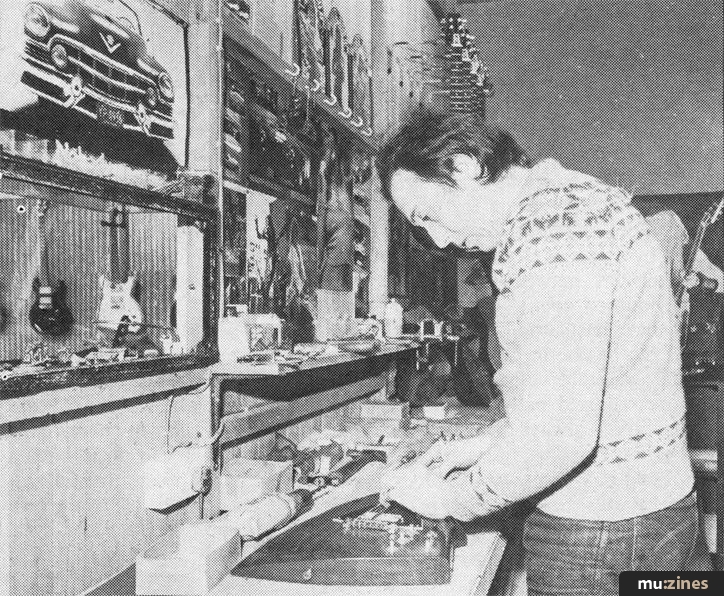
Geoff Gale pretends to adjust bridge in his new shop — see Gale Warning.
Gale Warning
Guitar maker Geoff Gale (see SI Nov '78) is now well ensconced in his new shop in Clifton, Bristol (above). Geoff sees the venture as a logical addition to his guitar making activity, and the shop now serves a number of purposes. Primarily it's a retail outlet for Gale guitars, of course, with the 'production' model doing very well at £295 including case and the dreaded VAT. But also it allows Geoff to buy and sell desirable old second-hand electrics and collectors' items generally, something for which he hopes to build a reputation. And it provides a showcase for the Gale custom guitars, and for the new guitars, accessories, guitar making equipment and woods which he'll gladly sell to you. 'Also,' explains Geoff, 'if anyone's got anything interesting I can put it on the wall and sell it for a commission.'
The shop is usually open from 11 to 4 on weekdays, and is at (Contact Details)0. If you have no joy there, Geoff can be contacted at his home workshop on (Contact Details). Or you can always try the Alma Tavern.
Frankfurt: A Visitors Guide
We don't print previews; we prefer to use space constructively and talk about new equipment when we've actually seen it. However, should you be visiting the Frankfurt Fair early this month, Sound International will of course be there to sample the ambience. Come along to Stand 37 in Hall 5 and say hello to Tony Bacon and Alan Griffiths. We promise to answer nicely.
Concept Corner No 1
There is. Real power, stunning tone, versatility: this combination pushed the DiMarzio company into an expansion position of sheet acceleration. The thrill rubbed off on the new products and the latest things to help you "cook" your sound are the result of the adrenalin that has poured in bucketfulls through the designers.
Recent advertiser's announcement from DiMarzio.
Publisher: Sound International - Link House Publications
The current copyright owner/s of this content may differ from the originally published copyright notice.
More details on copyright ownership...

Sound International - Mar 1979
Donated & scanned by: Mike Gorman
News by Mel Lambert, Dave Crombie, Chris Cutler, R Cane
Help Support The Things You Love
mu:zines is the result of thousands of hours of effort, and will require many thousands more going forward to reach our goals of getting all this content online.
If you value this resource, you can support this project - it really helps!
Donations for May 2026
Issues donated this month: 0
New issues that have been donated or scanned for us this month.
Funds donated this month: £0.00
All donations and support are gratefully appreciated - thank you.
Magazines Needed - Can You Help?
Do you have any of these magazine issues?
If so, and you can donate, lend or scan them to help complete our archive, please get in touch via the Contribute page - thanks!
If you're enjoying the site, please consider supporting me to help build this archive...
...with a one time Donation, or a recurring Donation of just £2 a month. It really helps - thank you!

 @mu_zines
 RSS Feed
 Blog
Blog