
Magazine Archive
Home -> Magazines -> Issues -> Articles in this issue -> View
Oberheim Matrix 12 Synth | |
Article from One Two Testing, June 1985 | |
layers a gogo

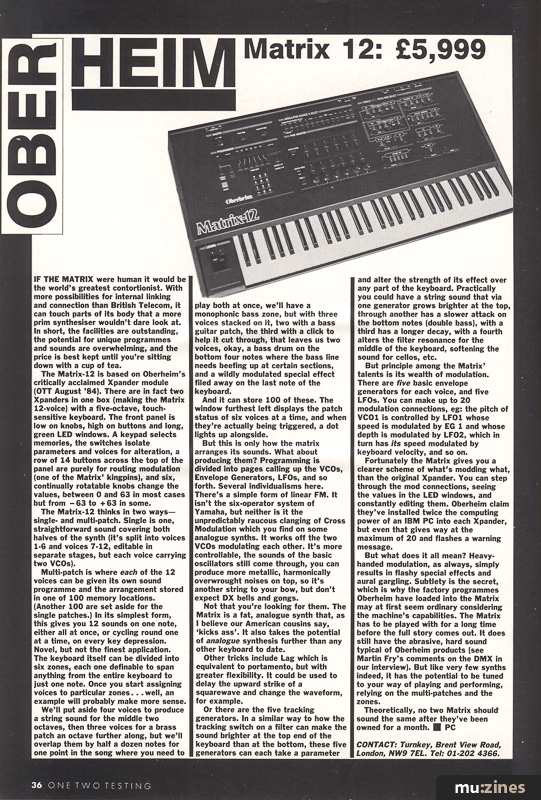
IF THE MATRIX were human it would be the world's greatest contortionist. With more possibilities for internal linking and connection than British Telecom, it can touch parts of its body that a more prim synthesiser wouldn't dare look at. In short, the facilities are outstanding, the potential for unique programmes and sounds are overwhelming, and the price is best kept until you're sitting down with a cup of tea.
The Matrix-12 is based on Oberheim's critically acclaimed Xpander module (OTT August '84). There are in fact two Xpanders in one box (making the Matrix 12-voice) with a five-octave, touch-sensitive keyboard. The front panel is low on knobs, high on buttons and long, green LED windows. A keypad selects memories, the switches isolate parameters and voices for alteration, a row of 14 buttons across the top of the panel are purely for routing modulation (one of the Matrix' kingpins), and six, continually rotatable knobs change the values, between 0 and 63 in most cases but from -63 to +63 in some.
The Matrix-12 thinks in two ways — single- and multi-patch. Single is one, straightforward sound covering both halves of the synth (it's split into voices 1-6 and voices 7-12, editable in separate stages, but each voice carrying two VCOs).
Multi-patch is where each of the 12 voices can be given its own sound programme and the arrangement stored in one of 100 memory locations. (Another 100 are set aside for the single patches.) In its simplest form, this gives you 12 sounds on one note, either all at once, or cycling round one at a time, on every key depression. Novel, but not the finest application. The keyboard itself can be divided into six zones, each one definable to span anything from the entire keyboard to just one note. Once you start assigning voices to particular zones... well, an example will probably make more sense.
We'll put aside four voices to produce a string sound for the middle two octaves, then three voices for a brass patch an octave further along, but we'll overlap them by half a dozen notes for one point in the song where you need to play both at once, we'll have a monophonic bass zone, but with three voices stacked on it, two with a bass guitar patch, the third with a click to help it cut through, that leaves us two voices, okay, a bass drum on the bottom four notes where the bass line needs beefing up at certain sections, and a wildly modulated special effect filed away on the last note of the keyboard.
And it can store 100 of these. The window furthest left displays the patch status of six voices at a time, and when they're actually being triggered, a dot lights up alongside.
But this is only how the Matrix arranges its sounds. What about producing them? Programming is divided into pages calling up the VCOs, Envelope Generators, LFOs, and so forth. Several individualisms here. There's a simple form of linear FM. It isn't the six-operator system of Yamaha, but neither is it the unpredictably raucous clanging of Cross Modulation which you find on some analogue synths. It works off the two VCOs modulating each other. It's more controllable, the sounds of the basic oscillators still come through, you can produce more metallic, harmonically overwrought noises on top, so it's another string to your bow, but don't expect DX bells and gongs.
Not that you're looking for them. The Matrix is a fat, analogue synth that, as I believe our American cousins say, 'kicks ass'. It also takes the potential of analogue synthesis further than any other keyboard to date.
Other tricks include Lag which is equivalent to portamento, but with greater flexibility. It could be used to delay the upward strike of a squarewave and change the waveform, for example.
Or there are the five tracking generators. In a similar way to how the tracking switch on a filter can make the sound brighter at the top end of the keyboard than at the bottom, these five generators can each take a parameter and alter the strength of its effect over any part of the keyboard. Practically you could have a string sound that via one generator grows brighter at the top, through another has a slower attack on the bottom notes (double bass), with a third has a longer decay, with a fourth alters the filter resonance for the middle of the keyboard, softening the sound for cellos, etc.
But principle among the Matrix' talents is its wealth of modulation. There are five basic envelope generators for each voice, and five LFOs. You can make up to 20 modulation connections, eg: the pitch of VCO1 is controlled by LFO1 whose speed is modulated by EG1 and whose depth is modulated by LFO2, which in turn has its speed modulated by keyboard velocity, and so on.
Fortunately the Matrix gives you a clearer scheme of what's modding what, than the original Xpander. You can step through the mod connections, seeing the values in the LED windows, and constantly editing them. Oberheim claim they've installed twice the computing power of an IBM PC into each Xpander, but even that gives way at the maximum of 20 and flashes a warning message.
But what does it all mean? Heavy-handed modulation, as always, simply results in flashy special effects and aural gargling. Subtlety is the secret, which is why the factory programmes Oberheim have loaded into the Matrix may at first seem ordinary considering the machine's capabilities. The Matrix has to be played with for a long time before the full story comes out. It does still have the abrasive, hard sound typical of Oberheim products (see Martin Fry's comments on the DMX in our interview). But like very few synths indeed, it has the potential to be tuned to your way of playing and performing, relying on the multi-patches and the zones.
Theoretically, no two Matrix should sound the same after they've been owned for a month.
OBERHEIM Matrix 12: £5,999
CONTACT: Turnkey, (Contact Details).
Also featuring gear in this article


Featuring related gear

Oberheim Xpander
(EMM Sep 84)

Oberheim Xpander Module
(12T Aug 84)

Xpand Your Horizons
(ES Oct 84)
Browse category: Synthesizer Module > Oberheim
Publisher: One Two Testing - IPC Magazines Ltd, Northern & Shell Ltd.
The current copyright owner/s of this content may differ from the originally published copyright notice.
More details on copyright ownership...

One Two Testing - Jun 1985
Donated by: Colin Potter
Review by Paul Colbert
Help Support The Things You Love
mu:zines is the result of thousands of hours of effort, and will require many thousands more going forward to reach our goals of getting all this content online.
If you value this resource, you can support this project - it really helps!
Donations for January 2026
Issues donated this month: 0
New issues that have been donated or scanned for us this month.
Funds donated this month: £0.00
All donations and support are gratefully appreciated - thank you.
Magazines Needed - Can You Help?
Do you have any of these magazine issues?
If so, and you can donate, lend or scan them to help complete our archive, please get in touch via the Contribute page - thanks!
Please Contribute to mu:zines by supplying magazines, scanning or donating funds. Thanks!
Monetary donations go towards site running costs, and the occasional coffee for me if there's anything left over!

 @mu_zines
 RSS Feed
 Blog
Blog