


Magazine Archive
Home -> Magazines -> Issues -> Articles in this issue -> View
Peavey Q231F Graphic Equaliser | |
Article from Sound On Stage, March 1997 | |
Paul White tries out Peavey's new graphic equaliser, which automatically displays the offending frequency when feedback occurs.
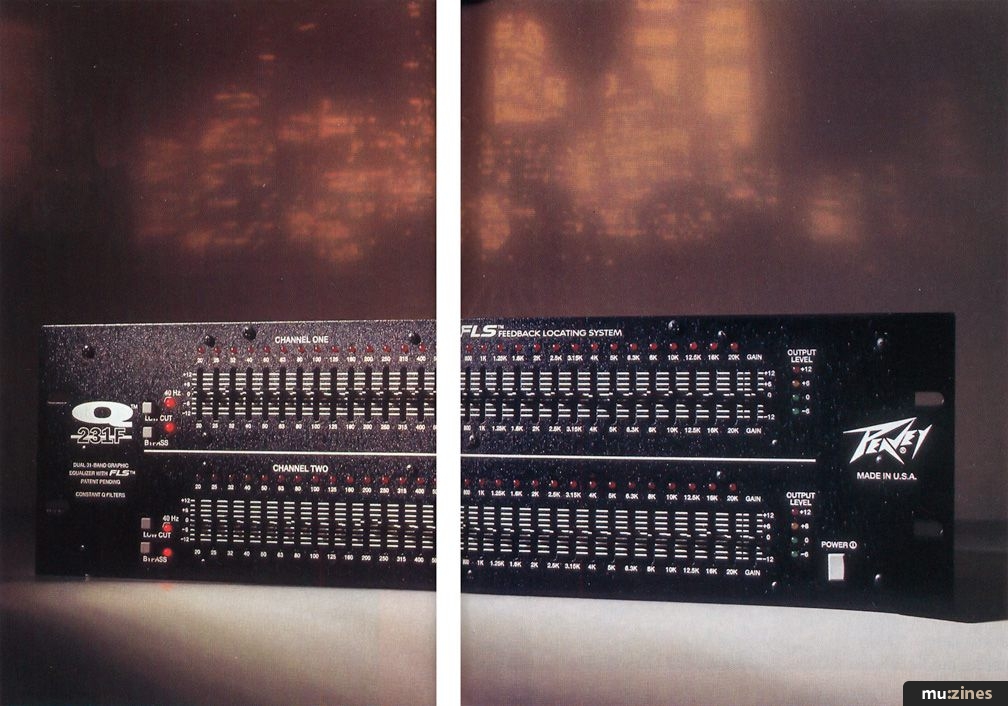
Graphic equalisers are an integral part of modern live sound systems, both in helping to compensate for difficult venue acoustics, and for attenuating frequencies prone to feedback. While EQ can never cure room problems or completely eliminate feedback, it can at least improve the subjective sound of a PA system in a difficult environment, and by carefully pulling back any frequencies prone to feedback, the system gain can usually be increased by a few valuable dBs. An experienced live sound engineer can usually identify which frequency band is feeding back, or ringing, purely by ear, but some of us could use a little help.
Peavey set out to provide that help by building the Q231F, a low cost, 3U rackmount equaliser with a feedback indicator LED over each frequency slider. The idea behind this is that if the LED comes on, there is an excessively high level of signal in that particular band. By increasing the system gain to the point where it feeds back, during the soundcheck, potential trouble spots can be identified and the relevant band faders pulled down a little to restore stability.
GRAPHIC DESCRIPTION
In most respects, the Q231F is a fairly conventional dual channel, 31-band graphic equaliser, covering the audio spectrum from 20Hz to 20kHz in third octave bands set at ISO standard centre frequencies. The filters are constant Q types (Q = 4.77). The use of a 3U case does mean that the unit is rather large, but the upside of this is that the controls are clearly labelled and in no way cramped. Overall, the construction is best described as tough but unglamorous, and the plain white legend shows up clearly against the black powder coated, mild steel metalwork. Both the input and output audio connections are on balanced jacks, but they may also be used unbalanced if required by plugging in an unbalanced jack. Mains is supplied via a detachable IEC mains cable, and the Power switch is on the front panel, although there is no power LED to tell you the unit is on.
Short travel, centre-detented faders are used to control the cut or boost within each band; separate faders are provided for each channel rather than being ganged for stereo operation. Having a single set of stereo faders makes setting up much quicker in most situations, but Peavey's approach — making the two channels independent — provides the freedom to use one channel of equalisation, for example, in the feed to a mono PA and the other in the feed to a mono stage monitoring system.
The feedback detection system operates very simply. A red feedback LED mounted above each slider is illuminated when the signal in that frequency band exceeds an internally set threshold. Consequently, it is necessary to have a healthy signal level passing through the equaliser before any LEDs will come on, so it sometimes helps to turn the mixer outputs up and the power amplifier inputs down.
In addition to the two rows of frequency sliders, there are separate bass cut and bypass switches for each channel, both with status LEDs. The high-pass filter provides a 12dB/octave roll-off at 40Hz to prevent sub-bass frequencies from using up amplifier and speaker power unnecessarily. A 4-LED output level meter is fitted to each channel covering the range -6 to +12dB, and a gain slider with a ±12dB range is located at the end of each row of frequency sliders. This would normally be used to compensate for any gain increase or loss caused by the application of filtering. The maximum input and output level of 18dB means the Q231F can be operated at both +4dBu and -10dBm without undue compromise.
"... the Q231F is good value, it performs well, and the feedback detection system is a genuinely useful innovation."
IMPRESSIONS
On sound, the Q231F compares well with most other well-designed, low to mid-price graphic equalisers and provides suitably precise control without adding any appreciable amount of noise or undesirable tonal artifacts. Setting up can take a while, purely due to the number of faders involved in two channels of EQ, and for those working with a stereo PA, a version with a single row of stereo faders would make more sense, as well as taking up less space. Perhaps Peavey might consider adding such a unit to their range?
Although the feedback location system is very simple in concept, it is actually very helpful. Unfortunately, it is only really usable when ringing out the system during the soundcheck. Once music is passing through it, the display can't really tell you what is music and what is feedback. As it stands, only full bodied feedback tends to get picked up — ringing is usually low enough in level not to trigger the LEDs. This being the case, I feel the designers should consider putting a global threshold control on the LED feedback detectors so that the threshold could be reduced whenever insufficient level is available to generate a display. Some restraint is necessary when using the equaliser to notch out potentially troublesome frequencies as you can find yourself pulling down too many faders and ruining the sound. Once the first couple of feedback frequencies have been dealt with, it's probably best to call it a day — things will usually get better when the audience comes in anyway!
On balance, the Q231F is good value, it performs well, and the feedback detection system is a genuinely useful innovation. It isn't a universal panacea for feedback, but it will help you claw back a few dB of gain. I still feel the unit could have been built into a 2U rack rather than the 3U it now occupies, but at the price, I'm not going to complain too much.
Q231F £399.95 inc VAT.
Peavey Electronics Limited, (Contact Details)
pros & cons
pros
- Sensibly priced.
- Simple feedback detection system.
- Roadworthy construction.
cons
- Rather large.
summary
A useful graphic EQ for combating feedback problems in FOH or stage monitoring applications, with the added benefit of visual feedback frequency indication.
Publisher: Sound On Stage - SOS Publications Ltd.
The contents of this magazine are re-published here with the kind permission of SOS Publications Ltd.
The current copyright owner/s of this content may differ from the originally published copyright notice.
More details on copyright ownership...

Sound On Stage - Mar 1997
Review by Paul White
Help Support The Things You Love
mu:zines is the result of thousands of hours of effort, and will require many thousands more going forward to reach our goals of getting all this content online.
If you value this resource, you can support this project - it really helps!
Donations for May 2026
Issues donated this month: 0
New issues that have been donated or scanned for us this month.
Funds donated this month: £0.00
All donations and support are gratefully appreciated - thank you.
Magazines Needed - Can You Help?
Do you have any of these magazine issues?
If so, and you can donate, lend or scan them to help complete our archive, please get in touch via the Contribute page - thanks!
If you're enjoying the site, please consider supporting me to help build this archive...
...with a one time Donation, or a recurring Donation of just £2 a month. It really helps - thank you!

 @mu_zines
 RSS Feed
 Blog
Blog