


Magazine Archive
Home -> Magazines -> Issues -> Articles in this issue -> View
Raising The Standard | |
Article from Music Technology, June 1991 | |
As MIDI expands its influence, guidelines for improved compatibility between instruments are emerging. Vic Lennard examines the new General MIDI spec and Roland's proprietary GSS system.
If you haven't seen them already, prepare to have to deal with two more MIDI abbreviations - GM and GS - because they're about to change the way we use MIDI.
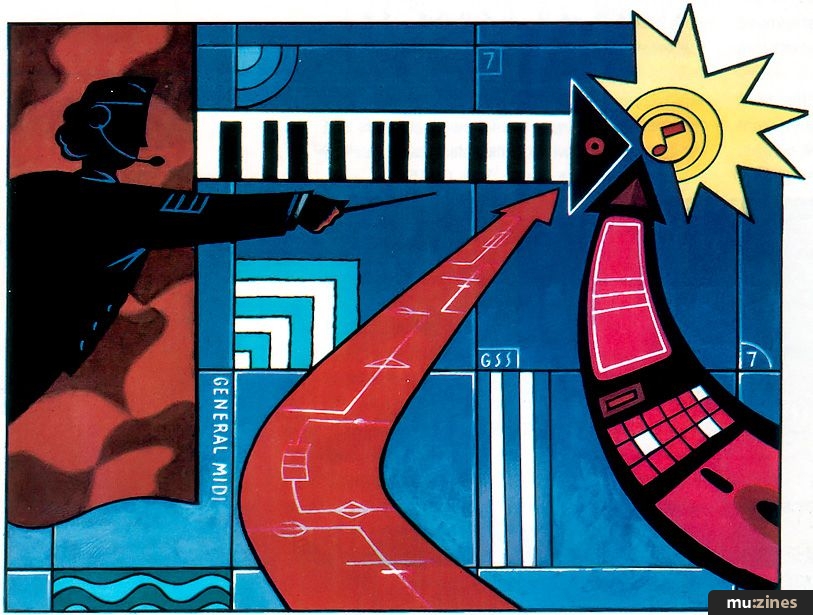
THE ORIGINAL REASON Dave Smith (then Sequential's president) was inspired to invent MIDI was to enable a number of synths to be connected together so that one could be used as a master controlling a number of slaves. It seems a pretty unambitious start to a system that now forms the heart of most of our musical setups (we're now inclined to take it for granted), but the alternative methods of the day were various Control Voltage and Gate systems and manufacturers' proprietary communication busses. Result: complete incompatibility between different companies' instruments.
MIDI has come a long way since its invention in 1983, especially when considered in the context of multitimbral synths. It's doubtful whether a 30-note polyphonic synth module capable of playing eight different parts on different MIDI channels, along with a full drum kit and onboard effects, could even have been envisaged in those days, but today it's a reality.
There has been much talk of a "MIDI 2" system over the years, but it's worth taking into consideration that MIDI is fast enough to fool most of us into believing that five notes being played as a chord on a keyboard is actually a chord - even though the sound source is actually playing a very fast arpeggio. Unless a high degree of aftertouch or pitchbend are being used, it is rare to hear delays in MIDI (many sound modules have a reaction time in excess of 15 milliseconds or so, masking any MIDI delay). In fact, the micro-processor on most multitimbral units is under such strain that switching between screens causes an audible glitch.
There is one area where improvement could be made, however, and that's in the compatibility of song files between different synths. There's little point in recording a song onto your sequencer using, say, an acoustic piano sound, when playback on another system produces the same tune apparently played by an Irish piper on acid.
More seriously, you may run into problems such as insufficient polyphony because the synth you've used has 16 notes available while the house synth at the studio where you're recording only has 12-note polyphony. There's every likelihood that you've used MIDI Program Changes in your song which correctly select the sounds on your synth, but call up a totally different selection on a different unit. That marvellous slurred brass stab with the four-semitone pitchbend now slides over an octave due to the different pitchbend range. And how about playing back a drum track with bass drum and snare drum and getting cowbell and crash in their place? The problems are practically endless.
GM PHILOSOPHY
A PROPOSAL DEFINING a minimum capability for synths has been fine-tuned over a period of time and finally proposed and passed by the MIDI Manufacturers Association (MMA) in America. Called General MIDI (GM), it's aimed at improving the above situation, and also opening the MIDI format for commercial exploitation. Historically, MIDI has limited appeal, due partly to its relative complexity against, for instance, a CD player where you simply place a disc in a slot and press Play. If MIDI Files adhered to some standard and a MIDI File player could be used to play them in a similar way to a CD player playing CDs, a new market could be created around MIDI File disks.
GM FEATURES
AS GM HAS only been passed by the MMA and is currently being scrutinised by the Japanese MIDI Standards Committee (JMSC), in-depth details cannot be revealed just yet. However, a reasonable overview can be given.
First, and most superficial, a synth which conforms to General MIDI will have the GM logo on its casing. General MIDI is intended to be a mode which can be turned on, meaning that there can be more features to a synth which could be used outside of GM. In fact, there's already a MIDI message for turning GM on and off.
GM has no dictate over the method of synthesis. Analogue, digital, FM, LA - this aspect of an instrument, correctly, remains completely in the hands of the manufacturer. What is specified is the polyphony of a GM unit - this is currently 24 voices, dynamically allocated to save the problems of having to set reserves for the parts playing. Depending on the manner of synthesis, the drum part may effectively be a separate unit within the sound module, so there is the option for 16 of the voices to be dedicated to the synth parts and eight voices to the rhythm section, or to have all 24 voices accessible by both the melodic and percussive sounds. Obviously, all 16 MIDI channels must be accessible, with different instruments available on each. While it's currently undecided whether specific MIDI channels will be designated for specific types of sound, MIDI channel 10 will always be used for key-mapped percussion.
On the hardware front, GM synths are likely to be quite sparse, with a master volume on the front, MIDI In/Out/Thru connectors and stereo audio out on the rear, plus a headphones socket.
The mainstay behind GM is the tone mapping. There are 128 timbres, or instruments, available and each can be accessed via a specific MIDI Program Change numbered 1-128, not 0-127 as is the norm with MIDI. For example, Program Change #17 might call up a flute, but that doesn't mean that the flute sound has to be sound #17 in a synth. The proviso is that it is assigned to MIDI Program Change #17, so manufacturers can tailor the order of the internal sounds as they wish. Consequently, if this Program Change is selected within a song, it will always call up a particular sound on a GM synth. A similar situation occurs with key-mapped percussion. Single instruments are designated for a range of keys and include Latin percussion.
A further problem is the manner in which the different timbres respond. For this, there is a Voice Definition Table which specifies the MIDI key range, velocity range and envelope characteristics for each timbre. This prevents the situation arising where the instrument is correctly named, but has the wrong response. For example, having played in a lead line on a synth sound with a fast attack, the last thing you want is to have playback on a similar sound but with a slow attack. The entire line would sound out of syne with the song. To help in this department, the table will also include the relative loudness at a given MIDI volume level.
The more common of the MIDI Controllers have been specified, and the likes of Pitch Bend range and Volume have definite default values. Whether the manufacturers who use an All Notes Off command after a Sustain Pedal Off (to make the sustain pedal work as a hold pedal) will be allowed to continue with that practice remains to be seen - personally, I hope they will not.
ROLAND GSS
WHILE GM IS intended to be perfect for the consumer market, due to its inherent simplicity, it has severe limitations, not least of which is the total number of timbres. As a result, Roland have already implemented their extension to GM and called it GSS (General Synth Standard). This has the ability to have up to 128 banks each of 128 timbres through the recently-defined MIDI Bank Select command.
The first bank of timbres are called the Capital Tones and coincide with the GM bank. To prevent the limitation of one instrument being represented by one tone, there can be up to seven other tones which are variations on their Capital Tone in terms of certain parameters like envelope or brightness. If the differences are going to be more substantial, then Sub Capital Tones are also defined, again based on a specific Capital Tone. For example, you could have a synth bass as the Capital Tone and a different synth bass as the Sub Capital Tone. The way in which Capital, Sub Capital and Variation Tones are distributed among the banks is in a fixed manner so that should you record a song using a GSS synth and playback on a GM synth, the MIDI Program Changes will point back to the relevant Capital Tone.
One important aspect of GSS is the use of Non-Registered MIDI Controllers in place of System Exclusive for the editing of Tone parameters such as filter and envelope. Provisional GSS equipment has already been shown at this year's Frankfurt Music Fair. The first is the SC55 Sound Canvas, a 1U-high, half-width sound module with remote control, 315 LA sounds, nine drum kits and built-in digital reverb and chorus. It even includes an audio input which can be mixed with the sounds being generated internally and output from just one pair of outputs. The SB55 Sound Brush is a Standard MIDI File record and playback device using 3.5" disks.
MIDI FILES
IT IS BECOMING common practice for companies to offer MIDI sequences and songs on IBM PC format disks. These are compatible with the Atari ST and can also be loaded into the Apple Macintosh by using the Apple File Exchange program. Caution should be exercised with these, however, as any of these disks will have been programmed before the precise details of GM were known, and so they are unlikely to have the correct tones assigned to the MIDI Program Change numbers. Depending on your playback unit, this may not matter too much, but it's likely that we'll see MIDI File playback devices appearing on the market at around the same time as the first GM devices and the ability to edit on these will be severely limited. Even if you can alter the Program Changes, it's very unlikely that you will be able to change the drum mapping without using a serious piece of sequencing software on a computer - hardware sequencers just aren't cut out to handle that type of editing.
While the powers that be have some control over the contents of a synth containing the GM logo, they can't stop non-members from abusing the system. It would be nice to think that correctly-produced disks for General MIDI will also have the GM logo on them but, again from a personal standpoint, I doubt it. The best approach when dealing with these is to be prepared to ask.
THE FUTURE
IF GM IS nurtured correctly, the word MIDI could be on the lips of millions of people within a couple of years. The idea of a MIDI File player resembling a CD player is not all that fantastic - remember, 3.5" disks cost a lot less than CDs.
Various technologies are currently within our grasp. CD+MIDI is one such innovation. Here MIDI information is encoded within a disk to provide combined playback of audio and MIDI information. Satellite MIDI is another concept under discussion. Here the equivalent of a radio plays back MIDI songs, and anyone will be able to select which of their GM synths are used for the playback of particular songs. Satellite MIDI may sound a little far fetched right now, but it may be the acceptance of this and similar concepts that will take MIDI into the 1990s and beyond the year 2000.
More with this topic
 Managing MIDI |
 Technically Speaking |
 Taking Control - Using MIDI Continuous Controllers |
 MIDI Timing Delays - Software & Hardware Thrus |
Get Organised! - Keeping Track Of MIDI Connections |
 Standard MIDI Files - In Search Of The Truth |
 The Integration Game - Improving your MIDI Environment (Part 1) |
 MIDI and the Micro |
 Drum Role - An application guide to Roland electronic percussion |
 Technically Speaking |
 MIDI 2.0 Is Here! |
 Radio Days - Technology On The Air |
Browse by Topic:
MIDI
Publisher: Music Technology - Music Maker Publications (UK), Future Publishing.
The current copyright owner/s of this content may differ from the originally published copyright notice.
More details on copyright ownership...
Music Technology - Jun 1991
Feature by Vic Lennard
Previous article in this issue:
Help Support The Things You Love
mu:zines is the result of thousands of hours of effort, and will require many thousands more going forward to reach our goals of getting all this content online.
If you value this resource, you can support this project - it really helps!
Donations for April 2026
Issues donated this month: 0
New issues that have been donated or scanned for us this month.
Funds donated this month: £0.00
All donations and support are gratefully appreciated - thank you.
Magazines Needed - Can You Help?
Do you have any of these magazine issues?
If so, and you can donate, lend or scan them to help complete our archive, please get in touch via the Contribute page - thanks!
If you're enjoying the site, please consider supporting me to help build this archive...
...with a one time Donation, or a recurring Donation of just £2 a month. It really helps - thank you!

 @mu_zines
 RSS Feed
 Blog
Blog