


Magazine Archive
Home -> Magazines -> Issues -> Articles in this issue -> View
Staccato Mg Bass | |
BassCheckArticle from International Musician & Recording World, June 1986 | |
Dave Burrluck on Staccato's affordable, hi-tech instrument
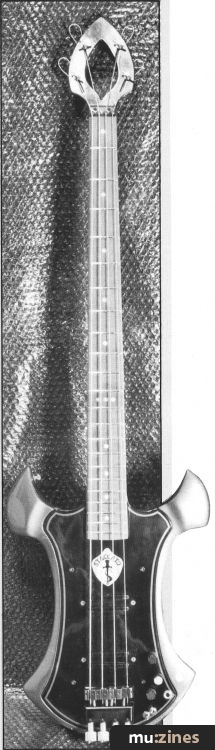
There aren't many people willing to experiment with new designs and materials who are making instruments in the UK at present.
It is to Staccato's credit then that they're still in business in an industry that seems to like change as much as Europe likes our football fans! Quite a few people may have thought Pat Townshend and Chris Jagger were developing an instrument that would have seen them following the same path as Jim Burns and Dan Armstrong before them — good ideas but no future, especially financial.
Pat's first production instruments featured interchangeable necks and a fairly total re-design of the guitar as we know it, all at a price in excess of £1,300. The development of the Mg bass, therefore, comes as a welcome surprise and one that could ensure Staccato's future. Priced at £977 it isn't cheap but all the important 'hi-tech' features remain at the expense of the innovative but limited appeal modular neck and probably too advanced electronic spec of the originals.
Economies may have been made from the original design but the important thing is that the Mg retains all the basic design elements that place Staccato at the front of hi-tech guitar design.
Staccato are now being distributed through Mike Cooper which should ensure that they reach the correct retail outlets. This is combined with a move to new and larger workshops in Norfolk where Pat and his few employees will be producing the Mg bass. As with the previous model the Mg is assembled, setup, lacquered and polished at the workshop while all the basic moulding and machining is farmed out to specialists. At present, production is around the 20 a month mark but there is facility for double that should enough interest be generated.
Construction
On the face of it the Mg has changed little from its predecessor; certainly the basic shaping and style is the same. The instrument is still made in two basic parts — a magnesium alloy casting forms the basis of the instrument and the neck, head and centre body section which is attached to the body via four Allen-keyed bolts. The body is made from an outer Fibreglass shell filled with polyurethane foam resulting in a very strong but light construction. When the two parts are separated you realise just how small the body is – just something to cover the bottom of the casting, and something to hang a strap on!
The shaping of the body is one of its most radical aspects; you either love it or you don't, but distinctive it certainly is. 12 colour options are available including two-tone finishes such as blue and purple pearl and red and gold. The samples I've seen show off this cellulosed based finish to the full; after all the Mg is no ordinary instrument so why give it an ordinary finish?
The neck and central spine is the business part of the Staccato – to it all the fittings are attached. The shape of the neck is good with a deepish oval contour. A matt black carbon-fibre based reinforced plastic fingerboard is actually screwed to the neck (allowing a re-board rather than a re-fret) and features 22 wide and flat 2.5mm frets.
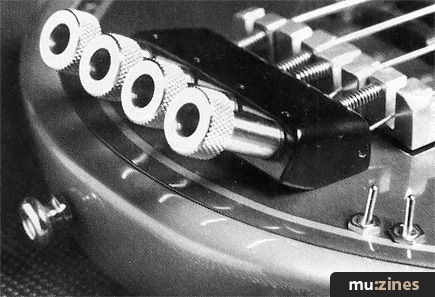
This end tunes...
Each one has been finely polished but then it should be on an instrument of this price. Pearl dots are standard on the Mg although abalone is offered as an option as well as fibre-optic markers. As it stands, pearl ones are fine! The headstock shape is the now familiar oval-ish design with the centre portion removed to reduce weight. Although we have a headstock the actual tuners are fitted at the body end of the bass so the head only houses the locking points for each string. This arrangement simply has a groove through which the string end passes over which a screw clamps down to lock it in place. The screw has a 'T' bar for ease of use. When the string is secured, the end can be clipped off and passed back into another hole in the head giving a very neat appearance.
The nut system remains the same with a small individual saddle for each string which can be adjusted for height via a small screw placed behind the nut.
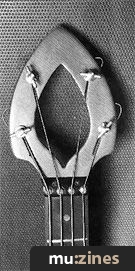
...this one locks
If you thought the adjustable nut was neat then wait for the tuning system! Visible we have four individual saddles finished in anodised blue (the saddle colour will match the colour scheme of the rest of the guitar as will the individual nut pieces) each adjustable for height via two grub screws. The saddle has a roller bearing over which the string passes and is held into the tuning assembly with a single Allen-keyed bolt which also serves as the intonation adjustment, accessed from the front of the saddle. Protruding from the rectangular black base section are the four stainless steel tuners themselves. They are thrown up at an angle of 30 degrees or more for ease of use. Each string passes through the end of a tuner which has a long shaft with a knurled end for easy adjustment. Inside this is the thread on which the system works. Simply turn the tuner clockwise and the threaded interior which holds the string passes up the shaft and raises the pitch and vice-versa. Certainly the system is very accurate and works well – a lot easier to use than to describe! The whole unit is very compact and while similar to the Steinberger method with the lateral thread providing a high gear ratio, the Staccato system does seem to have the edge. Certainly once tuned the bass remains very stable and any adjustments necessary are precise and easy to execute.
Pickups and Electronics
The Mg features two rather unusual Kent Armstrong pickups. The high impedance humbucking design has twin bladed pole-pieces which are the only visible part of the unit. The bulk of the pickup is hidden under the surface of the cast spine and is typically encapsulated in black resin with height adjustment via two small bolts at the side of the unit.
The original Mg bass featured a simple passive wiring harness, but the production models, due to consumer request, now feature an all-active system. Three controls are visible – volume, passive/active pan-pot and pickup pan-pot with a centre detent indicating both pickups full on. Two mini-toggle switches take care of humbucking/parallel humbucking mode for each pickup.
It is the active/passive pan-pot (middle knob) that is the neat part of the system. Powered by a 9 volt PP3 battery for approximately 50 hours use the circuit features a three-band Eq with ± 20dB cut/boost. The setting of the three bands is achieved via three trim pots mounted internally on the circuit board. In use the control pans from passive (knob full on) to active tone (knob full off.) The advantages are obvious in that the degree of active 'sound' can be added gently to the overall tone giving subtle or extreme tonal change. The factory setting on the sample I tried boosted mainly the top and middle frequencies to some extent as well as improving the overall level and clarity but with such a degree of change available you can very easily pre-set the tone to suit your personal requirements.
Sounds and Playability
Obviously any active circuit is a compromise between maximum tonal variation and minimum controls. The options available on the Mg give a wide range of tones without altering the pre-set Eq, from deep passive bass to a toppier more fashionable 'click' with the active in. The pickup selections provide a wide change too with the pan-pot giving much more subtlety than a switch would. The series/parallel switches, however, are possibly too subtle – the difference between modes is not very pronounced although a slight phase character can be achieved with the switches in parallel mode and the pan-pot in centre position with both pickups full on.
The circuit offered here certainly provides more than necessary tonal change via the pre-set trim-pots. However, if the trim-pots were accessed via a small cover plate on the face of the instrument then setting the sound in a recording situation could be made a lot easier – you wouldn't have to dismantle the guitar – and it would therefore be more useful. As it stands a player can easily tailor his/her sound to match a specific amp set-up at the expense of being able to add 'a bit more top' etc without a fair bit of fiddling about, although at least it is actually possible.
However, the overall quality is superb – the sustain is brilliant and you have to over-damp to avoid overtones which you wouldn't normally encounter on a wooden bass.
The actual playing of the Mg takes a bit of getting used to. The small body doesn't make it particularly good for seated playing – especially slapping style – and the bass is a bit neck heavy when suspended with a strap. However, one man's meat is another man's poison as they say and the Staccato won't appeal to everyone in every aspect. Personally I found the instrument to be of the highest quality in terms of sound and tonal design, although ergonomically I felt more work needs to be done. I don't see the point of going for a strong visual design if it is at the expense of playing comfort.
Another initial problem was that of microphonic tendency enhanced by the direct contact of the pickups on the cast alloy spine. Thankfully this has been solved by inserting a few rubber washers in the pickup mounting assembly.
Conclusion
It is all very well applauding the design of this instrument but it must be said that its appeal will be limited. The design concept attempts to provide an instrument with purposeful improvements over the standard fodder that's on offer. Anything of course that is so different and specialised is bound to meet resistance, especially in this country where guitarists are slow to embrace new technologies, especially if it doesn't have a Fender style body or is played by Mark King.
However, this year's Frankfurt show saw Staccato attracting great interest, especially in terms of sales as well as a possible licensing deal for a mass produced mag-alloy bass. More now than ever the guitar industry needs innovation, something that the Mg bass has in abundance!
RRP: £977.50
| Scale Length (in mm's) | 862 |
| Width of Neck at nut | 39 |
| Width of Neck at 12th | 54 |
| Depth of neck at 1st | 22 |
| Depth of neck at 12th | 25 |
| String spacing at nut | 30.5 |
| String spacing at bridge | 58 |
| String action as supplied at 12th | |
| Treble | 3.0 |
| String action as supplied at 12th | |
| Bass | 3.5 |
Publisher: International Musician & Recording World - Cover Publications Ltd, Northern & Shell Ltd.
The current copyright owner/s of this content may differ from the originally published copyright notice.
More details on copyright ownership...

International Musician - Jun 1986
Review by Dave Burrluck
Help Support The Things You Love
mu:zines is the result of thousands of hours of effort, and will require many thousands more going forward to reach our goals of getting all this content online.
If you value this resource, you can support this project - it really helps!
Donations for August 2026
Issues donated this month: 0
New issues that have been donated or scanned for us this month.
Funds donated this month: £0.00
All donations and support are gratefully appreciated - thank you.
Magazines Needed - Can You Help?
Do you have any of these magazine issues?
If so, and you can donate, lend or scan them to help complete our archive, please get in touch via the Contribute page - thanks!
Please Contribute to mu:zines by supplying magazines, scanning or donating funds. Thanks!
Monetary donations go towards site running costs, and the occasional coffee for me if there's anything left over!

 @mu_zines
 RSS Feed
 Blog
Blog