


Magazine Archive
Home -> Magazines -> Issues -> Articles in this issue -> View
Article Group: | |
Tanrak Digital Delay/Sampler | |
Studio TestArticle from International Musician & Recording World, August 1986 | |
The sampler you can fit in your rack sampled by Tony Reed
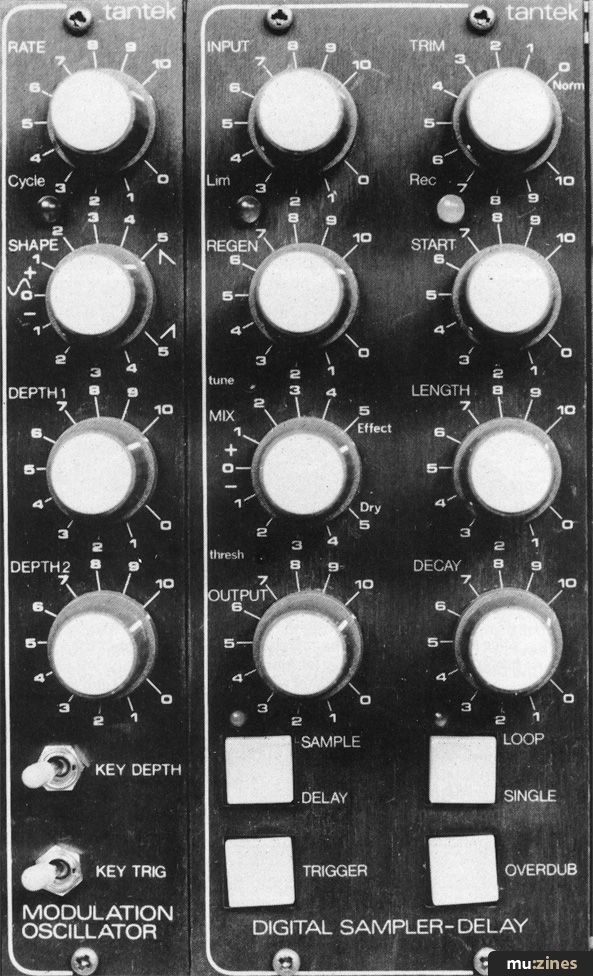
The sampler, and the all important Mod. oscillator.
As regular readers of IM&RW will already know from our September'85 review, Tantek's Tanrak is a modular effects system along the lines of the pro Scamp or Rebis racks, but aimed specifically at the needs (and budgets) of home and semi-pro recordists.
Since we last looked at the range (available ready-built or if you're feeling keen, in kit form), things have been happening in Tantekland. In the first place, the original yuk-brown finish of all the sturdy steel units has been substituted for a nice shade of black, which goes much more tastefully with their orange pots and legending. There've also been a few additions to the original ten units. Joining the existing Gates, Comp/lims, Delays, Eqs and the rest are an Infinite Flanger, a Mike Preamps Mixer, and Tantek's most ambitious module so far, a Digital Delay/Sampler.
Like its companions, the Delay/Sampler follows a standard 4U-high format, designed to slot into a 19" rackmounting/free standing combined sub rack and power supply. Unlike its companions, though and befitting its special status, it is a double-width unit, taking up two of the eleven spaces available in each subrack. In either delay or sampler mode it offers 1.4 seconds of sound at a pretty good 15kHz bandwidth, stretchable to a maximum 8 seconds at reduced bandwidth, and a dynamic range of 72dB stretched to a maximum 87dB by the builtin limiter. In sampler mode, sounds can be triggered by front panel Trigger, by a footswitch plugged into the rear Gate jack socket, or played over a maximum six octaves by a CV and Gate equipped synth connected to the relevant rear-panel sockets. Connecting a drum pad to the rear panel Audio In allows a stored sample to be played dynamically, and connecting an audio source to the same socket (say, a bass drum track off your portastudio) will also trigger the unit, opening up the possibility of 'replacing' sounds after they've been recorded, á la AMS.
A pretty impressive spec for such a relatively cheap gadget, I think you'll agree. Can it deliver in use?
Front Panel
For all of the sophistication of its function, front panel layout is admirably clear. The eight pots which dominate the top two thirds of the panel fall into two camps — the four on the left governing input and output through the unit, those on the right, manipulation of the actual sample or delay.
Top left is the Input pot and associated Limiter LED — connect an audio source to the rear panel audio in, and adjust the Input until the LED flickers on and off. If it doesn't light at all, the input is too low, if it glows continuously, it is too high, and the action of the limiting circuitry may become noticeable. In practice, the input sensitivity was very broad, accepting everything from an un-pre-amped mike to a synth line out. The limiter made it very hard to overdrive the input. Beneath this is the Regen pot, used to set sustain of the echo effect, the Mix pot (from all effect to all source) and an Output control.
At the head of the right-most four pots, we find the Trim control, used in Delay mode for fine tuning delay times, and in Sampler mode to set the sample time ('Norm' gives the maximum bandwidth, minimum time setting of 1.4 seconds.) Once a sample has been taken, this control is also used to tune it up or down.
Beneath this is the Start pot, used to set where in the available sample memory playing will begin — effectively allowing you to edit forwards through the sample, to isolate the start of a drum sound, say, or to store a number of short, discrete samples simultaneously. Length, unsurprisingly, sets sample duration from the start point, and thus allows you to progressively chop off the end of a sample. Used in conjunction with the Start control, any portion of the memory contents can thus be 'sandwiched'.
The final pot, Decay, imparts a controllable amount of 'natural' decay to any sample, to mask an abruptly-ending string sound, say.
Switching between Sample and Delay is achieved with the top left of the four momentary-contact tablet buttons. On Power up, the Unit defaults to Delay mode. A press of the button, and you flip to sample, with a little green LED telling you so. Next to this you'll find the Loop/Single button (the LED lights up in Loop mode), and beneath them, the Trigger, and Overdub button.
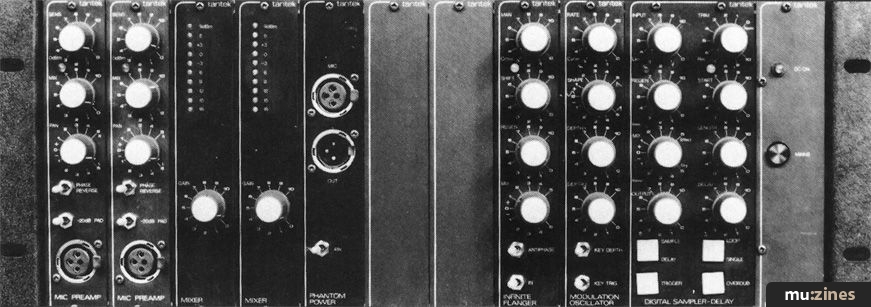
Racked up and ready: the newcomers to the Tanrak range
In Use
As a delay, the unit benefits enormously from pairing with another Tanrak effect, the Modulation Oscillator. With this, the whole gamut of modulation-based delay effects are possible — Chorus, Flanging, and the rest. Without it, you're restricted to straightforward repeat echoes, from very short ADT effects, to long slapbacks. Use of the Regen control will extend that flexibility a little, giving 'bath-tub reverb', and near-infinite multiple repeats. Within the limitations of this basic operation, the unit performs very well indeed, but it is as a sampler that it comes into its own. Operation couldn't be simpler. Entering Sample mode immediately prepares the unit for recording, indicated by the large LED beneath the Trim control turning yellow.
Recording can be initiated in a number of ways — from the front panel Trigger button, from a footswitch, from a CV/Gate synth, or as soon as an incoming signal passes a preset Threshold level (this can be altered by adjusting the preset screw, accessible through a small hole on the front panel.)
While recording, the large LED turns red, and when complete, reverts to green, at which point the captured sound can be edited, tuned, or played back in the ways already described.
I made successful samples from the line out on a synth, a microphone, and from a cassette deck, using both auto and manual triggering.
The simplest method of playback is Single, or one-shot, with the only editing usually required being a tidying up of the front and back of the sound — fine for drum sounds. For more sophisticated sustained sounds, you'll need to go into Loop mode, and search through the sample for a likely glitch free Loop point. Setting Length too and slowly advancing the Start pot will do just that, making editing a simple and instinctive business.
Triggering of a sampled sound worked equally well regardless of the method used — I was particularly impressed with the Tanrak's ability to accurately track a fast MC202 sequencer pattern across three of the maximum six octaves available (though the musicality of a sample taken so far away from home is debatable!) A nice touch: Each time a looping sample is gated, a length of sample at zero memory will be played before the loop, thus retaining the initial attack. Looping still functions during the decay of a sample too, so some very natural extended sounds can be created. (One tip: I found overdriving the input slightly, causing the limiter to 'flatten' out the sound, improved my chance of getting a glitch-free sample.) Hitting Overdub lets you layer subsequent samples over those already in memory, in exactly the same way as the initial recording, allowing complex composite sounds to be created, though there is an unavoidable trade-off in signal quality for each new recording.
Unfortunately there is no way to store your samples, other than record the signal from the audio out, but you can't have everything, I suppose.
Summing up
I was very impressed with the flexibility and fidelity of this device, it far outstrips anything else currently available within this price range for user-friendliness, and brings some quite sophisticated techniques within range of the home recordist. (Especially the triggering off tape...)
The promised memory expansion add-on should make it an even more attractive proposition later on in the year, but for now the only real caveat is whether or not you want to commit yourself to the Tanrak system — you'll need the subrack, probably want the modulation oscillator, and still be left looking at a lot of awfully tempting open spaces...
PRICES
| Kit | Built | |
| Digital sampler/Delay | £219.95 | £299.95 |
| Sub rack | £39.95 | £47.95 |
| Power Supply | £33.95 | £42.95 |
| Modulation Oscillator | £39.95 | £55.95 |
*All prices inc. VAT & Postage (UK)
Further info on these and the rest of the Tanrak range from Tantek, on: (Contact Details).
Also featuring gear in this article

Stack In A Rack - Tanrak System (Part 2)
(EMM Aug 86)

Tantek Digital Sampler-Delay
(SOS Sep 86)
Browse category: Studio/Rack FX > Tantek
Publisher: International Musician & Recording World - Cover Publications Ltd, Northern & Shell Ltd.
The current copyright owner/s of this content may differ from the originally published copyright notice.
More details on copyright ownership...

International Musician - Aug 1986
Recording World
Review by Tony Reed
Previous article in this issue:
Next article in this issue:
Help Support The Things You Love
mu:zines is the result of thousands of hours of effort, and will require many thousands more going forward to reach our goals of getting all this content online.
If you value this resource, you can support this project - it really helps!
Donations for May 2026
Issues donated this month: 0
New issues that have been donated or scanned for us this month.
Funds donated this month: £0.00
All donations and support are gratefully appreciated - thank you.
Magazines Needed - Can You Help?
Do you have any of these magazine issues?
If so, and you can donate, lend or scan them to help complete our archive, please get in touch via the Contribute page - thanks!
Please Contribute to mu:zines by supplying magazines, scanning or donating funds. Thanks!
Monetary donations go towards site running costs, and the occasional coffee for me if there's anything left over!

 @mu_zines
 RSS Feed
 Blog
Blog