Reviews
(IM Dec 86)


Magazine Archive
Home -> Magazines -> Issues -> Articles in this issue -> View
Article Group: | |
Tascam 246 Portastudio | |
StudiotestArticle from International Musician & Recording World, December 1985 | |
A dream or a mere luxury?

Last year it seemed like the trend in portastudios was towards the lower end of the market, or to put it more politely, towards the songwriting aspect of home recording. If Tascam's new portastudio, the 246, is about to set a new trend it will be in the opposite direction, in favour of the home user who is actually interested in producing demo-quality, or perhaps even master quality four track recordings.
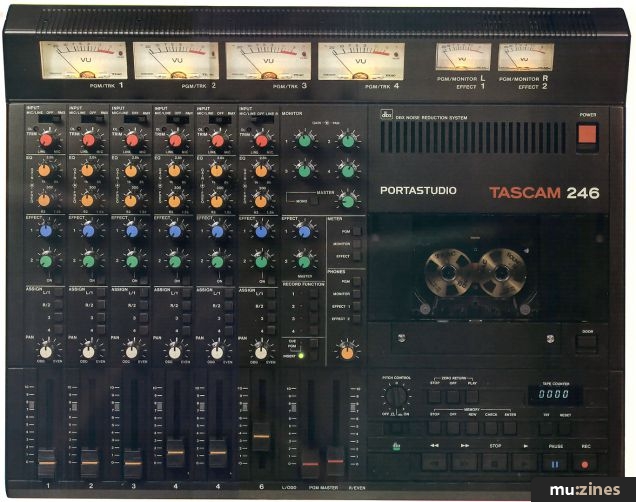
The 246 has been designed primarily with a luxury market in mind; the musician who wants the best possible portastudio on the market. In looks it is quite similar to the 244, with its 'Manhattan skyline' mixer section and raised metering section. The staring difference between this machine and its sibling is the inclusion of two extra channels on the mixer, and this is the most obvious reason for the approximately £200 price difference between the two machines. The other luxury features on the machine include a two-speed switch enabling you to use masters recorded either on machines like the Porta One or the 244, a memory system to cut down on time spent cueing drop-ins etc, optional dbx plus the option of dispensing with dbx on one track only, and a mixer intended to resemble a professional mixing console in all but its proportions.
The question for the home musician concerned with serious recording, (as opposed to the rich kid who simply wants a flashier toy than the next Gervase) is whether the extra outlay needed for the purchase of this machine is justified in terms of the ability to incorporate more of one's production and sound processing ideas into the recording. The basic problem with four track recording is the fact that once you go beyond its initial multitracking limitation you are taking risks with both the ability to mix creatively and with the sound quality itself. The inclusion of two auxiliary channels on the mixer does not significantly affect this conundrum although they are desirable for a number of other good reasons.
The initial process of recording is as simple as on machines like the 244 or the Fostex 250, except for a few mainly superficial points. The usual system of using, for simplicity's sake, the same input channel on the mixer for different track recordings, routing them to different tracks on the recorder applies. However instead of the stereo bus system of an 'odd/even switch' and a pan pot, the 246 has four assign buttons, marked L/1, R/2, 3 and 4. This does tend to make the idea of routing a signal more comprehensible at first sight, but the necessity of turning the pan pot to the left for odd channels and right for even channels still applies.
Other minor frustrations are the fact that the input selectors tend to get obscured behind the Eq pots, and also the Eq pots themselves are a bit fiddly.
The monitoring section is in stereo, with the option of a mono monitor mix and the levels can be checked on the two extra meters included on the right of the four PGM/track VU meters.
The last features on the mixer section for each channel are the effects send controls. These consist of two effect send pots marked 1 and 2, of which the second is switchable in and out. These take a post fade and Eq signal to two photo outs on the back of the unit where they would be fed into either one or two effects units.
The idea is then to record the effect through the Line B inputs which to go channels 5 & 6, routing them back to the track that the original sound is being recorded on giving the user a number of creative possibilities not available on other portastudios.
The first option, and the only one which the manual actually suggests is the ability to record two tracks simultaneously using the same effects unit, but with different levels of the effect on each track. Now since the idea of multitrack recording is to enable the user to record separate tracks at different times this option seems to me to be a bit of a red herring. However I can see the value of using this system when bouncing two tracks down, or when recording a drum machine and a sequencer simultaneously — a course which is occasionally necessary if you haven't any space for a sync track of some sort.
The signal paths of all six channels can be accessed via six insert jacks at the back of the unit, enabling the pre-fade, pre-Eq signal to be sent to a rack effects unit. The prime virtue therefore of using a separate channel for the effect is in being able to blend the effected sound with the original and to use a separate Eq on each. The effect out channels are metered on the PGM/Monitor VUs, and the overall level of the signal is controlled with a couple of master effects pots.
The remaining functions on the mixer section of the unit are the four record function buttons for each track on the recorder, three buttons to select whether the two extra VU meters measure the levels of the monitor outs, the remix outs (ie the stereo master signal) or the effects levels. Four buttons determine whether either of the effects (line B) channels, the monitor or the mix down signal is heard in the headphones, and there is a level control as well for the phones.
The remaining two buttons are a little enigmatic, especially since the manual actually doesn't explain their function, only how they should be used with regard to specific recording situations. The first of these is marked Cue/PGM and an LED lights when it is in the PGM position. This switch is used to decide whether the monitors are used for cueing a performer whilst recording (where for instance the rhythm track might have to be boosted), or whether they are used to monitor a mix down. The second button, marked Insert, is a very useful addition to the mixer. When this switch is in the off position a drop-in can be rehearsed by playing the appropriate section of the recording, and pressing the record function button so that you can hear what you are playing. The drop-in can then be recorded with the insert button down, with the actual drop in being recorded at the press of the Record button on the recorder.
The recorder section has, as I mentioned above, many features which could be described as luxury. In actual fact it was these features which impressed me most. I'm not quite sure how useful the two speed facility (1⅞ and 3¾ ips) would be after an initial period of owning this machine, but I found it very useful since I have a large selection of unfinished portastudio recordings made on Porta Ones and Fostex 250s. The switch is safely hidden under the cassette cover which should prevent any disasters for the ham-fisted musician.
The pitch control is similarly protected from mishap by a switch which brings it in and out of operation.
The recorder is equipped with zero return, which can be set to either play the track again automatically or simply stop it at zero. It also has a programmable stop or rewind point which I found very useful... when it worked! The tape counter also doubles as a timer although the memory and zero return functions cease to work when the counter is in this mode. All of these features are, in the strictest sense of the word, luxuries, but they nevertheless make the recording and rehearsing of tracks very much quicker, and simpler, as well as saving wear and tear on the tape.
The recorder controls are plastic touch-sensitive buttons which feel very positive and hardwearing. The general layout of the unit is fairly clear, with the different pots being colour-coded for greater simplicity. All the buttons in the mixer section are square, two coloured affairs which resemble small Liquorice Allsorts. My main criticism of the layout of the machine is the proximity of the main (PGM) channels to the auxiliary (Line B) channels.
Of course it would hardly be otherwise on a portastudio where economy of size is a consideration, but something like a line or a dividing marker on the body of the unit would have prevented me from losing a couple of takes when testing the unit due to switching the wrong input select switch.
The back of the unit houses a socket for remote punch in/out, a remote control bus connector, for use with the RC-71 unit. Four phono outputs marked PGM Buss In enable the outputs of another tape machine or a mixer to feed into the unit. Another four phono outs enable one to use the 246 to be used as a mixer or for recording the material onto another machine. Also on the back are monitor outputs, four tape outs which take the signals direct from the tape out to another unit, and the two effect out and effect in sockets associated with Line B. All of these are phono connections, which in the case of the Line B connections is a definite disadvantage bearing in mind that a lot of home recordists use pedal effects which don't often employ phono connections. Finally there are the six Insert jacks which take a signal and send it back through the same socket. As you can see, the unit isn't all that amenable to being used with pedal effects.
One last thing on the back of the unit is the switch for either dispensing with noise reduction altogether, or for just dispensing with it on track four only. This last is designed to avoid some of the problems associated with laying sync tracks down and noise reduction, most of which have been solved on modern drum machines, but which can cause drop out when recording sync tracks from older drum machines.
Putting myself in the situation of someone considering investing in a portstudio I would have to say that if I was only considering using a portastudio for songwriting I would give the 246 a miss, that is unless I had a lot of money to spare. However, I've never really managed to satisfy my own expectations of what a demo should be on a portastudio, and I think this machine would bring me a little nearer to that end.
The extra input channels would be very useful for getting a good mix on a drum track, and for enabling a greater flexibility of effects options, which these days is all important in making demos.
If it's not too pretentious to talk about how the thing sounds, then I would say that I was quite impressed, finding it a bit warmer and more full sounding than the machine I usually use. However the features which endeared me to the unit most were the transport memory and tape return features which changed cues and overdubs from a chore to a pleasure.
The 246 has not been designed with a mass market in mind, and I doubt whether it will have much effect on people whose aspirations or ingenuity would otherwise lead them to the Fostex 250 or the Tascam 244, but it could be the first serious contender for the market among young musicians who are realising that making a demo does not necessarily mean spending hundreds of pounds under pressure in eight or sixteen track studios.
FOR: Ease of recording, input flexibility, more creative use of effects a possibility.
AGAINST: The price, strange choice of output sockets, complexity
TASCAM 246 — RRP: £980
Also featuring gear in this article

Tascam 246 - an Un-Reel Machine
(HSR Jan 86)

Tascam 246/Audio-Technica Portastudios
(12T Feb 86)
Browse category: Cassette 4-Track > Tascam
Publisher: International Musician & Recording World - Cover Publications Ltd, Northern & Shell Ltd.
The current copyright owner/s of this content may differ from the originally published copyright notice.
More details on copyright ownership...

International Musician - Dec 1985
Donated & scanned by: Mike Gorman
Recording World
Review by Richard Walmsley
Ads for Gear in this article:

Help Support The Things You Love
mu:zines is the result of thousands of hours of effort, and will require many thousands more going forward to reach our goals of getting all this content online.
If you value this resource, you can support this project - it really helps!
Donations for October 2026
Issues donated this month: 0
New issues that have been donated or scanned for us this month.
Funds donated this month: £0.00
All donations and support are gratefully appreciated - thank you.
Magazines Needed - Can You Help?
Do you have any of these magazine issues?
If so, and you can donate, lend or scan them to help complete our archive, please get in touch via the Contribute page - thanks!
If you're enjoying the site, please consider supporting me to help build this archive...
...with a one time Donation, or a recurring Donation of just £2 a month. It really helps - thank you!

 @mu_zines
 RSS Feed
 Blog
Blog