


Magazine Archive
Home -> Magazines -> Issues -> Articles in this issue -> View
The Height Of Ashbory | |
The Ashbory BassArticle from In Tune, May 1986 | |
World scoop review of The Ashbory Bass
First shown as a prototype at last year's Guitar Weekend, picked up for licence-building by one of the top U.S. makers, and featured on BBC's prestigious Tomorrow's World, the Ashbory Bass is a revolutionary new instrument. Gary Cooper reviews the first ever sample.

It's as rare an experience as a tax rebate, as heady as love at first sight, that moment when you chance upon an instrument that's genuinely new, capable of simultaneously challenging and expanding both your playing technique and your musical ideas. It hasn't happened to me often - maybe not since I first tried an early Moog synth, or a fretless bass; it's that sort of experience - and I felt it when Al Jones and Nigel Thornbory took me aside at last Autumn's Guitar Weekend and showed me their latest brainchild, the Ashbory bass. I wasn't the only one who saw this new instrument's potential; other guitar makers, players who attended the show and (perhaps most emphatically of all) a leading U.S. guitar maker, all had a distinct buzz about the Ashbory - notably the U.S. company, who immediately opened negotiations with the Ashbory's inventors to secure a worldwide manufacturing/distribution deal for this astonishing little instrument.
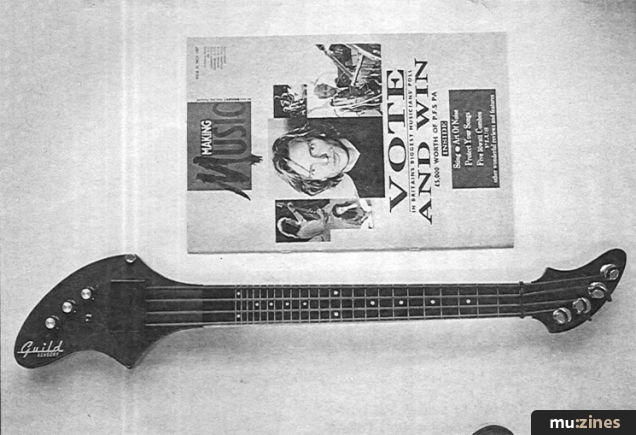
Trying to explain what it was about the Ashbory bass which made it appeal to me so strongly isn't easy. On the face of it, the plain (and rather roughly finished) carved wood prototype of a four-stringed instrument measuring not much more than a couple of feet end to end, fitted with one pickup and - believe it or not - an almost obscenely flexible type of polymer elastomeric strings (not far removed in concept from rubber bands!) sounds about as daft as the first prototype looked - and its inventors were sheepish enough about its appearance to show that they realised the apparent absurdity of their idea. But then I heard it being played. Here was a bass sound some way between a fretless bass guitar and a double bass coming from this tiny instrument, but with a depth and sustain, a drive and musical purpose which completely belied the 'toy' looks. The saga of the Ashbory's evolution has continued without interruption since then. Development work has led to a custom made Nigel Thornbory/Ashworth version being available for players immediately, with a lower-cost U.S. backed 'production' model soon to follow. All this from the bare wood 'toy' shown at the Barbican just a few months ago. Having bided my time since that first showing, but also having kept in close touch with Al Jones (yes, he of the definitive Ashworth acoustic instrument transducers which we praised to the skies in Issue 4) I have now been able to try what amounts to the almost final version of this extraordinary bass instrument: and no, my initial faith hasn't been dented - on the contrary, as I'll explain.
The Ashbory In Focus
We've probably all played around with stretching rubber bands over cigar boxes or similarly resonant containers when we were kids; getting that a-thunka, thunka, thunka, thunka, plomp sound and imagining that it was the Ricky or Precision that we really dreamed of owning. Just as likely, we'd never even heard of a Precision when we did it - greasy kid's stuff, eh?
Well, it takes genius to grasp at an idea as primitive as that and wrest it into a worthwhile form, and genius is what Al Jones seems to have - in quite unreasonable quantities, too.
I don't know when or how Al got the idea of turning every schoolboy's toy into a real musical instrument, but at some stage in his career that's just what he did, searching around for a flexible material for strings, devising (with noted guitar maker Nigel Thornbory) a tiny, solid bodied instrument measuring a mere 28¾" tip to toe, and putting the two together with one of his own magnificent transducer systems to produce a voice which can almost rival a full stand-up (double) bass for resonant depth and 'balls'. When I finally got my sample Ashbory from Al and Nigel it had lost the original's grotesque plain wood look, this version having been carved from a solid piece of mahogany and less eccentric in its shape (although still pretty odd to wear on a strap, believe me!). Weighing no more than a couple of pounds, the Ashbory bass is utter simplicity. You strap it on just like a conventional bass, plug your lead in via the sensibly rear-mounted jack socket, and start playing - well, almost. Perhaps we should look at the specs, first to get a better idea of what we have to hand, before getting down to discussing the playing of this oddball bass.
To begin with, you've got a fully active range of tones from the on-board battery powered circuit. This is wired to three rotary pots (volume, treble and bass) plus a 3-way LED-indicated selector switch which enables you to choose off/passive/active sounds. The Ashbory's hardware follows the designer's motto of keeping things simple. The strangely rubber band-like polymer elastomeric strings fasten through the back of a fairly conventional bridge/backplate, behind which a simple knot holds them fast. Riding over the saddle (beneath which lies the superb Ashworth transducer), they travel up across the fretless fingerboard (thankfully it's been fret marked - there are 24 of them, by the way, to show your playing positions!) before passing over a fixed nut, under a restraining bar and hence onto traditional violin-type tuners. This latter feature, incidentally, is one which may yet be altered by the time the finished models appear; the designers are still gaining playing and using experience with their baby which may yet cause some minor changes to be made. The principle, however, is right and fixed - polymer strings it is, and what an effect they have!
How To Play It (I Think!)

Tune the Ashbory to a standard EADG, that's what I assumed; and I have to say that, with the strings supplied, this wasn't easy at first. Being as flexible as they are, the Ashbory's polymer strings not only feel unusual to your fingers but they also expand in a disconcerting way, so that tuning isn't particularly simple when you've just fitted new strings. Stretch them after you've fitted a set, however, and they do begin to settle down, although they retain their odd feeling - almost sticky under your fingers, and producing some effects which, to anyone used to conventional metal bass strings, will be potentially off-putting to begin with. Persevere, however, and you soon begin to develop a new technique for handling them, which I'll try and explain. Firstly, it's vital that you understand what you're doing when you first try one of these instruments. When stringing up, you must stretch the strings to relieve any slack, which could later result in pitch difficulties. Furthermore, whatever type of bass you play now you must familiarise yourself with some of the new playing techniques you'll need to develop to get the best from the Ashbory. Not being the world's greatest fretless bass player, I have a tendency to play fretted basses using quite a lot of bent notes (cheating again!). With the Ashbory you can forget that for a start! Bend a string and next to nothing happens to the pitch. What's more, sliding up to a note (much as you would on a conventionally metal-strung fretless bass) isn't at all easy, because the inherent friction of the string material means that as you slide to a note, the string stretches and produces a pitch which is higher than you had anticipated. Slide up to a note with normal finer pressure and instead of, say, gaining a couple of semitones, you might find yourself having only gained 1¼. On the other hand, you soon learn that a lighter touch will minimise this effect, and - given an hour or so - a new approach develops, enabling you to get accurate pitch. One tip here, by the way, is to apply a small amount of talcum powder to the strings (something which you'll sometimes see acoustic guitarists doing), as this reduces friction and helps avoid this note sliding difficulty.
Obviously, with strings made of such a material, having jagged fingernails doesn't help your sound (emery boards all round, ladies and gentlemen!) but on the other hand the unusual nature of these strings brings its own definite benefit. Try using a fingernail on them to produce a slide guitar sound, and you'll see what I mean! In fact the Ashbory is capable of some remarkable sounds once you get used to handling it, and it won't be long (he confidently predicted!) before some bright spark comes along and teaches us a whole new playing approach using this bass, as revolutionary in its own way as were the first slap sounds of players like Larry Graham.
Accompanying my sample Ashbory was a tape produced by Al Jones, which showed some of the sounds he has been getting during the development phase of this new instrument. Sometimes it sits back in the mix, sounding not unlike a very low, growly fretless bass; at other times Al has double tracked it, overdubbing the instrument as a lead bass and making full use of the weird and wonderful effects obtainable from it. Following Al's guidance and working with the Ashbory myself, I soon found that I could use it in a variety of roles which I hadn't seen at first. Once you've learned the knack of handling it, the range of both sounds and effects is staggering.
Don't expect to pick one of these basses up and be able to play it immediately. Take yourtime in learning the techniques required, and it will reward you with sounds that you could never get from a conventional fretless. Just be patient - it's all in there, and it's not so difficult to play that any even halfway competent bass player won't be able to manage it. It's a lot easier to handle than a Chapman stick, believe me!
The Sound
The Ashbory's basic sound is surprisingly rich - almost fruity in character. I say surprisingly, because your first guess when you see the tiny scale and minute body is that it will inevitably sound more like a piccolo bass. But no; the notes are deep and round, amazingly full, and graced with a tonal richness and sustain which looks impossible, but isn't. The active Eq system works well, and its range is certainly sufficient for both fundamental bass and lead lines to be manageable with ease. The output is perfectly high enough for any conventional amp without fear of unwanted overloads.
Having discussed the versatility of the sounds, what is almost impossible to explain is the richness, roundness and vibrancy which the miniscule Ashbory produces. Tape it and (assuming you both play and Eq it the right way) you'd be hard pressed to know that it wasn't a full-size string bass at work. Likewise, 'tweak' the treble and, although the depth is there, the sound is much nearer to that of a lead/funk fretless bass guitar. Try it with the treble up a bit, via a Chorus pedal and/or a Delay, and the combined effects of the pedal's swirl with the very 'natural' sound produced by these polymer strings gives you an eerie effect that can be quite spine-chilling. Equally, duplicate a stand-up bass from a portable instrument, sharpen the attack and get towards a fretless bass guitar, experiment with pseudo-bottleneck sounds - there's a universe of new ideas in this strange-looking machine!
Conclusion
As things stand now, to get to see and try an Ashbory you'll have to contact the U.K. makers, Nigel Thornbory and/or Al Jones. If you're a pioneering player at heart, then my suggestion is that you really should. If, on the other hand, you're diffident about new ideas, perhaps some months' wait, until (all being well) the U.S. maker with whom Nigel and Al are currently discussing mass production and distribution gets to work, might be a better bet - because then you'll be able to see one in a local shop.
I have no doubt that the Ashbory bass is a major new contribution to bass sounds and playing techniques. Speaking personally, if I were a player looking for new areas to explore I wouldn't be able to bring myself to wait for a mass produced model which might (who knows?) not appear for anything up to a year from now. What I would want to do is get there first and have one of these remarkable basses to experiment with and find the best personal uses for, so that I could carve-out a unique sound of my own as soon as possible.
Although it's small and relatively simple in design, build and materials content, £295 for an original Ashbory looks like a good deal to me. This instrument is a step in a new direction, and affords a new dimension of sounds and ideas to the creative player. If you can, try one soon!
Price £295
More info from Ashworth Electronics, (Contact Details) and/or Nigel Thornbory, (Contact Details).
Also featuring gear in this article
Ashbory Bass
(MM Dec 87)

Ashbory Mini-Bass - BassCheck
(IM May 86)

Ashbory Original Bass
(12T Jun 86)
Browse category: Bass > Ashbory
Publisher: In Tune - Moving Music Ltd.
The current copyright owner/s of this content may differ from the originally published copyright notice.
More details on copyright ownership...

In Tune - May 1986
Review by Gary Cooper
Help Support The Things You Love
mu:zines is the result of thousands of hours of effort, and will require many thousands more going forward to reach our goals of getting all this content online.
If you value this resource, you can support this project - it really helps!
Donations for June 2026
Issues donated this month: 0
New issues that have been donated or scanned for us this month.
Funds donated this month: £0.00
All donations and support are gratefully appreciated - thank you.
Magazines Needed - Can You Help?
Do you have any of these magazine issues?
If so, and you can donate, lend or scan them to help complete our archive, please get in touch via the Contribute page - thanks!
If you're enjoying the site, please consider supporting me to help build this archive...
...with a one time Donation, or a recurring Donation of just £2 a month. It really helps - thank you!

 @mu_zines
 RSS Feed
 Blog
Blog