
Magazine Archive
Home -> Magazines -> Issues -> Articles in this issue -> View
The Venue | |
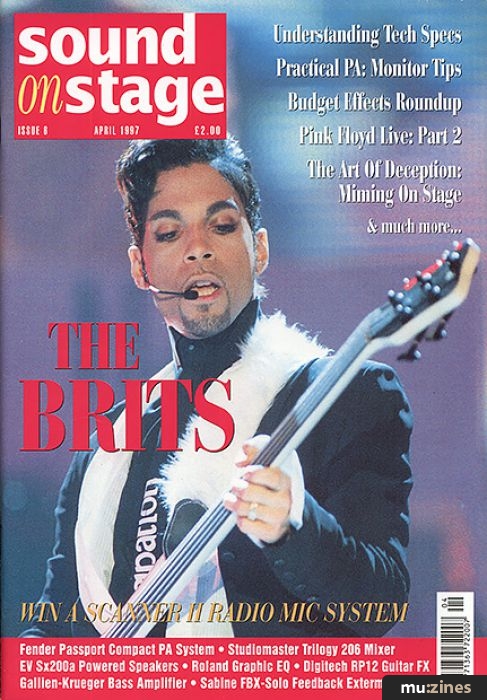
Bar Lorca, North LondonArticle from Sound On Stage, April 1997 | |
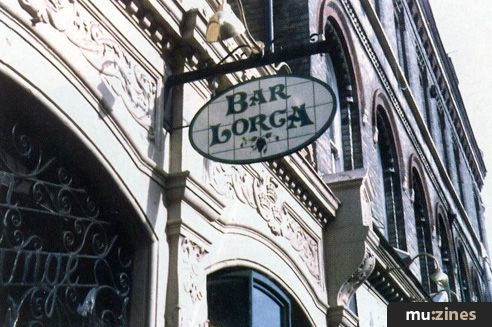
Before Bar Lorca moved into North London, the corner site was home to just another dingy pub no-one cared about. Now Stoke Newington plays host to one of the more hip joints in town, where Latin butt-swaggering dance is taken very seriously, the sangria flows like water, and swarthy and flamboyantly mostachioed men strut behind the bar, eager to carve you ham from a recently sacrificed carcass. But if you were to think that Bar Lorca's only concern was image and getting the senoritas through the doors, you'd be wrong. A new system supplied by Shuttlesound has shown the venue's commitment to keeping the bands, restaurant, and dancefloor happy. Tim Gray of Shuttlesound helped troubleshoot the install process, and as he knew the system better than most, I was pleased to have him show me around.
Bar Lorca is an L-shaped space. The stubby end is occupied by the dancefloor and stage, with the larger area taken up by tables and the bar area, and as such, it is split into two distinct theatres of operation. On the one hand, the restaurant and bar area needs a restrained and distributed sound coverage, while the dancefloor and stage require something far beefier. The system combines ElectroVoice speakers and subs, Rane signal processing, and ElectroVoice power amplifiers.
14 SPEAKERS, 2 AMPS
Six EV S-40 compact full-range speakers are bracketed to the walls of the restaurant to provide the sound for the restaurant area. At the business end of the room, two ElectroVoice Sx200 speakers are directed onto the dance floor, while a further two face outwards from the stage. The Sx200s are teamed with four GSS 15XR Greystone subs, two stacked on the dancefloor, two on stage. The whole speaker system's power requirement is thriftily met by two EV P Series amplifiers. All of the six 8-40 monitors are run in series and parallel from one side of a P1250 amp, the other side powers one of the 8x200s on stage. The remaining three Sx200s and four subs are powered from one P2000 amp. The three full-range speakers are run in parallel, while the Greystones are wired in series and parallel, effectively applying a 2 Ohm load to both sides of the amp, and drawing about as much power as can be squeezed from the P2000. "These amps are made by Dynacord in Germany, and they are the best selling ones we have," said Tim. "We've found that their reliability is absolutely astounding, even in comparison with the Crown and Amcron amps Shuttlesound used to supply." House Engineer and DJ — the mysteriously named Tico — concurred: "The reliability is great. The amps can be going for 15 hours with no problems."
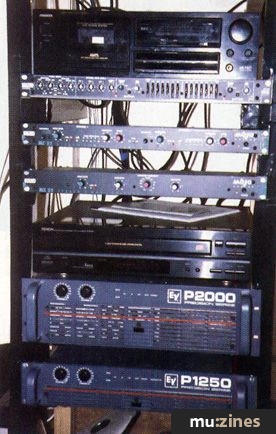
Sharing the rack with the ElectroVoice amps are various items of Rane gear
Sharing the rack with the EV amps are various items of Rane gear, including elements of Rane's new Mojo series. The Rane CP-62 zone mixer offers the requisite specs for the two area environment, with plenty of music ducking and priority options plus seven-band graphics for both zones. The Mojo Divider splits the signal to the Sx200s and Greystone subs, crossed over at 126Hz. There's also a Mojo Squeeze compressor lurking in there as well. "I don't actually know why they put in a compressor. I can't imagine that they would operate it correctly, or really need it, but it's there and set to limit and not much else," mused Tim. "But the Mojo series is a great new concept. What they've done is kept the quality of the components just as high as the rest of the Rane stuff, but boxed it up with less options and fewer things to fiddle with, which is great for the MI industry. If you're in a duo out there starting with a tri-amp system, the fewer things to crossover the better, they don't want time delays and time alignment features and things like that." Thanks Tim, the Rane Corporation cheque is no doubt in the mail.
The front-of-house mixing duties are discharged by a Soundtracs Macro 14-channel stereo mixer, a perfectly adequate inclusion but one that must be pushed to its limits, given that many of the bands on the agenda are seven or 10 piece. Notably absent are effects and processors. Bar Lorca have decided that the band has the job of bringing their own monitors, although there are a good complement of Shure SM58 mics and stands.
AY¡ CARUMBA
Returning by night, Bar Lorca has been transformed into a heaving Latin American cantina. Hombres suck on Sol, and waiters struggle through the throng laden with mussels drenched in garlic and butter. Such is the mood that shouting 'Oleé!' in your worst Speedy Gonzales accent would scarcely raise an Iberian eyebrow. On stage, the Kitoto Band whip up an energetic mix of samba and reggae, with the EV cabs finally allowed to work up a bit of a sweat. At the back of the room, the Sx200s' impressive HF dispersion and throw characteristics are the first things you notice, while the S-40s help fill in the sonic gaps. Towards the stage, the picture becomes more complete, lots of HF energy, good vocal intelligibility, and healthy bass. Nearing the dance floor, as the 15-inch subs make an impression, the low end is further reinforced. All in all, a healthy variation of level and low frequency energy is provided across the room. What's also illustrated is how a strong system can be installed at a reasonable cost, bringing all the added verve and interest of live music into what is essentially a pub/restaurant environment.
More with this topic
 Vive Le Difference! |
 On the Road - Music U.K.'S P.A. Test |
 Overtones - Gig Tactics |
|
 Tuned in & Turned on - In-Ear Monitoring Enlightenment |
How To Get Gigs - ...And Keep Them Coming Back For More |
Around The World Trip |
 On the Road |
Hardware Or Software? - Sequencing On Stage |
 Camera Shy - TV Sound |
 Relax... your solo will be just fine - Relaxing For Gigs |
 Access all areas - Glastonbury sound |
Browse by Topic:
Live
Publisher: Sound On Stage - SOS Publications Ltd.
The contents of this magazine are re-published here with the kind permission of SOS Publications Ltd.
The current copyright owner/s of this content may differ from the originally published copyright notice.
More details on copyright ownership...
Sound On Stage - Apr 1997
Feature by Christopher Holder
Help Support The Things You Love
mu:zines is the result of thousands of hours of effort, and will require many thousands more going forward to reach our goals of getting all this content online.
If you value this resource, you can support this project - it really helps!
Donations for June 2026
Issues donated this month: 0
New issues that have been donated or scanned for us this month.
Funds donated this month: £0.00
All donations and support are gratefully appreciated - thank you.
Magazines Needed - Can You Help?
Do you have any of these magazine issues?
If so, and you can donate, lend or scan them to help complete our archive, please get in touch via the Contribute page - thanks!
Please Contribute to mu:zines by supplying magazines, scanning or donating funds. Thanks!
Monetary donations go towards site running costs, and the occasional coffee for me if there's anything left over!

 @mu_zines
 RSS Feed
 Blog
Blog