


Magazine Archive
Home -> Magazines -> Issues -> Articles in this issue -> View
V-Amp 30 | |
Article from Music UK, August 1982 | |
Britain's newest amp swallows pages. Read why
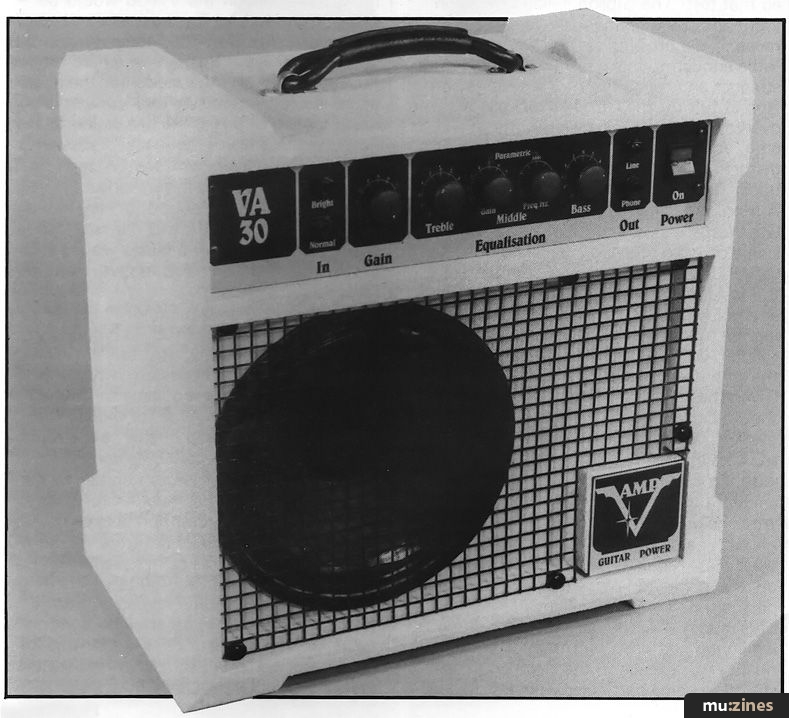
In last month's MUSIC U.K. we promised you a look at a sample from the new V-AMP range of combos — plus, of course a chance to win one in this issue. We've kept both promises, needless to say, and if it looks like we're going overboard on this new all-British product — well, the music business seems pretty excited about V-Amps too, so they'll be trying hard to sell them to you over the coming weeks. A good enough reason for us to check out a sample as fast as we can.
Part of the reason why many retailers and pundits are so convinced that V-Amps will become a market leader lies in the track record of the two men who run the company — Malcolm Green (who co-founded H.H.) and Peter Robinson (the man behind the excellent Packhorse Cases). Put together Malcolm's electronic abilities with Peter's cabinet building and designing skills and you should get a superb product. Well, that's the theory at any rate!
Planned eventually to be a large range of ultra-modern amps, V-Amps have been launched with just a handful of well developed combo models. These begin with the VA-10 (a 10 watt combo fitted with a single 8" speaker), move through the VA-30 (the subject of this review) to the VA-30S (which is fitted with a sustain/overload function) onto a 30 watt bass version and then three sixty watt types, a standard version, a sixty watter with sustain and reverb and, finally, a sixty watt bass version.
All of the V-Amps share a very modern, sturdy appearance — in fact sturdy is probably far too modest a description of the strength of construction of these newcomers. The first surprise when you confront a V-Amp is the covering material. It's not that familiar vinyl leather cloth which most makers use, but rather a heavily stippled ultra-thick material which bears more than a passing resemblance to plastic pebble-dash!
What's more it comes in a staggering range of colour options too — brick red, poppy, blue, yellow, antique grey, white and traditional black. The colours I've seen are very vivid indeed and certainly make a change from the usual looks of most products these days. But the individual looks go much further than the covering and colour. The speaker grill isn't cloth, it's a very sturdy plasticised metal which allows maximum acoustic transparency from the front-mounted off-centre speaker.
"...ONE OF THE LOUDEST30 WATT COMBOS I'VE COME ACROSS."
Constructional details are really very fine indeed. The casing is of 15mm birch plywood, bonded with chipboard, glued and pinned. It looks as if the V-Amp will take a harder life than most amps — certainly a harder life than many Japanese combos I've reviewed (I single some of them out for being generally the flimsiest I've come across). Some first-sighters might assume that the heavy duty carrying strap on top of these combos might be weak in so far as it is held in place with mere rivets — aha, but what you can't see is that these clip through internally and form a superbly strong assembly which should, actually, last far longer than most apparently tougher designs.
Strength is all well and good, however, but it's no substitute at all for a good sound and adequate facilities. So, moving away from the range in general, let's get on with the results of our tests on a specific model, the VA-30.
From the rear view, the basic model in the 30 watt range (the VA-30S having reverb and distortion facilities which this basic model is lacking) looks distinctly naked. The back is virtually sealed and seamless, apart from a small port through which the mains lead and plug are stored. That's all you get — everything else lives round the front end.
"...FOR PLAYERS WHO WANT A CLEAN SOUND IT'S GOT TO BE VERY GOOD NEWS INDEED."
The panel there carries all the facilites of the VA-30. There are twin inputs (bright and normal) plus a single gain control, and then a very modern tone section comprising an active treble control which zeros at top dead centre and cuts or boosts as you turn it left or right, a matching bass pot and then a twin stage mid parametric with a gain control and a frequency sweep pot.
Following these are two standard size jack sockets, one for headphone out (very useful for backstage tuning) and a line-out. Finally, a mains switch completes the line-up. Overall, then the VA-30 looks basic but very, very tough. Now onto the acid test - the sound. It's very important when trying a V-Amp guitar combo for the first time to make sure which model you're trying. Realising that not all guitarists want distortion, the makers have dispensed with it as an integral feature which you have to pay for whether you want it or not. If you're one of those players who don't like it then you want this model, the basic VA-30. If distortion and/or reverb is your thing, then what you want is the VA-30S.
To give the 30 a fair trial I tried it with several guitars. The first off was a Les Paul Pro — perhaps not really a fair test as most of these amps are destined for semi-pro low power use — a player in which sector being unlikely to be able to afford such an expensive guitar. Nonetheless, the Gibson is capable of a very subtle sound quality and it is always interesting to try any amp and see if it's capable of coping with the best.
"IT ISN'T JUST GOOD VALUE FOR MONEY - IT'S POSSIBLY THE BEST VALUE FOR MONEY THAT WE CAN FIND FOR AN AMP OF THIS POWER RATING CURRENTLY ON SALE ON THE U.K. MARKET!"
Well, the sound of the VA-30 certainly passed that test! The Gibson needed the 'high' input and the tremendously versatile tonal range of the pre-amp section was quite versatile enough to make full use of the natural strength and capability of the guitar's output. Run at full tilt the Gibson's pickups weren't overwhelming the input sensitivity of the amp, although it did, eventually, run into distortion when turned on full with high boost factors on the mid-range Eq.
A more typical guitar to pair with the VA-30 was Westone's Concord 2 — a Strat-type single coil axe of a good Japanese quality, very much a modern semi-pro guitar. Here the V-Amp was really impressive. The speaker employed (a 10" Fane) is capable of taking the full power of the amp and any distortion when run up full is the product of the amp itself, rather than speaker strain. Given that fact the lifespan of this Fane should be very good. It's also a very clean speaker, well capable of reproducing both the bass lift of the Gibson on full power with the Eq section set 'thick' and delivering a really fine shrill treble with the single coil Westone on the bridge pickup and the amp set with bass rolled off, treble up full and what meat required being added by pushing up one of the mid-range frequencies with the parametric — really excellent!
This model V-Amp really was everything which we had been promised. The build quality was excellent, the electronic construction being particularly neat, tidy and safe, the speaker well chosen and of excellent specification, and posessing a tonal range of first class capability.
Run flat-out the V-Amp is far louder than the specs would tend to indicate. Some 30 watt amps sound dull and restrained (a combination of many different factors like cabinet design, speaker efficiency, damping factors and what have you) but not the V-amp. This is certainly one of the loudest 30 watt rated combos I've come across and would be quite loud enough for rehearsals, recording, practice and smaller gigs (pubs and clubs notably).
In its basic version the VA-30 would be very suitable indeed for the player needing a loud, clean amp with good tonal range, which would really stand the pace of a hard money-earning life. It isn't the model for the heavy metal lead player and we look forward very much indeed to trying the 'S' version to see how good Deanvard, the maker's, design is here. But for players who want a clean sound it's got to be very good news indeed. If you want a 'half-and-half' sound for, say raunchy rhythm guitar, though, this has that too, although (being without a master volume arrangement) the amp has to be turned up fairly loud to get it.
So — is this new amp value for money? Priced at a recommended £108.73 it actually undercuts significantly most but the very meanest 30 watt combos currently on the market. It isn't just good value for money — it's possibly the best value for money that we can find for an amp of this power rating currently on sale on the U.K. market! No kidding, just dig out issues number five and six's amp guides and compare it for yourselves — the VA-30, despite the exceptional quality it offers in all areas, is one of the cheapest amps of this rating available. It's our opinion that for any guitarist wanting a powerful, fine-sounding combo of this 30 watt rating with physical strength and tonal range far beyond its price — the V-Amp 30 just cannot be equalled, never mind bettered at its price.
RRP £108.73
Also featuring gear in this article

Carlsbro & Deanvard Amps
(12T Jan 83)

V-Amp Combos
(12T Jan 85)
Browse category: Amplifier (Combo) > Deanvard
Publisher: Music UK - Folly Publications
The current copyright owner/s of this content may differ from the originally published copyright notice.
More details on copyright ownership...

Music UK - Aug 1982
Review by Gary Cooper
Ads for Gear in this article:


Previous article in this issue:
Next article in this issue:
Help Support The Things You Love
mu:zines is the result of thousands of hours of effort, and will require many thousands more going forward to reach our goals of getting all this content online.
If you value this resource, you can support this project - it really helps!
Donations for June 2026
Issues donated this month: 0
New issues that have been donated or scanned for us this month.
Funds donated this month: £0.00
All donations and support are gratefully appreciated - thank you.
Magazines Needed - Can You Help?
Do you have any of these magazine issues?
If so, and you can donate, lend or scan them to help complete our archive, please get in touch via the Contribute page - thanks!
If you're enjoying the site, please consider supporting me to help build this archive...
...with a one time Donation, or a recurring Donation of just £2 a month. It really helps - thank you!

 @mu_zines
 RSS Feed
 Blog
Blog