


Magazine Archive
Home -> Magazines -> Issues -> Articles in this issue -> View
A 20/20 Vision | |
Sabine FBX-2020 Feedback ExterminatorArticle from Sound On Stage, January 1997 | |
Sabine's latest addition to their pioneering feedback eliminator range now incorporates 20-bit conversion and 10 filters per channel. Mike Crofts checks out the new FXBX-2020, two-channel automatic feedback detector and exterminator.

Imagine a world where feedback just isn't a problem. Imagine a world where you can turn up the volume whenever you want to, just because you feel like it. Imagine a world where the PA even listens out for feedback while you go for a cup of tea and adjusts itself as necessary. Perhaps this is what sound engineers dream about (who will ever know?), but it is no longer complete fantasy thanks to the Sabine FBX-2020 Feedback Exterminator.
Every now and then someone invents something, which is more than just a Good Idea — reflect if you will upon the compact cassette, the double-decker bus, the Fender bass, the Mini, the skirt of the same name, and so on. Now there's something else, which is rapidly becoming part of everyday (PA) life.
The Sabine FBX-2020 is called a 'feedback exterminator', because that is exactly what it does. The idea is that one simply connects it — usually in place of a graphic equaliser — between mixer and power amp, or in an insert point, then follow a few simple setting-up instructions. The rest really ought to become history. If you regularly do battle with unfriendly acoustics (horrible venues, not aggressive guitars), you will want to switch on the answering machine for a while and read on...
WHAT IT DOES
In simple terms, the FBX-2020 has two separate banks of 10 very sharp (ie. narrow band, either 0.1 or 0.2 octave) digital filters, each of which is assignable to any particular spot frequency between 35Hz and 20kHz. The filters can be individually user-configured to either operate at a fixed frequency or to function as dynamic filters. The unit is factory set so that seven are fixed and three are dynamic circuits, which is recommended as a general-purpose optimum arrangement, or at least as a good starting point.
The composite audio signal — in other words, the mix — is monitored as it passes through the unit, and when feedback is detected at any particular frequency, one of the fixed filters is automatically assigned to attenuate that frequency until the feedback is eliminated. Another six fixed filters will automatically lock on in this way (allowing more and more gain before feedback in each case), leaving the three dynamic filters to 'roam' during the performance, detecting intermittent runaway frequencies, and applying attenuation until order has been restored. These three filters will continue to monitor the signal, ready to seek out and destroy feedback almost before it can be noticed. The typical find and eliminate time is 0.4 sec at 1kHz, rather slicker than your average sound man!
A CLOSER LOOK
The unit is built into a compact 1U rack-mounting metal case, with an attractive matt finish. It has an internal power supply (hooray), is available in 240V and 115V versions, and weighs around 3.6kg. The on-board memory has a backup battery, which is claimed to have a typical life expectancy of around seven years. The front panel features include a power on/off switch, an active/bypass mode switch, a signal LED ladder, and various filter switching and activity monitoring features. At the back, there are balanced or unbalanced XLR and TRS jack connectors for all inputs and outputs, the standard IEC mains connector, and a ground lift switch.
A number of improvements over the previous version (the 1802) are incorporated in the FBX-2020, including the use of 10 full 20-bit digital filters per channel and Sabine's patent-pending 'Clipguard' input circuitry. The Clipguard automatically matches the unit's internal dynamic range to the input drive level, an area of critical importance when driving any digital equipment, as well as increasing the overall dynamic range to 110dB, and improves signal-to-noise ratio. Another new feature of the FBX-2020 is called 'TURBO' set-up mode, which reduces initialisation (ie. the time it takes to automatically set the first fixed filter at the most apparent feedback frequency) and therefore total setting-up time, with less audible feedback occurring.
The digital filters normally operate in 0.1 octave mode. This is where the feedback eliminator is so noticeably different from the use of a graphic equaliser in trying to reduce feedback; typical equaliser bands are third-octaves, and anything more than the slightest tweak will result in a noticeable alteration of the programme material. The width of all the FBX-2020 filters can be set to one-tenth or one-fifth octave, depending on the application and the severity of the problem. The handbook recommends the use of one-fifth octave filters for teleconferencing, lectures etc. It is possible to set combinations of tenth and fifth-octave filters to operate at different frequencies within the same channel.
"The FBX-2020 made more difference to the sound system performance in a matter of minutes than anything that could have been achieved by adjusting equalisers and other components until the cows came home!"
THE WAY THAT YOU DO IT
You connect the FBX-2020 between mixer and power amp (ie. where a graphic equaliser would go) and set it up one channel at a time, which could, of course, be main left and right, main mono and foldback, or whatever — the FBX-2020's two channels are completely independent of one another. With all the normal mic channels open, the master gain (for one channel, the other being in bypass mode for the time being) is slowly increased until feedback occurs — in this case, not for very long either. You will notice the first of the filter LEDs come on to show that a filter has locked on, and the feedback just disappears. The master volume can then be increased again, and this time another frequency will be detected and notched out, and so on. When all seven fixed filters have been assigned, the process is repeated on the other channel, and the system is ready to use, with (hopefully) a significant increase in volume. Now just in case you think all this sounds too good to be true (like I did), you will want to know if it really works...
CHURCH SERVICE

The ideal test venue — the Church of Christ The Cornerstone in Milton Keynes provided a suitably challenging acoustic!
I visited the Church of Christ The Cornerstone in Milton Keynes and, courtesy of the Building Manager, Jim, and his team, connected the Sabine into their installed system. The church building is interesting as well as beautiful, with its circular worship area, two tiered galleries, and high domed roof (it is affectionately referred to as 'St Paul's' when giving anyone directions in or around the city centre). The acoustics vary depending on your position in the building, and it has a fairly widely distributed sound reinforcement system, with speakers in various locations and angles to try and provide even coverage, but there are almost no absorbent surfaces. Several microphone locations are used, the main ones being a cardioid pulpit mic, an omnidirectional plate mic at the altar, and a radio mic. The constant problem is to achieve enough gain for everyone to hear clearly without the ringing which sets in at a fairly early stage. This is a source of concern for Jim, who, among his very many duties, looks after the sound system, and was therefore very interested in what the FBX-2020 could do for him.
One of the most appealing aspects of the Sabine FBX-2020 is its apparent simplicity in installation and use. As the church building is heavily used most of the time, we only had a time window of about half an hour to connect it all up and carry out any testing. Up to that point, I had not had an opportunity to even play with the unit at home, so this would be a 'straight out of the box' test, which always gets the old adrenaline going, especially since I had already told Jim that here was the answer to all his feedback problems.
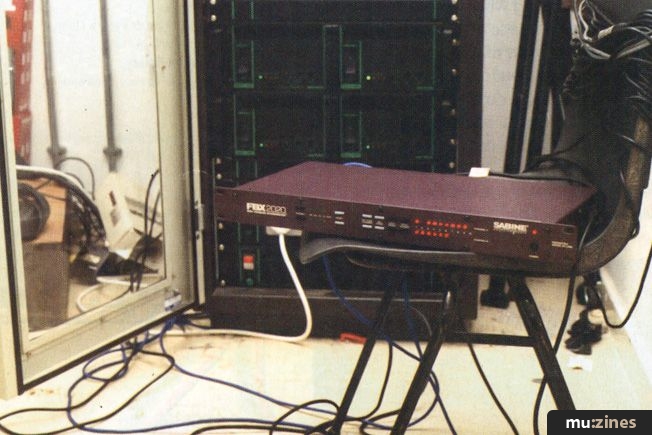
The Sabine FBX-2020 was temporarily inserted into the church's installed system, just after the mixer output.
Unlike many older church buildings, Christ The Cornerstone has a built-in control room, which is used on occasion by the BBC and houses the sound equipment rack, complete with Jim's pencil marks to show the points where all the mic levels usually start to howl. The system incorporates two graphic equalisers, which I decided to leave in circuit as this would provide a better 'before and after' comparison test. Following a quick look round behind the rack, I managed to insert the FBX-2020 just after the mixer output; my wiring lash-up wasn't pretty, but it was certainly fast. As Jim was hovering, I made lots of what I hoped were reassuring comments like 'oh yes, I see what they've done here' and 'right, that should do it' to alleviate his worries.
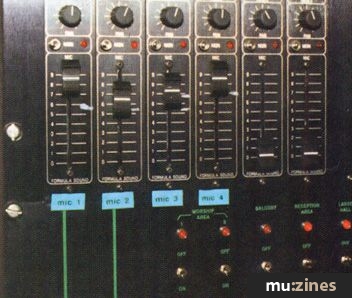
With the FBX-2020 in operation, the mixer controls could be set way above their normal operating positions (Jim's pencil marks) and still no feedback could be heard.
First I asked Jim to turn up the mics to the normal limit, which confirmed the validity of his pencil marks; just think about moving your hand towards the faders and feedback occurred almost instantly! Operating guide in hand, I then went through the set-up procedure and watched — and listened — as, sure enough, the FBX-2020 locked on to seven ringing frequencies and squashed them one by one. With the mixer controls now set way above their normal positions, we could hear no feedback, and Jim went downstairs to try out the mics. I could hear him via the control room monitor speaker — 'this is the pulpit microphone... hello, hello, that's much louder... this is the altar one now... wow!' or words to that effect. The increase in system gain was far more than I would have believed possible. In the limited time available, I was not able to explore the full capabilities of the FBX-2020, but I am sure that given half a day to properly optimise the system, even more safe, stable gain would be achieved. The sad part was when I had to put everything back as it was, using the pencil marks (no-one has yet come up with a better way, have they?). All the old ringing came back with a vengeance. I have an idea that Jim thought I had somehow cured his system for good and was a bit disappointed when nothing had permanently changed!
CLUB 18-65
In a club venue blessed with a low, flat ceiling, and shiny tiled floor, I placed a microphone about a foot to the side of one PA speaker and pointed it straight upward (which seems to be the method favoured by most part-time comperes). I went through the same setting-up procedure as before, except that only four fixed filters were needed before the master gain setting became ridiculously high for the venue. As at Cornerstone, the volume was surprisingly high when the mic was actually used — you do have to be careful with this until you're used to it, as the low background noise and absence of ringing tends to give the impression that the system is set at a much lower level. With the FBX-2020 thus set and in circuit, I fed a CD source through the system and tried to detect the effect of the filters on the programme material. With pop/rock material, I couldn't hear any difference at all, no doubt courtesy of the very narrow filters in use.
FEEDBACK
It really does work! The two test applications — particularly the church — demonstrated immediate and impressive results. The FBX-2020 made more difference to the sound system performance in a matter of minutes than anything that could have been achieved by adjusting equalisers and other components until the cows came home! If the FBX-2020 has any serious vices or undesirable side effects, I haven't found them yet. I know of two venues that seriously want one, preferably yesterday!
FBX-2020 £1,380 inc VAT.
Fillion pic, (Contact Details).
pros & cons
pros
- Does all that the designers claim.
- No fuss, easy to set up.
- Neat and well made.
- Flexible user configuration options.
cons
- Operating guide diagrams are a bit on the small side.
summary
A very well-designed and engineered piece of quality hardware, which could enhance any sound reinforcement application.
THE GUIDE
Unfortunately, the diagrams are rather small, and you can't always read the smaller legends, which represent the panel markings. There is also a section dedicated to various safety concerns, which goes as far as tabulating maximum sound levels versus exposure times, albeit to the US OSHA regulations. The warning paragraph goes on to recommend the use of ear protectors when using this device. Given the increase in volume possible, this sounds like a very sensible idea (for more on this subject, see the Elacin ER15 Musicians' Earplugs review in the December 96 Issue).
Publisher: Sound On Stage - SOS Publications Ltd.
The contents of this magazine are re-published here with the kind permission of SOS Publications Ltd.
The current copyright owner/s of this content may differ from the originally published copyright notice.
More details on copyright ownership...

Sound On Stage - Jan 1997
Review by Mike Crofts
Previous article in this issue:
Next article in this issue:
Help Support The Things You Love
mu:zines is the result of thousands of hours of effort, and will require many thousands more going forward to reach our goals of getting all this content online.
If you value this resource, you can support this project - it really helps!
Donations for August 2026
Issues donated this month: 0
New issues that have been donated or scanned for us this month.
Funds donated this month: £0.00
All donations and support are gratefully appreciated - thank you.
Magazines Needed - Can You Help?
Do you have any of these magazine issues?
If so, and you can donate, lend or scan them to help complete our archive, please get in touch via the Contribute page - thanks!
Please Contribute to mu:zines by supplying magazines, scanning or donating funds. Thanks!
Monetary donations go towards site running costs, and the occasional coffee for me if there's anything left over!

 @mu_zines
 RSS Feed
 Blog
Blog