


Magazine Archive
Home -> Magazines -> Issues -> Articles in this issue -> View
Cats' Tales & Slick Picking | |
Phantom, Rocker And SlickArticle from International Musician & Recording World, January 1986 | |
Two ex-cats and an earl add more lines to the story of Rock and Roll. David Marx chronicles
Phantom and Rocker were the rhythm behind the Stray Cats' strut to success. Earl Slick twanged a mean six-string on Bowie's tours and records. Could this be the ELP of R'n'B?

"It's not everyday you get the chance to beat a tambourine over Ringo Starr's head is it?" enthuses Slim Jim.
"And it's not every day you find guitar players like Eric Clapton, Jeff Beck, Dave Edmunds and George Harrison stood speechless 'cos they've just had their heads blown apart by Carl Perkins," replies Rocker.
And it's not every day that two rockabilly rebels such as the aforementioned should team up with one of the world's most sought after session guitarists simply because of a mutual interest. Still, if Bruce Springsteen and Tina Turner can do it, why not Phantom, Rocker and Earl Slick.
Well, the simple fact of the matter is they have. Not only have they taken part in the recording of the now semi-legendary Carl Perkins HBO Special that took place a couple of months ago, they've also recorded an album that celebrates some of the finest Rock and Roll I've heard in eons. What with Keith Richards contributing a guitar solo (solo???) to a song called My Mistake, which admittedly, hints at The Stones' Some Girls, the band's debut album should surprise quite a few people.
It's far less urgent than The Stray Cats, but to say it's any less insistent would be foolish, almost criminal. Having met at last year's Los Angeles trade show, Earl Slick gives a brief synopsis of what it's all about: "This band enables each individual member to do far more than what they were doing before. For example, Lee's no longer stuck with the stand up bass, he now plays electric bass as well, and he's also singing lead vocals which is something he never used to do.
"Jim's got the chance to sit behind a full size drum kit, and he can finally use all those lyrics he's been writing for years and years... As for me, well it's no longer a case of 'can you play this part' or 'can you play that part' or any of that kind of shit. I'm now writing with guys who understand my writing; I can therefore stretch out."
So would you say that session playing stifles one's creativity?
"It depends on how you look at it. I've always been accused of being a session player, but what's happened is, I've just been asked to play on other people's records. John Lennon's album was not a session, that was an experience. I spent two months making that record (Double Fantasy), and as for David Bowie, well I've never walked in, put down a solo and then said goodbye. I've always spent the whole time making the record.
"To me a session player is someone whose whole life is based around going from studio to studio, from artist to artist making records. A band guy is someone who puts all their time and effort into one thing, which is what I've been trying to do for years.
"No, session playing only stifles your creativity if you'll let it."
You mention the fact that the recording of Double Fantasy wasn't so much a session, but more of an experience. How would you describe it?
"I was getting sick and tired of seeing gongs and drums from here to Santa Monica" Slim Jim Phantom
"Unless you were there, I couldn't describe it. It was great, I mean Lennon was always tops with me, and I think one of the reasons it was great was because I felt as if I was playing in a band. Sometimes you meet heavy duty guys of the same calibre and they have a tendency to scare you to death. With Lennon there was none of that horse shit; you never felt intimidated.
"Put it this way; on the first day of the recording me and John spent the first four hours tuning up. Asa result of that, we immediately had an alliance. Don't get me wrong, he knew a lot about certain technicalities, but at the end of the day, he couldn't even tune up his damn guitar! He'd say 'it's not in tune, but it's okay. Let's just do the goddamn track and if it feels good – fuck it', which was fine by me."
Lee: "Listen to this guy, he's meant to be a technician, he's played with David Bowie and Mick Jagger goddammit (laughs)."
And as you'd expect from a man in his position, he obviously knows his stuff.
"About 18 months ago, I began changing the sound of my guitars, which are all custom made Di Marzios. They're like Stratocasters, but have nothing to do with Fender whatsoever.
"Where the pickups used to have a very over-driven type of sound, they now have a far more cleaner sound whilst still retaining their initial impact with balls. Rather like a Telecaster I suppose. The reason for this is because the guitars themselves don't have the usual configuration of three pickups. Most of them just have one pickup with one volume control. 500k pots with capacitors on them and no tonal adjustment, so that the pickup gets from where the string hits it to where the amp receives it without having to go through unnecessary circuitry.
"I've also changed amplifiers over the last year or so. I'm now using Carvins with ElectroVoice speakers which are a lot cleaner. Each cabinet is capable of handling 800 watts...
Lee: "It's loud."
Earl: "You could cook eggs on them. The thing is, I used to use Marshalls, but I found they got tired halfway through a show and they distorted a lot. I'd be doing a two hours how and when I started, I sounded great, but after awhile I experienced the paper in a supposed high wattage speaker beginning to crap out."
Lee Rocker has been experimenting with new equipment too, having recently semi-retired his double bass.
"Hand made stand-ups fall apart after a few nights... but maybe that's because I stand on them" Lee Rocker
"Well it wasn't so much a transition because I'm equally as competent on both instruments. In theory, I was playing electric bass before I was the double bass. The way I look at it is, you do what's right for the song; in other words you don't solo your arse off."
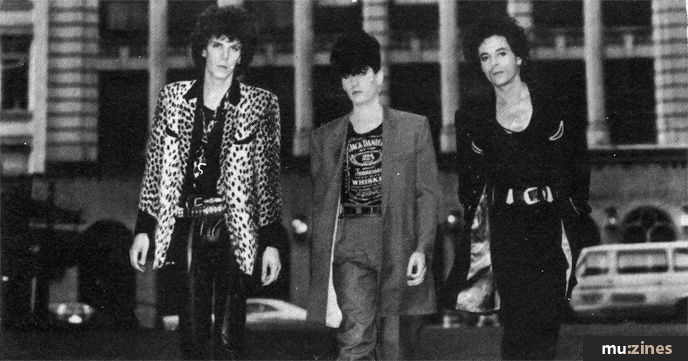
Runaway boys?
How do you go about miking the double bass?
"Good question. Most of the people I know who try and mike up a double bass always end up with all these microphone clicks and no bottom end. We've tried every possible combination ie mike inside the bass with foam, contact mikes and all sorts.
What I ended up doing was customising an old Precision pickup and having it mounted onto a piece of wood which I then added to the end of the fingerboard. That was when wired to the inside of the bass through a trap door. So that took care of the note sound. For the percussive sound, I've got a contact pickup actually built into the neck of the bass.
"Then, the whole thing's wired through to two channels of an amp. You proceed to balance the more or less electric note sound with that of the percussive sound and that's it."
Have you ever used radio mikes?
"Yeah, but I didn't like them and they didn't like me."
Is your stand-up bass factory made or hand made?
"It's an East German factory-built plywood student bass which costs less than 1200 dollars. I find hand made stand ups fall apart after a few nights on the road, but then maybe that's because I stand on them and stuff."
Would you say your technique is derivative of a lot of early Presley bass playing?
"Definitely. I used to listen to all those records that had Bill Black on them, plus Bill Haley records. Loads of material like that. The thing was, when I started playing, I was trying to emulate that sound on an electric bass and it just didn't work. The stand up bass really is a different instrument altogether. I don't really go along with the idea that the electric bass is the same as a double bass. Electric bass is a modern invention – late fifties, and the reason everyone jumped on it was because it was easier to carry around.
"I've always been accused of being a session player, but what's happened is, I've just been asked to play on other peoples' records" Earl Slick
"The electric bass guitar is a valid instrument, but not the same instrument in a different form."
What sort of bass guitars do you like?
"I've got a '64 Precision and a '59 Tele and all kinds of other classy instruments like that and they all sound like double shit.
"A friend of mine called Skunk Baxter recently gave me a Hondo Dan Electro for 90 dollars including case (shrieks with laughter), and it's the best bass guitar I've ever played in my goddamn life."
Slim: "Hey what is this? Double bass monthly magazine? How about drums?"
Quite.
"Okay. I studied drums with Mathew Alexander who used to play drums with Benny Goodman's band. I use Gretsch drumsand Paiste cymbals, my favourite two drummers are Ringo and Charlie (Watts) and...
IM: Feel drummers?
"Exactly. When The Cats came along I was going through my period of rebellion so I started playing just a cymbal and a snare drum. Not even a bass drum...
Earl: "I didn't know that."
"Yeah, and the good thing about that set up is it's the weirdest arsed thing anyone's ever seen. I was getting sick and tired of seeing gongs and drums from here to Santa Monica."
"Playing drums standing up is all a question of logistics and balance. Ringo told me he tried it and he broke his ankle; couldn't walk for a week... arsehole."
So why the change?
"Cause I got bored and I found playing a cymbal, a snare and a bass drum a little limiting."
At this stage of the interview Lee Rocker decided to light up another cigarette, as well as Earl Slick's hair, a couple of albums. Slim Jim's clothing and yours truly's tape recorder. Future plans include the recording of a second album and maybe some sort of a tour.
If we get out of here alive, it might actually happen.
Publisher: International Musician & Recording World - Cover Publications Ltd, Northern & Shell Ltd.
The current copyright owner/s of this content may differ from the originally published copyright notice.
More details on copyright ownership...

International Musician - Jan 1986
Interview by David Marx
Previous article in this issue:
Next article in this issue:
Help Support The Things You Love
mu:zines is the result of thousands of hours of effort, and will require many thousands more going forward to reach our goals of getting all this content online.
If you value this resource, you can support this project - it really helps!
Donations for May 2026
Issues donated this month: 0
New issues that have been donated or scanned for us this month.
Funds donated this month: £0.00
All donations and support are gratefully appreciated - thank you.
Magazines Needed - Can You Help?
Do you have any of these magazine issues?
If so, and you can donate, lend or scan them to help complete our archive, please get in touch via the Contribute page - thanks!
If you're enjoying the site, please consider supporting me to help build this archive...
...with a one time Donation, or a recurring Donation of just £2 a month. It really helps - thank you!

 @mu_zines
 RSS Feed
 Blog
Blog