


Magazine Archive
Home -> Magazines -> Issues -> Articles in this issue -> View
Article Group: | |
Drummers Drumming (Part 2) | |
Drum kitsArticle from One Two Testing, March 1985 | |
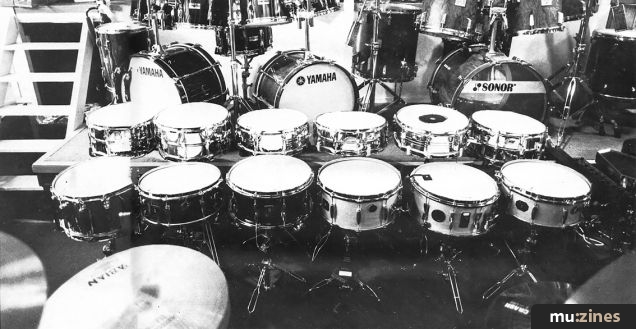
With sticks, stool and stylus in hand, Andy Duncan surveys a cross section of today's kits. Black and white finish by Grahame Tucker.
One fact that I can confidently report as drummers bash their way into 1985, is that it's never been more fun than it is now. After years of patiently waiting behind their kits while fellow band members had all the fun wrestling with the latest innovation in guitar pedals or synths, the last few years have seen the technological tables turned.
Now the drummer can drive everyone else crazy with hours of deafening and interminable fiddling, thinly disguised as 'programming' by the breed which barely qualified as musicians until those oddly-shaped pad and trigger boxes came along.
Nor have the conventional drum manufacturers taken this lying down. Their response has been to improve quality, variety and prices.
Meanwhile, traditional drums show no sign of going permanently out of fashion, either live or on record, so the drummer now has more ways to invest the old paper-round money than ever before.
To get a realistic idea of the available models and their prices I went to my local drum shop, Gigsounds in Streatham, and spent a morning with their man Maurice Latin, looking at his stock and talking drums.
If you walk in off the street with five hundred quid you can be sure of a wide range of choices. This is a fiercely contested area of the market and most of the manufacturers want a slice of it. In One Two, number 19, you might have read my comments on Premier's Advanced Percussion Kit, their latest budget package which is effectively the Royale series with power toms (12 and 13) a deeper bass drum shell (22 by 16), and better quality stands.
In what they see as the beginner's price range, the makers are offering complete kits, usually in these same sizes, with a 16 by 16 floor tom, a metal snare, tom holder, two cymbal stands, hi-hat pedal, snare stand and bass drum pedal. At £549 it offers good value overall with bonus marks for the sound of the snare, the robust stands and response of the pedals but reservations about their durability, small but vital elements like the hi-hat clutch and cymbal retaining nuts, and the quality of the drum finish. By comparison with other makes, the white test set looked rather dull.

Pearl Export.
Other makes consist mostly of the eager ranks of Japanese manufacturers, all of whom offer tremendous value for money. The Pearl Export equivalent is made of six plies of mahogany and two of birch which is then coated inside in the currently fashionable manner to improve resonance.
The six available finishes are uniformly excellent with the walnut and wine red natural wood lacquers looking particularly good. The stands are light (good) but solid and well balanced. Including a boom cymbal stand in the pair is a good idea, as is the elimination of the ridiculous and huge counterweights which adorned the original boom stands — they became useful only in the event of the mid-gig punch up, wherein the drummer suddenly found that he had an extremely dangerous weapon with which to pacify all-comers. I'm no fan of Pearl snare drums (more of which elsewhere) so suffice it to say that this one is no exception. The bass drum pedal, on the other hand, is a beauty.
Simple, smooth and strong this model beats many more expensive versions with its poise, power and complete playability. For £506 you can't go wrong (unless you then buy Pearl cymbals: they may be cheap but they soon lose their sound, and no amount of whacking will bring it back).
The Trak Series 200 is even cheaper in price, £499, but includes only one, straight cymbal stand and a 5in deep snare drum (Pearl and Premier's being a 6½). The nine-ply Lauan shells score well inside and out (more sealing inside, more lacquering out), the stands seem very useful and the ball-and-socket tom holder, which is after the fashion of the Tama (which is after the fashion of the Yamaha) is efficient in all aspects of rigidity and adjustment. Like the Pearl, the Trak SD5-2 snare is not up to the same standard and the plastic strip connecting bass drum beater to footplate looks as though it would last about five minutes under the unrelenting stomp of Cuban heel or Doc Marten.

Tama Swingstar.
With 600 smackers you're in the Tama price range. Their nine ply Swingstar retails at £652 but again has only one, straight cymbal stand, a 5in snare, and in this case, only the traditional 12 by 8, 13 by 9, 16 by 16 toms and a 22 by 14 bass drum. Out of fashion, but not out of date if you sit low and like to see over the toms. The finish is an unimpressive plastic wrap of black or white and there's equally little dalliance with inner coatings of any sort. The lack of give in the metal bass drum hoops promote slow detuning and has been ditched by most rivals. No complaints about any of the Stage Master stands nor the Flexi-Flyer bass drum pedal which is a marginally more lightweight version of the Pearl.

Luscious Ludwig Super Classic.
Also in this price range is the potential killing in the secondhand market. Gigsounds had a beautiful 1967, old badge Ludwig Super Classic on offer for £600 which looked well worth the money. The 400 snare alone is the proverbial Rolls-Royce, the champagne glitter finish is the ultimate in beat-chic, and if you think that they might be past it in sound terms, check Bruce Thomas with the Attractions who's still gleefully extracting his money's worth from one of Ringo's old kits (which would give even the one I saw a few years head start). Ludwig hardware (the Speed King apart) was never quite in the same league, of course, so you would still have to expect to invest in some new stands. The thrill of the chase in the back pages of MM or the Exchange and Mart is what you could call a unique experience.
Beyond £700 you can afford the Trak 400 series (£775). In most respects they bear a striking similarity to their Tama rivals, both in drums and hardware. This is no bad thing, of course. Plain, single nut boxes, well matched seals at the shell joints, the Omnilock tom holder and Titan lookalike stands (or 'System 4') all make the difference hard to spot. Trak's stab at originality is a hi-hat which can be angled towards the player (or even away for the truly avante garde, I suppose). It looks as unlikely as their Crane, boom cymbal stand (CC-429) which has an extra leg (no Rolf Harris jokes) and looks strong enough to support the drummer with suicidal tendencies, never mind about a mere cymbal. The entire tangle will add up to just the sort of weight to test the resolve of anyone trying to heave it down a fire escape in the rain at two in the morning.
At £875 we find the Tama Royal Star which is another solidly made effort. Eight plies (six anonymous, two Shina — that's what the catalogue says) and available in a Cherry or chocolate 'Brazilian' wood finish. Another snare of lesser quality, in this case a 6½in, power toms and a deeper bass drum are added to the same Stage Master stands as the Swingstar, but for this price you should expect more than one cymbal stand, even if it is a boom version. It's also a pity that there's no spring tension adjustment on the hi-hat, and changing the humble Flyer bass drum pedal to a chain driven alternative is more a matter of personal taste than obvious quality improvement.
By the time we hit £900 you're probably beginning to feel the pinch so what kind of HP deal can you expect? The Pearl DLX 7500 costs £921 (for the basic five drum power kit with 6½in snare and stands — one boom), but this could be paid off over a period of one to three years with something like the Gigsounds scheme for example, which is a no-interest method. Repayments can be easily calculated; £88 per month if you wanted to pay it off within a year, for instance.
Would the DLX be worth it? All the drums mentioned so far are perfectly well playable and recordable, with tonal, visual and comfort elements very much a case of personal opinion. Limitations can obviously be detected, but within the price range they still offer great value for money.
For £900 you expect something very good, however, and as far as I can tell the DLX is a splendid development of the tried and tested Pearl range, though I'm sorry that the fibreglass shell has been dumped.
I've already praised the P800 bass drum pedal and much the same goes for the H800 hi-hat which is responsive, well-balanced, has plenty of spring tension adjustment, pings nicely when tapped with a stick, and is still light enough to be lifted into a new position without undue strain.
Stands which do the job without permanently crippling their owners are a much debated subject, as are methods of tom holding. There is a school of thought that thinks that tone, resonance and volume are better retained if the minimum number of holes are drilled in the shell. Although this is very true, the consequent use of the L-bracket design (invented by Ludwig, improved by Tama, used by many) seems to have a choking effect on these same elements when the drum is tightened into position on bass drum or stand. See for yourself. Hold a tom in one hand, tap it with a stick. Listen. Then fit the drum into place and try again. The difference will probably surprise you.
Ironically this is a problem which has never afflicted the Pearl with its right-angled, tubular holders, one end of which disappears into the tom shell, the other into the bass drum. The drums match perfectly with the decay of floor toms, and any owner still concerned about the quality of soundwaves can always hacksaw off any interior holder protrusions, assuming that ultimate positioning has been, achieved of course.
As you will gather, I like the DLX, its improved range of natural wood finishes (Birch, Walnut and Red) the seven-ply shells (loud and bright), the deeper Superhoops (good for consistent tuning and snare crack), and all the hardware. I would still pass on the snare which lacks tonal depth, so at this point it's worth mentioning that Gigsounds, like most good stores, will happily adjust to suit your needs, should you have a preference for another brand of snare, pedal or stand. If you do, then stick to your guns and don't be flannelled by some loudmouthed dealer. A package which is easy for him to sell might not be right for you, and trying to unload a duff item at a later date will be costly and tiresome.

Yamaha 9000R.
Once you hit the magical £1000 barrier the feeling is very much that you will have developed a good idea of what you want from a kit so this mix and match approach is common procedure. With your recent Pools win or inheritance to blow, you can now consider the impressive Sonor Phonic range, five drums (12, 13, 16, 22 and snare), which will cost you £930, and basic hardware will be another £300. Or there's the Yamaha 9000R series which retails at somewhere between £1150 and £1200 depending on which snare you prefer (prices ranging from £130 to £190).
The Yamaha is undoubtedly one of the finest kits made, and the recent inclusion of power toms (eight sizes from 8 by 8 through to 16 by 14), and deeper bass drums (22 by 16 and 24 by 16) along with the Cherry, lacquered-wood finish can only add to their appeal. Of all the lacquered finishes available, this is the most impressive and compares very well with the black lacquer which has itself been likened to the look of a concert grand.
This quality is reflected in every component part of the kit as I found when reviewing the kit for One Two number five. The shells are as well finished inside as out, smooth, and painted a matching matt colour. The ball-and-socket tom holder is strong and efficient, and a small, hexagonal rod means the smallest possible hole in the drum. All this adds up to a great sound of immense variety.
The stands are equally well made, if somewhat heavy, but the boom cymbal stand is a knockout, especially as the arm can be retracted into the upper third of the stand and used straight if preferred. The bass drum and spurs are faultless examples of simple efficiency, and it's great to see the company offering front heads ready-cut. The bass drum pedal is a bit sluggish for my liking and the almost inevitable question mark rests against the snares. Even Steve Gadd, who endorses Yamaha, is always photographed (even for ads) with his trusty Ludwig 400. Curious that the snare is the recurrent weakness of Japanese drums.

Sonor Signature.
If you can afford £2000 for a drum kit you won't need the likes of me to tell you what you do or don't want, but now we're talking in terms of the Sonor Signature series. The snare is the least of your worries since the 8in HLD 580 is a superb drum (see the snare feature). You could, however, do with a fork lift truck.
The Signature is all of 12 plies in thickness finished in either African Bubinga or Indonesian Makassar Ebony hardwoods. Add the weight of that lot to heavy nut boxes, tom fittings and leg holders, spurs and Superhoops, and you have the heaviest drums ever made out of wood. Mind you, they do sound wonderful; very loud but with a broad spectrum of tones to play with.
Just as well since five drums will cost you £1461 and a basic set of hardware will be another £500. This has also been developed with classic German thoroughness and includes elements which will one day be copied by many a rival. A choice of metal spikes or rubber feet on all stands is obvious common sense. So is a chain driven hi-hat and a bottom cymbal tilter which is big and easy to adjust. The chain driven bass drum pedal is a masterpiece of design which offers every conceivable type of adjustment in conjunction with strength and rigidity (unlike the old Rogers Swiv-O-matic which meant well, but fell to pieces).
If it's Gretsch you're after, you'll need to contact Pro Percussion in Kentish Town who are now the sole importers in the UK. Since the drums arrive un-drilled you can have any configuration of spur, leg or tom holder. The kit I saw (at Gigsounds) had Pearl spurs and a Tama Omnilock tom holder and was going for £500 because of its unusual combination of 12 and 14 power toms, 16 floor and small, 20 by 14 bass drum (no snare or stands). Otherwise the drums are still made by hand and look unchanged by passing years of fashion, even the logo.
Nor does the choice end there. The Premier black shadow will cost you £650 (for five drums, no stands), but I didn't see it, nor the top of the range Ludwig which is expensive but worthy of the mystique which has grown around it. Also good for those who favour lighter hardware. Nor could I find anything by Rogers or Slingerland so you're on your own there. If you're interested in the Tama Artstar (£1431 for three toms and a bass drum), see One Two, number 17.
Meanwhile bear in mind that I've based all this on the classic, five-drum set-up, but a bewildering variety of alternatives sizes and hardware is available. If you walk in waving readies, all prices will suddenly become negotiable.
So, as ever, go to it I say, things have never been better.
Series - "Real Drum Special"
Read the next part in this series:
Drummers Drumming (Part 3)
(12T Mar 85)
All parts in this series:
Part 1 | Part 2 (Viewing) | Part 3 | Part 4 | Part 5 | Part 6 | Part 7 | Part 8
Publisher: One Two Testing - IPC Magazines Ltd, Northern & Shell Ltd.
The current copyright owner/s of this content may differ from the originally published copyright notice.
More details on copyright ownership...

One Two Testing - Mar 1985
Donated by: Colin Potter
Real Drum Special - Part 1
Series:
Real Drum Special
Part 1 | Part 2 (Viewing) | Part 3 | Part 4 | Part 5 | Part 6 | Part 7 | Part 8
Review by Andy Duncan
Help Support The Things You Love
mu:zines is the result of thousands of hours of effort, and will require many thousands more going forward to reach our goals of getting all this content online.
If you value this resource, you can support this project - it really helps!
Donations for May 2026
Issues donated this month: 0
New issues that have been donated or scanned for us this month.
Funds donated this month: £0.00
All donations and support are gratefully appreciated - thank you.
Magazines Needed - Can You Help?
Do you have any of these magazine issues?
If so, and you can donate, lend or scan them to help complete our archive, please get in touch via the Contribute page - thanks!
If you're enjoying the site, please consider supporting me to help build this archive...
...with a one time Donation, or a recurring Donation of just £2 a month. It really helps - thank you!

 @mu_zines
 RSS Feed
 Blog
Blog