


Magazine Archive
Home -> Magazines -> Issues -> Articles in this issue -> View
Frankfurt: The Final Frontier | |
Article from Music Technology, May 1991 | |
Following on from last month's pictorial exclusive, this account of Europe's largest hi-tech music exhibition fills in the details. Tim Goodyer files the report.
Like the crew of Captain Kirk's enterprise, MT's reporters are engaged in an ongoing mission to boldly go and europe's largest music fair was the most recent port of call.

LIKE SOME ANNUAL holy pilgrimage, Frankfurt's Musik-Messe attracts the music equipment industry's hordes from across the globe. Frankfurt always acquires a dominant theme of some kind: a trend in the application of new technology or an improvement in the image of local German musos if we're lucky, a bit of industry gossip or a new musicians' joke if we're not. This year as the reporting teams from MT and sister magazine Rhythm arrived in Frankfurt, we were trying to name all the members of German rock outfit The Scorpions. You can decide for yourself how our luck was running.
Out on the many floors of the exhibition, however, there were many places to go and some exciting gear to see. This year marked the withdrawal of the DTI subsidy scheme that had assisted British exhibitors in previous years. Consequently there were fewer Brits occupying a few square yards of German land. In spite of their non-appearance at last year's British Music Fair, Cheetah International were part of the occupying forces situated on the outskirts of the massive Roland camp. Cheetah were making much of the 700 sounds that now inhabit their MD16 drum machine (see review, MT March '91). Also on display were the new MS770 MIDI Master Keyboard (£849.95), fresh from its NAMM debut and the still uncompleted MS800 Sampled Wave Synthesiser. The MS770 is a weighted, 88-note MIDI controller boasting both velocity and aftertouch sensitivity. The MS800 expander (£199.95) is enjoying a second lease of life, having been withdrawn from Cheetah's catalogue once already. The unit is still awaiting its finishing touches, but expect to see a 16-voice, digital multitimbral unit available soon.

Roland JX1 synthesiser
Entering Roland territory, you couldn't escape the presence of their impressive new JD800 and JX1 keyboards. The JX1 (£535) features a 61-note, velocity-sensitive keyboard, and 64 preset and 32 user-programmable Tones derived from PCM sources and processed by Roland's Time Variant Filter. The JX1 is being touted as a Performance Synthesiser and is intended to appeal to newcomers to synthesis as well as live players. The JD800 (£1699), however, is decidedly up-market, offering a weighted 61-note keyboard, 24-voice polyphony, 64 patch memories (64 further patches on RAM cards), 108 digital waveforms, TVF, TVA, two LFOs, and transient generators for filters, amplifiers and oscillator pitch. The filter may be configured as high-pass, low-pass or bandpass and permits self-oscillation - very analogue. And it's an analogue approach that's behind the front panel layout, which allows extensive control of the synthesiser's functions from good old buttons and sliders and includes a Palette function facilitating simultaneous modification of a single parameter for up to four Tones. The JD800 also has a selection of onboard effects including reverb, chorus, phase, delay, parametric EQ, spectrum enhancement and distortion. More keyboard activity took the form of the Rhodes VK1000 Drawbar Keyboard (£1850). Picking up where Roland's own VK1 left off in the mid-'80s, the VK1000 offers the classic sounds of the Hammond organ without the backache. Based on what's termed the Adjustable SA Sound Source, the VK1000 will generate 16 ten-Partial voices - complete with key clicks. A 76-note unweighted (naturally) keyboard accompanies 13 drawbars in presenting those old tone-wheel sounds in a traditional setting, and these are accompanied by a selection of pipe organs. What's new to the arrangement is velocity sensitivity - but you can switch it out if you wish. The VK1000's three-part multitimbrality allows you to recreate the dual manual and pedals of the Hammond C3/B3 and there are Rotary Speaker, Overdrive, Reverb and Delay effects to help complete the illusion.

Roland JD800 synthesiser
On the subject of sampling, Roland's impressive S770 sampler sees the arrival of new (v2) software and a sibling in the form of the S750 sampler. The S770's software update brings Compression, Expansion and Digital Filtering to the instrument. A new feature called Wave allows you to draw waveforms with a mouse, while sample conversion facilities permit exchange of data with CD and DAT formats. The S750 (£2750) offers 16-bit sampling at 48kHz, 44.1kHz, 24kHz and 22.05kHz sampling rates. Expandable from 2Meg to 18Meg (2Meg more than the S770 max), the sampler will accommodate an impressive 94 seconds of stereo sample at 48kHz. Conversion is via 20-bit D/As while internal processing is 34-bit. Onboard is a 2Meg 3.5" floppy drive, which is part of the sampler but can also be connected to hard disks, optical disks and Roland's CD5 CD-ROM player.
Also in evidence were the intriguingly-titled SB55 Sound Brush and SC55 Sound Canvas sequencer/sound module pair. The SB55 (£435) is a 16-part multitimbral expander offering 315 sounds and onboard effects treatments. The SC55 (£485) will accept sequences in MIDI File format from your regular sequencer or from any other source of pre-recorded sequenced music. Combining MIDI sequencing and SMPTE syncing, the new SBX1000 (£1995) is aimed firmly at film and video suites. Thirty-two tempo maps can be held in memory to be edited for use with the unit's Cue Sheet. Here up to 30,000 events can be assembled in step or real time. The 16-track sequencer will hold up to 10,000 notes which can be sent via two MIDI Outs. Recording is again in step and real time, and loop-in-record programming is supported. The sequencer is compatible with the MV30, W30 and MC-series sequencers via its internal 3.5" disk drive.
If you're in the market for a preset rhythm machine the CR80 might have taken your Frankfurt fancy. Although preset (36 styles), the CR80 (£449) allows real-time modification of patterns and features sounds from the TR808 as well as Latin, jazz and rap voices. Another Roland handy - or Boss handy - on show was the BL1 MIDI Bulk Librarian. The BL1 (£175) will accept MIDI SysEx information from (and transmit them to) instruments supporting bulk dumps - up to a capacity of 32K. For storage of dumps the information can be transferred to M256E RAM cards.
Roland were also making quite a play of their new GS Standard - the format offers guidelines for allocation of voices and MIDI assignments (tone mapping) so that prerecorded sequences can be readily played back with fair, if not total, correspondence of sounds to their musical roles. Roland claim GS to conform to the forthcoming MMA GM (General MIDI) standard.
New keyboards were the order of the day for Ensoniq - three of 'em to be precise, although details were only forthcoming after the show was over. The SQ1 had become the SQ1 Plus (£1195) as a result of taking on board a Megabyte's worth of sampled piano waveforms. The SQ2 (£1345) is a new workstation boasting a 76-note weighted keyboard, 21-note polyphony, and Mega Piano Waves amongst the 125 sampled waveforms. No less than 180 sounds are stored internally in the instrument, with a further 160 available on RAM card, and these can be further enhanced by the SQ2's onboard effects processing. The synth lays claim to "workstation" status through its onboard 16-track sequencer, which will hold 9000 notes (expandable to over 58,000) in 30 songs based on 70 sequences. The SD1 (£1996) looks all set to replace the VFX-SD as Ensoniq's Music Production Synthesiser. Featuring a 61-note, velocity and poly-pressure sensitive keyboard, the SD1 holds 3.5 Meg of waveforms including those of the VFX-SD II and the above piano waves. The SD1's 24-track sequencer offers real- and step-time input while the synth itself holds 180 sounds and 60 Performance Presets. Effects processing is covered by 22 effects algorithms including Leslie and distortion treatments, as well as the more usual reverb and chorus effects.

Alesis D4 drum module
Moving from the Ensoniq stand to that of Alesis (since they're both distributed by Sound Technology in the UK), the recently-released SR16 drum machine had undergone a metamorphosis into a 1U-high rackmount unit called the D4 (£499). The number of voices has been boosted to "over 400", and six onboard trigger-to-MIDI channels make the D4 well-suited to use by (short intake of breath) drummers.
On the theme of drum machines, no visitor to the E-mu Systems stand could have failed to spot the new addition to the Pro something family of sound modules - the Procussion (price to be confirmed; expected to be around £679). Filled with over 1000 16-bit drum and percussion voices, Procussion takes the form of a full-width, 1U-high rack unit. The voices are organised into 128 kits (64 in RAM, 64 in ROM), 16 of which can be played simultaneously - hence the unit's 32-voice polyphony. Procussion also features real-time expression control over its sounds (see also Yamaha's RY30 Rhythm Programmer) and six polyphonic audio outputs. The standard set by the Proformance module is high, so Procussion is sure to encounter high expectations. But then, E-mu are good at meeting them. Also attracting the right kind of attention was the EIIIx Emulator III expander. Designed to work with the EIII or as a standalone unit, the EIIIx (£TBA) possesses 16 stereo (24 mono) voices; 16-bit encoding/18-bit decoding; 48kHz, 44.1kHz, 32kHz, 24kHz, 22kHz and 20kHz sampling rates; 8Meg of memory as standard (expandable to 32Meg); onboard 3.5" floppy and optional 200Meg hard drives; SCSI interface for further hard or optical drives.
Staying with samplers inescapably brings us to Akai, who hadn't failed to litter their stand with new kit. In no particular order then, the S1100 (see review elsewhere in this issue) has gained a friend in the form of the S1100EX (£1899), a 16-voice expander incorporating the heart of the master unit but without the user interface. Up to seven S1100EXs can be chained together to form a massive 128-voice system. Also for use with the S1100 was the HD84 hard disk unit (£849).
The sporadically popular MPC60 has become the MPC60II. The 'II is the same unit with improved cosmetics and a smaller price tag (£1899). Perhaps this will get what's essentially an excellent compositional tool into wider circulation. Given that MIDI patchbays are currently gaining a higher profile and that Akai's ME30P was one of the first to appear, the new ME80P (£229) is a timely addition to their range. The 8 In/10 Out matrix with two-channel merging, MIDI filtering and 128 memories should be an attractive unit to small studios and gigging musicians alike. Another old favourite - the Akai EWI/EVI/EWV2000 system - came in for a '91 update in the form of the EWI3000m expander (£399) and X335i breath controller (£99). Anxious to broaden the use of the EWI3000m, Akai are promoting its use with systems other than the original wind and valve controllers - synths for example. To this end, the breath controller, which looks more like a headset mic than a kazoo, is intended to offer keyboard players the sort of expression that's previously been reserved for brass and wind players. The intentions are good, now it's down to you and me.
Following on from their M1 Music Workstation, Korg have enjoyed considerable success with related M-series instruments and the T-series keyboards. Obviously not content with this, Korg had additions to both series' on show in Germany. The T2 and T3 had become the T2EX (£2999) and T3EX (£2399) respectively, being endowed with 8Meg of ROM and built-in PCM RAM as well as the T-series' range of effects processors. The M1R had also acquired "EX" status (£1599), doubling up the M1R's memory to 8Meg of ROM and 275 Multisound programs. The sound programs have also undergone what Korg describe as "enhancement" to add to their clarity.
Perhaps most interesting of the new Korg instruments, however, was a Wavestation variant, the WS1-AD (£1575). What made the WS1-AD of special interest was the inclusion of analogue inputs (on its rear panel) complete with analogue-to-digital conversion, allowing you to involve externally-derived sounds in a wave sequence or make use of the unit's seriously impressive vocoder functions. There was talk of an upgrade kit for the Wavestation, giving the same power and samples (but not the analogue inputs) as the WS1-AD. Both units are definitely worth watching out for.
Waldorf's excellent Micro Wave was seen keeping good company in the form of the Wave Slave voice expander and the MIDI Bay MB15 programmable MIDI patchbay. The Wave Slave (£699) uses 32 oscillators and 16 analogue filters to fuel the eight additional voices it provides for the Micro Wave. Powerful stuff. The MB15 (£549), meanwhile, is a 15 x 15 matrix with two-channel merging and remote control via the MBR1.
On entering the vast territory occupied by the mighty Yamaha Corporation, there was much to see and hear. On the keyboard front you couldn't miss the latest addition to the SY range, the SY99 (£TBA). Predictably based on the current flagship SY77, the SY99 boasts an entirely new set of 267 samples at the heart of its AWM2 tone generation system which is twinned with AFM capabilities. A 76-note velocity- and aftertouch-sensitive keyboard gives you control of the instrument's 16-note (16 AWM2, 16AFM) polyphony. Onboard RAM is 512K as standard, expandable up to 3Meg. Sample data can be accepted via MIDI Sample Dump standard and the synth is readily conversant with sample data from the company's TX16W sampler.
Voice memories break down into 128 presets, 64 internal programs and 64 on card, while a choice of four of the 63, 28-bit effects processes can be used simultaneously to modify patches. On top of this, there's a 16-track sequencer capable of holding roughly 27,000 notes in ten songs. One word of caution, though: the SY99 was very much in its preliminary stages at the show - display models were in perspex cases with just a handful of sounds to be heard on headphones - so don't start throwing your cash at Yamaha just yet. Watch this space for further details and a full review as they become available.

Yamaha RY30 rhythm programmer
Also causing a stir in Yamaha's camp were the QY10 voice module/sequencer - small enough to fit into your pocket, big enough to warrant a review elsewhere in this issue of MT - and the RY30 Rhythm Programmer. Drawing on Yamaha's AWM2 system for its (impressive) sounds, the RY30 (£449) is 16-voice polyphonic, sports 12 velocity-sensitive pads commanding 96 voices, 100 preset/100 user-programmable patterns, 20 songs and can accept further voices on plug-in cards. The most interesting aspect of the RY30, however, has to be the inclusion of a synth-style "bend" wheel for real-time control of the unit's voices. Options for this control include pitch, decay, pan, filter, balance and timing parameters - all of which can be recorded as part of a drum pattern. It's so neat you wonder why it's taken so long to appear, and as one perceptive British Yamaha man observed at the time, it makes sampling the RY30 that bit less satisfactory.
Although there isn't room to mention new additions to the ever-widening range of digital pianos here, if you're in the market you should check out a fresh new range from Akai, as well as more from Roland, Yamaha, Korg and Casio - who warrant special mention for including a CD player in their AP7 model which is intended, amongst other things, to take advantage of interactive CD systems as they arrive.
FROM HARDWARE TO software. On their home turf, Steinberg took the opportunity of the Musik-Messe to demonstrate the portability of their software. We're not talking about the ease with which you can slip a 3.5" disk into your pocket, rather the fact that Cubase has now found its way onto the Apple Macintosh (£550). Version 1.8 currently lacks any music scoring facilities but they are scheduled to appear later in the year. Similarly, the old Atari ST favourite, Pro24 (£285), is now firmly ensconced within the chips of the Commodore Amiga 3000. Back on the Mac, Cubase Audio (£695) is a version of the Cubase program that falls in line with C-Labs' Notator in supporting Digidesign's Sound Tools digital editing system. Integration is the name of the game.
Steinberg Avalon v2.0
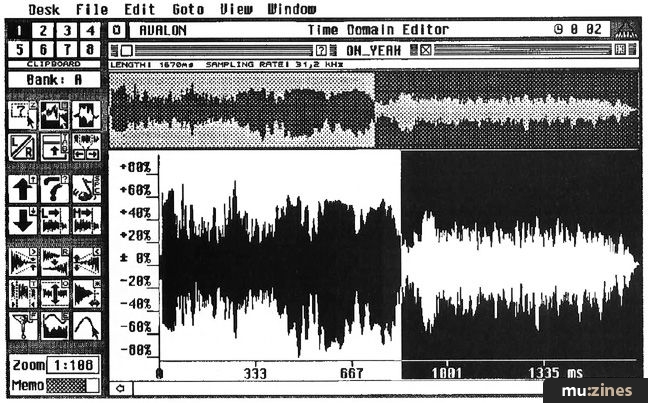
Changing the name to supercession, the powerful Avalon Sample Processing program for the ST (£325) had reached v2.0 and included SCSI interface facilities and what Steinberg call a "synthesiser" facility for scratch-building sounds. The program has also followed Cubase's example by becoming large-screen compatible. Completely new at Frankfurt were editing software for Korg's Wavestation (and rackmount Wavestation) in the Synthworks range (£165), the SMP11 (£TBA), a slimmed down (and therefore cheaper) version of the SMP24 SMPTE synchroniser, and the VLTC1 video sync unit (£TBA).
Visiting Americans Opcode had brought a variety of new programs with them. Vision 1.3 (£399) is the latest version of Mac sequencer Vision which, amongst other things, facilitates the use of over 200 MIDI channels. Studio Vision 1.3 (£799) is ready and waiting for use with Digidesign's imminent four-channel digital audio hardware as well as offering the features of Vision 1.3. Galaxy Plus Editors (£TBA) is a soon-to-be-available editing program supporting in excess of 40 current MIDI devices including Korg's Wavestation, E-mu's Proteus and the complete Kurzweil K1200 series. Two more programs from Opcode are Track Chart (£TBA) (which generates hard-copy track sheets) and Max (£TBA) (a real-time graphics programming environment) - not essentially musical, but they're there if we need them. What Opcode have chosen to call the Open MIDI System is a new approach to integrating the software and equipment currently found in the recording studio. Details are scarce but it permits a one-off setting up of your system to optimise its use, after which operation of the gear is somewhat streamlined. Needless to say, Vision 1.3, Studio Vision 1.3 and Galaxy Plus are all OMS compatible.
Back on their home turf were C-Lab, who were concentrating on consolidating the recently-released v3 of Creator/Notator, and more recent suite of educational programs, Aura, Midia and Notator Alpha (all reviewed elsewhere in this issue). Seen at last year's British Music Fair but still unavailable at the time of the Musik-Messe, the Polyframe modular generic editing system was still looking good - review to follow.
Crossing over into the recording side of this year's show, both Cubase and Notator were benefitting from demonstrations of Plasmec's ADAS direct-to-hard disk recording system for the Atari ST. ADAS (£850) offers to turn your ST into a hard disk recording system by using the computer purely as a host and leaving the hard work to the ADAS hardware. Because of this, you can still run your sequencer on the ST and - if it's Cubase or Creator/Notator - you'll be able to integrate direct-to-hard disk recording into your MIDI recording techniques. On top of the ST and ADAS unit you'll need a hard disk (10Meg gives 1 minute of stereo sampling at 44.1kHz) and if you want high quality D/A and A/D and digital ins and outs for DAT editing you'll need an extra card (£299), but this will also allow you to back up your hard disk to DAT (any data, not just ADAS information). However you look at it, it's going to be an extremely cost-effective system.
Less cost effective but certainly no less impressive is Yamaha's YPDR601/RC601 CD recording system. The complete system comprises a mastering unit and remote control, and is expected to cost around 15 grand - considerably less than other currently-available systems. Yamaha's system isn't intended to produce CDs for domestic consumption, rather to produce the CD equivalent of test pressings. Still, if you've got the cash and nobody else will sign you up, you could be knocking out CDs for the family in your bedroom.
While the DMR8 digital multitrack isn't hot news, the DCM1000 (approx £21,300) certainly is. It's a digital mixing desk intended for use with the DMR8, having 22 inputs, ten main busses, four aux busses, snapshot automation of all control settings and dynamic automation of channel levels, pan, routing, EQ and aux sends. Mix automation information is stored via an onboard 3.5" floppy disk. Yamaha also unveiled their first DAT machine, the DTR2 (£1099). The machine is intended for professional use and supports both 48kHz and 44.1kHz sampling rates, boasts co-ax and optical digital ins and outs, and remote control. Several new signal processors put in an appearance at Frankfurt; amongst them were the EMP100 Multi-fx unit (£249) - a 16-bit unit based on the SPX series and containing 100 preset and 50 user-programmable memories - and the FX900 (£649) Simul-Effects Processor. The FX900 contains 100 preset and a further 100 user-programmable memories and features realtime parameter modification.
Back on the Korg stand, the company's new A1, A2 and A5 signal processors were much in evidence (the only reviews that count will be appearing in MT soon), but pride of place went to the Audio Link Digital Audio Production System (around £23,000). Audio Link is an 8-track direct-to-hard disk "Workstation" involving MIDI and video interfacing, MIDI sequencing, internal digital mixing and effecting and editing down to waveform level. Powerful or what?
Cheap or what? was the Alesis ADAT - Alesis Digital Audio Tape (£3700). The word was already out in certain circles before the show (that is to say we knew about it...), but it was on a short leash (...but couldn't tell you). Even at the Musik-Messe, ADAT was in a back room with a photography blackout in effect. Secrecy aside, ADAT is a 16-bit, 8-track recorder based on S-VHS videotape. The unit comes in two sections (ADAT recorder and BRC remote) and uses a variable sampling rate (42.76kHz-50.85kHz) with 64 times oversampling. Apart from its price, the system's greatest appeal is likely to be its facility to slave up to 16 units together under the control of the BRC unit (under £2000) to give 128 tracks of fully-synced digital recording.
Roland's bid in the direct-to-hard disk recording stakes took the form of the DM80 (£TBA). The 16-bit system is configurable as a four or eight track, will record at 48kHz, 44.1kHz or 32kHz sampling rates, features 24-bit digital mixing and comes with a cable remote unit. Where the four-track DM80 contains a single 100Meg hard disk (giving 18 minutes of monophonic recording at 44.1kHz), the eight-track version used two. Additionally, Macintosh operating software will be available to enable more than one DM80 to be used together.
Another impressive piece of Roland kit on display was the RSS (Roland Sound Space) Processing System. This 3D sound system - which has since been aired on a Tomorrow's World/Radio 1 linkup - uses special encoding of sound at the recording stage to describe a three-dimensional sound image on playback over a conventional stereo hi-fi system - and it works. The system comprises the RSS 8084 Sound Space Processor, ADA 8024 (18-bit linear A-to-D/20-bit linear D-to-A) convertor and SSC 8004 Sound Space Controller.
MIXING DESKS OF note at Frankfurt included Studiomaster's new Showmix line. These come in 16:2 and 16:4:2 formats (both expandable to 40 input channels) and feature four-band, two-sweep EQ and six aux sends. Although they're intended primarily for live use, they might also double for use in a sequencer-based studio setup. Soundcraft, meanwhile, were making much of their new Spirit range. The Sprits follow the in-line format and come customised for both studio and live applications and they'll only make a "budget"-sized hole in your pocket instead of a professional one. Reviews imminent. From Soundcraft to Soundtracs, and their new Megas range of desks. These adopt the split monitoring format and come in 16- and 24-buss formats. Live Megas go under the name Megas Mix.
The Dolby S version of Tascam's MSR24 one-inch, 24-track recorder - the MSR24S - was being given a high profile on the Tascam stand in the absence of anything genuinely new. More affordable but still remarkably desirable Tascam units, however, are already lined up for forthcoming MT reviews.
In contrast, Fostex' G24S Dolby S one-inch, 24-track machine was keeping the company of the new X28 personal multitracker and 1612 mixing desk. The X28 is a four-track cassette unit equipped with Dolby B and an eight-channel mixer, which allows simultaneous four-track recording. The 16-channel 1612 is another budget desk and boasts 12 output groups for use with up to 12 or 24-track machines.
Returning to the G24S, the machine's ability to be integrated with Steinberg's Cubase sequencing program as part of a fully-integrated, computer-based, MIDI-controlled recording system was being demonstrated to dramatic effect by none other than UKMA mentor and regular MT contributor Vic Lennard. Off to Italy for more demonstrations almost immediately after returning from Germany, Mr Lennard paused only to comment on his satisfaction with the G24S/Cubase interface and to knock out another couple of reviews.
And with that we must leave Frankfurt for another year. New gear we've got - synths, samplers, software, digital recorders, mixing desks... It makes you wonder what's left for next time, doesn't it? And another thing: was that really the Scorpions' Uli Jon Roth I passed on the escalator on my way out?
Most prices quoted in this report include VAT at the old rate of 15%. Prices are subject to change due to the recent increase in VAT; prices may also change before equipment becomes available in the UK.
Publisher: Music Technology - Music Maker Publications (UK), Future Publishing.
The current copyright owner/s of this content may differ from the originally published copyright notice.
More details on copyright ownership...

Music Technology - May 1991
Donated by: Mike Gorman, Ian Sanderson
Scanned by: Mike Gorman
Show Report by Tim Goodyer
Help Support The Things You Love
mu:zines is the result of thousands of hours of effort, and will require many thousands more going forward to reach our goals of getting all this content online.
If you value this resource, you can support this project - it really helps!
Donations for August 2026
Issues donated this month: 0
New issues that have been donated or scanned for us this month.
Funds donated this month: £0.00
All donations and support are gratefully appreciated - thank you.
Magazines Needed - Can You Help?
Do you have any of these magazine issues?
If so, and you can donate, lend or scan them to help complete our archive, please get in touch via the Contribute page - thanks!
If you're enjoying the site, please consider supporting me to help build this archive...
...with a one time Donation, or a recurring Donation of just £2 a month. It really helps - thank you!

 @mu_zines
 RSS Feed
 Blog
Blog