Drum Hum
Tuition / Technique
(MM May 87)


Magazine Archive
Home -> Magazines -> Issues -> Articles in this issue -> View
Article Group: | |
Fret Fax | |
Article from Phaze 1, July 1989 | |
WELL, THIS MONTH as promised, here are the full listings for major scales and chords in major keys. As you'll recall, every set of chords is based on its attached major scale, and you form a major scale, starting on any note by producing:
tone, tone, semitone, tone, tone, tone, semitone.
This complete chart of chords uses that scale organisation, and builds all the chords using only the notes of the chosen scale (a diatonic scale). All the chords are formed by doing a letter count from the root note of the chord (the note which names the chord). The second thing to remember then is:
Root + 3rd + 5th + 7th = triad (or seventh chord)
Armed with this information, you get the full list of chords shown below:
CHORD CHART
| KEY | I | II | III | IV | V | VI | VII |
| C | C | D m | Em | F | G7 | Am | B dim |
| G | G | A m | Bm | C | D7 | Em | F♮ dim |
| D | D | E m | F♮ m | G | A7 | Bm | C♮ dim |
| A | A | B m | C♮ m | D | E7 | F♮ m | G♮ dim |
| E | E | F♮ m | G♮ m | A | B7 | C♮ m | D♮ dim |
| B | B | C♮ m | D♮ m | E | F♮ 7 | G♮ m | A♮ dim |
| F♮ | F♮ | G♮ m | A♮ m | B | C♮ 7 | D♮ m | E♮ dim |
| C♮ | C♮ | D♮ m | E♮ m | F♮ | G♮ 7 | A♮ m | B♮ dim |
| F | F | G m | A m | B♭ | C7 | D m | E dim |
| B♭ | B♭ | C m | D m | E♭ | F7 | G m | A dim |
| E♭ | E♭ | G m | G m | A♭ | B♭7 | C m | D dim |
| A♭ | A♭ | B♭ m | C m | D♭ | E♭7 | F m | G dim |
| D♭ | D♭ | E♭ m | F m | G♭ | A♭7 | B♭ m | C dim |
| G♭ | G♭ | A♭ m | B♭ m | C♭ | D♭7 | E♭ m | F dim |
| C♭ | C♭ | D♭ m | E♭ m | F♭ | G♭7 | A♭ m | B♭ dim |
There is one other set of problems to solve before you can turn this theoretical knowledge into real sounds on the neck of the guitar. If you concentrate on any one key grouping of chords as shown in the list, you will notice that there are four different chord types shown:
Major (chords I IV), Minor (chords II, III and VI), Dominant (chord V) and Diminished (chord VII)
All these chords are built of a Root, 3rd and 5th (and 7th), yet they are different constructions. How does that come about? Try these two different chord shapes:
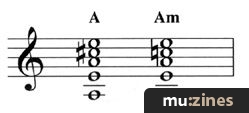
You will recall these two chord shapes from my chord lists in one of the earlier articles. From these it is clear that the 3rd is different in the major and minor chords.
A major chord has a major 3rd (4 semitones A A♮ B C C♮). A minor chord has a minor 3rd (3 semitones A A♮ B C)
Check any minor chord and you will find this to be true:

This is the most important distinction between chords, but naturally there are other "formulae" to be learnt and I'll deal with these in a later article. For the time being, it is important that you are aware of the difference between major and minor chords, and the dominant 7th chords (a major triad with the dominant 7th added — I'll define that 7th later).
What we must now do is turn this theoretical knowledge into real answers on the neck of the guitar. At this point I should make clear the special problems for guitarists. Without doubt, this is a tough instrument to take on physically. It is also not particularly helpful in terms of logic of layout. It's easy on a piano to make the crude judgement that if you go right up the keyboard the notes get higher in pitch and vice versa. That is not so obvious on the guitar when the 2nd note on the 4th string sounds exactly the same as the 12th fret on the sixth string!
"Ah, but the sound..." I hear you saying, because that what gets us all about this lovely instrument.
It's no use relying on set chord shapes without working out what they mean, and it is in this area of chord building that you can teach yourself invaluable musical information. Now you know the difference between G and Gm in technical terms (repeat after me "a major 3rd has 4 semitones, a minor 3rd has 3 semitones"), then you should be able to put that information to work on the neck:

Standard G and Gm shapes on the top four strings of the guitar, from which it becomes quite clear by shape and sound, what the difference is. That was an easy one because those are both standard shapes like these E and Em shapes:

Notice that although some notes are repeated at different pitches, there are still only three different notes in each triad, R 3 5. Can you work out a more tricky one? Play this C major chord, which is a standard left-hand shop, but you only play strings 5 4 3 and 2:
Now try the nearest voicing of Cm (R ♭3 5) C E♭ G:

You can now see how this sort of approach is going to teach you where the notes are, and how the chords are formed. Before too long, your whole concept of what the guitar can do will be changed, and you'll be on your way to playing whatever guitar style most grabs you!
Spend this month voicing major and minor chords, so you can hear the difference off the neck of your guitar. Of course, you should use my original list of chord shapes in previous articles as these will give you a good starting point. But do make sure you work out the names of the notes in the chords won't you!
More with this topic
 |
 Chord of the Month - Guitar |
 Synth Sense |
 Beat Box |
 Vocal Infection - Voice Training |
 Fender Fretless Precision - Fretless Bass Playing |
 Drum Hum |
 Drum Hum |
 Drum Hum |
 Coverage - Scritti Politti - The Sweetest Girl |
 Skill Centre - China Crisis Play 'Arizona Sky' |
 Chord of the Month - Guitar |
Browse by Topic:
Tuition / Technique
Publisher: Phaze 1 - Phaze 1 Publishing
The current copyright owner/s of this content may differ from the originally published copyright notice.
More details on copyright ownership...

Phaze 1 - Jul 1989
Do It Yourself
Feature by Peter Driver
Help Support The Things You Love
mu:zines is the result of thousands of hours of effort, and will require many thousands more going forward to reach our goals of getting all this content online.
If you value this resource, you can support this project - it really helps!
Donations for August 2026
Issues donated this month: 0
New issues that have been donated or scanned for us this month.
Funds donated this month: £0.00
All donations and support are gratefully appreciated - thank you.
Magazines Needed - Can You Help?
Do you have any of these magazine issues?
If so, and you can donate, lend or scan them to help complete our archive, please get in touch via the Contribute page - thanks!
If you're enjoying the site, please consider supporting me to help build this archive...
...with a one time Donation, or a recurring Donation of just £2 a month. It really helps - thank you!

 @mu_zines
 RSS Feed
 Blog
Blog