


Magazine Archive
Home -> Magazines -> Issues -> Articles in this issue -> View
Harrison Information Technology PA300 Mixer Amp | |
Article from In Tune, May 1986 | |
Harrison mixer amp – Hit or Miss?
Harrison's new 300w 6-channel mixer amp: Hit or Miss? asks Tim Oakes
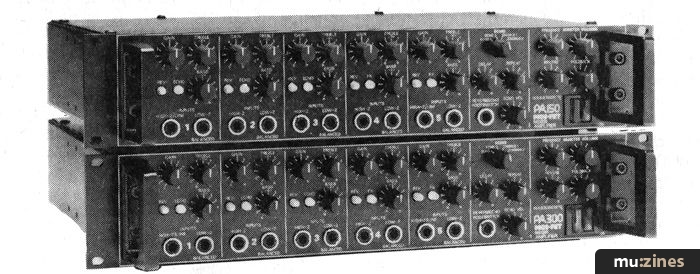
You've spent weeks drooling over the catalogues - multi-channel mixers with lots of flashing lights, and pretty knobs to twiddle. You've thought about taking a hammer to your poor old piggy bank, just for the price of a power amp: and then you discover that the cost of the necessary leads alone are going to set you back several weeks' gig money! A common scenario among prospective PA buyers? Too true: but there is an alternative - the 'old faithful' PA mixer/amp. Although treated by some musicians as chronically archaic, the mixer/amp still retains a firm following among many different types of musicians and, frankly, the reasons aren't hard to see.
The first reason, of course, is cost. Mixer/amps work out far cheaper than buying equivalent components of equal quality, and then there's the advantage they offer in setting-up time - much reduced from alternative systems. Finally, they're very simple to operate.
I must admit to being a mixer/amp fan at this point (having played through more amps of this type than almost anything else), so when a call came from above I jumped at the chance of having a really close look at a new contender in the stakes - the H.I.T. PA300. There are two models in H.I.T.'s mixer amp series: the PA150 and the PA300, the suffix numbers referring to their respective wattage outputs. Both models feature the same controls and ports, and only their output power differs, developed in both cases from what the makers call '2nd generation MOSFET' power amp stages. I'll say here and now, by the way, that, subjectively at any rate, the sound from my sample was very loud indeed! What's more, the H.I.T. offers such a wide variety of sound shaping controls and features that it really is eligible for that much over-used term, versatile. Notably, both models feature built-in Echo/Chorus systems, along with the more usual Reverb facility, and will also supply a foldback feed. What's more, they are very sturdily made and will fit any standard 19" rack system, filling only 2U in height.
The PA300 has five input sections, each with hi and low impedance jack inputs plus Gain, Treble and Bass controls and a Reverb in/out switch. Channels 1, 2 and 3 also have an echo in/out switch, while on channels 4 and 5 this is replaced by an FX in/out switch, to be used with the send/return ports on the amp's rear panel. On the far right of the front panel are the two 'master' sections, the left one containing the 'Echo Type Select' switch plus controls for Delay (length of echo). Repeat (determining the duration of the repeats) and Echo vol, which mixes the echo signal with the original. In addition there is also a reverb/echo footswitch footswitch jack, enabling remote on/off operation.
The 'Echo Type Select' switch gives the option of two echo and two chorus effects from the built-in effects circuit. Echo 1 is a single repeat (great for Rock 'n Roll!), while Echo 2 gives multiple repeats. Chorus 1 gives a medium sweep chorus effect, while Chorus 2 delivers a slow sweep - depending on how you manipulate the controls, of course. On the far right of the front panel is the mains on/off (an illuminated rocker switch) plus a master volume control, presence control, foldback channel level control and, finally, Reverb level control.
On the back panel, the H.I.T. features a five pin DIN tape in/out socket, foldback output jack, effects send and return jacks and two speaker output jacks. To ice the cake, H.I.T. have also added a clever Eq send/return section, so that Bose equalisers can be used with the system (assuming that Bose speakers are being used, of course). Alternatively, conventional graphic or other equalisers can be used if desired.
But enough of the specs - the sound is the thing! The Harrison PA series amps are ideal for a wide variety of uses it seems to me, including the obvious rehearsals and small venues, not to mention fixed installations like pubs and clubs. For most smaller venues (particularly for bands who just use PA for vocals and keyboards) this series really scores. As for testing this amp, here's one use that I put it to and can vouch works - and works very well! I used Channels 1, 2 and 3 for vocal mikes (two of them high Z, one low Z). All three had both the reverb and echo effects on. Channel 4 was used for a keyboard (again with reverb), while channel 5 held a DI output from an acoustic guitar (Hi Z, reverb on). I also connected the FX send/returns to a flanger, so that both the keyboard and acoustic guitar could be used with this effect. Plugging even this lot in took a matter of moments. Obviously, setting the reverb and echo the way you want them is a finer art, and takes a short soundcheck to sort out - but the majority of this estimation can be prepared at home, with fine tweaking taking place while the first pints are being pulled. Yes, the H.I.T., for all its facilities, is quick to set-up and easy to use.
From a tonal angle, the first reaction to the H.I.T. was how bright it sounded compared with most PA mixer/amps - and anyone who has used amps of this type will know just how hard it is to get a good 'sparkle' out of most of them! Dullness (especially from mikes) can be rectified easily with the treble controls, but, if that isn't enough, the Presence control gives even more of this sparkle - although judicious use is required to avoid feedback in smaller rooms. Of course, with more treble gain the echo and reverb have a better chance of developing a good sound too; and they did. Mind you, there's plenty of bass and mid available as well, so on all counts the Harrison performs extremely well.
Versatile, small and powerful, with the bonus of built-in echo/chorus and reverb effects, the H.I.T. performs really well. The 300 watt rating isn't much of a guide to its real output power because it's loud - especially through a good quality pair of speakers. Having said that, I also tried it with a bog-standard pair of 2x12s, and the improvement over the sound I usually get from them was quite marked. Taking everything into account, the 300 watt model (at an RRP of £443.84) is likely to be more useful to most readers than the £408.19 150 watt model, which is likely to be a bit quiet for many applications. Frankly, if you've got the extra money, go for the 300 - it's a great bit of kit!
RRP £443.84 inc. VAT
More details from Harrison Information Technology Ltd., (Contact Details), or tick the 'Harrison' box on this issue's free information request form.
Publisher: In Tune - Moving Music Ltd.
The current copyright owner/s of this content may differ from the originally published copyright notice.
More details on copyright ownership...

In Tune - May 1986
Review by Tim Oakes
Ads for Gear in this article:

Help Support The Things You Love
mu:zines is the result of thousands of hours of effort, and will require many thousands more going forward to reach our goals of getting all this content online.
If you value this resource, you can support this project - it really helps!
Donations for May 2026
Issues donated this month: 0
New issues that have been donated or scanned for us this month.
Funds donated this month: £0.00
All donations and support are gratefully appreciated - thank you.
Magazines Needed - Can You Help?
Do you have any of these magazine issues?
If so, and you can donate, lend or scan them to help complete our archive, please get in touch via the Contribute page - thanks!
Please Contribute to mu:zines by supplying magazines, scanning or donating funds. Thanks!
Monetary donations go towards site running costs, and the occasional coffee for me if there's anything left over!

 @mu_zines
 RSS Feed
 Blog
Blog