


Magazine Archive
Home -> Magazines -> Issues -> Articles in this issue -> View
HiWatt L50R Lead Valve Head | |
Article from In Tune, May 1986 | |
Gary Cooper finds Happiness in a Hot HiWatt!
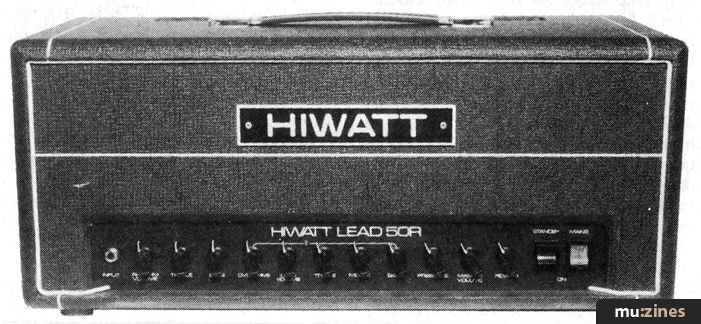
Yes valve-lovers, HiWatt are back - and with a vengeance! Despite the company's rather chequered history, HiWatt's amps have never lost their appeal, especially among bass players, who have always valued the extra 'balls and bite' that HiWatt's bass heads have given over more common valve heads, especially overseas, where their fortunes were maintained whilst British sales slumbered. 1986, however, sees HiWatt in new and unashamedly dynamic management hands, heavily re-invested in, and with a new range which has been stealthily developed during the past nine months. With a completely redesigned range of products now ready to hit the UK market, massive advance orders in hand from Japan, the USA and Continental Europe, HiWatt are now poised to attack the British market through a team of dealers to be called 'HiWatt Power Stations'.
Having been aware of all this frenetic background activity (but sworn to silence) since the programme for revitalising the HiWatt name began, I was fortunate to be loaned the very first production sample seen by any member of the Press - a 50 watt, all-valve lead guitar head fitted with an Accutronics spring-line reverb: part of the new 'Legend' series of HiWatt amps.
Aside of the 50 watt head (available in reverb or 'straight' versions), the new HiWatts come in 100 watt lead variations with or without reverb, bass 100, 200 and 400 watt head models and 50 and 100 watt reverb combos, and are matched with a range of cabs including 4x12" slope and straight fronted types, with a stupendous 4x12" horn-type bass system which will accept 1000 watts RMS!
THE SPECS
Although externally the HiWatt L50R looks like any previous HiWatt head, internally it's possibly the most advanced valve amp that I've yet examined. My immediate reaction on opening the back ran something like 'hey - wheresa alla my spaghetti, eh?', because the HiWatt, in common with all the Legend range, has dispensed with the familiar valve amp hand-wired tangle. In its place is a neat top panel bearing two EL34 output tubes, a shielded section carrying five ECC83s, and the Accutronics spring reverb. Nothing so strange thus far, but dismantle the amp still further (an easy job for any even halfway competent service engineer) and it's then that the shock hits you - a lot of empty space and just a high grade circuit board with everything tightly strapped down and ready for action. This is a bomb-proof amp which looks like it's been made for utter reliability. Even better is the news from HiWatt that their appointed 'Power Station' dealers will have to be capable of on the spot servicing of any HiWatts on demand, that they will all carry spare plug-in boards and will offer instant service on any models that go down - not that they should, judging from the constructional standards of my sample model!
Facilities on this 50 watt all valve head are very much in advance of what you would expect to find on a traditional valve head. The back panel, for example, offers just about everything even the most demanding pro could ask for - much more the sort of facilities that one finds on a modern tranny amp, in fact. The array of options begins on the right hand end of the panel with a standard plug-in IEC mains lead, followed by mains and HT fuses, FX send and return jacks, a socket for the remote channel switching/reverb footswitch (supplied, I was glad to note!) after which comes a line-out jack socket with a control next to it which enables a continuously variable output to be sent to your mixer/slave or recorder as you choose. Ending the back panel array are twin speaker jacks with a switch enabling you to select 8 or 16 Ohm feeds.
The front panel of this twin channel amp is equally full of facilities. A single input is followed by the rhythm channel volume level, treble and bass controls, after which you're onto the lead/overdrive channel with its overdrive, channel volume, treble, middle, bass and presence controls, then master volume and reverb controls. Mains on/off and standby on/off follow these. By any standards this is a superbly equipped head, capable of full stage, rehearsal and studio use with the absolute minimum of inconvenience.
HI-WHAT?!?!
I should have known better - 1 really should! Every time 1 get my hands on a valve head, some self-destructive urge makes me wind it up to full volume, plug in my Gibson and let fly. Sometimes I've been pinned against the office wall, other times I've had the Boys in Blue hammering on the door - but I've never singed the damned carpet before! Fifty watts? Hah! This is some sort of joke that HiWatt are playing, surely? I've always maintained that valve heads were intrinsically louder than tranny amps of similar wattage ratings, but this '50 watt' head defies all the rules! According to the makers it punches out a cool 60 watts RMS. 60 watts? Well, it just goes to show how little notice you should take of wattage ratings!
Other delights than sheer output level await the player trying the HiWatt, not least of which are the results of twiddling with the tone controls. Although the rhythm channel only offers treble and bass pots, these are remarkably effective, rendering a sound from my Seymour Duncan pickupped Tokai as close to the perfect Strat clean sound as I've ever got from any amp. Equally, my trusty SG rang clear and true, with a penetrating ring to it which made for some of the best clean rhythm sounds I've ever obtained from this guitar.
Kick the silent channel footswitch and a front panel LED lights, showing that you're now set to the lead/overdrive channel. Here you have a lot of controls to play with, but on no account should you treat the HiWatt as a typical valve head, by turning everything on full and hoping for the best! Mastering this channel takes time, as with all the best amps, simply because the tone controls work so well. Take your time with them though, and you'll pretty soon find all the sounds that you could hope for. I certainly got a hot Strat sound out of this overdrive channel, although some care has to be taken when setting the relative levels of the overdrive and channel volume controls (not to mention the versatile tone controls) as they're much more responsive than those on the majority of valve amps.
My Gibson, too, eventually felt just as at home running through this new amp. At first (my basic tendencies being what they are!) I over-ran the overdrive control and got, as a result, too 'raspy' a sound from this combination. Taking more time and trouble however, and balancing together the overdrive, lead channel gain and master volume controls, I was able to smooth the sound out, and eventually found what I personally use as a test of any new valve amp - whether I can get that smooth yet sharp yet expressive sound from an SG which players like Clapton (in the dim and distant past) and Mick Taylor have taught us to applaud. With care, I got this sound to near perfection from the HiWatt, discovering while I aimed for it just how much better applied the Accutronics reverb in this head is than many examples I've seen. Combined with this is the fact that the HiWatt's tone controls actually do something, which makes the newcomer a rare beast indeed by traditional valve amp standards.
On a less subtle note, both a Nadine (twin coil pickupped) and a 'super-hot' Strat (fitted with overwound UKG pickups) drove the Hiwatt to a wild intensity via its overload control, producing just the sort of sound that would send any HM fan into ecstasy.
The key to getting the best from this amp is time. Rush at it on the principle that it's like most other valve heads, and you'll find its sounds quite definitely over the top; take your time, however, and it is as subtle and responsive to your playing as a premium quality valve amp must be, to be worthy of its price. Given a little care in setting up, the HiWatt has all the 'breath' and 'space' in the sound which allows for truly expressive and subtle playing. Treat it like an HM monster and that's the sound you'll get. If that suggests to you that this head is far more versatile than most, then you're not far from the mark. True to the tradition of the very finest valve amps, this newcomer cam be all things to all players, whilst always remaining better than its tranny equivalent.
CONCLUSION
The new HiWatt team certainly haven't wasted their nine months intensive development time. From a constructional point of view this amp should prove to be both utterly reliable and - if the worst does happen - very easy to repair. Tonally it offers all that you can ask of any lead amp, from the sweetest, cleanest Strat/rhythm sound on Channel 1 to anything from a subtler Blues expression to outright HM from Channel 2. The reverb works to perfection and the instant, silent channel switching also shows how much effort has gone into making this amp work to the peak of perfection.
Take your time with this new amp and you'll find a versatility and depth which place it way over the typical valve head. Fifty watts sounds amazingly loud through decent speakers (give it at least a good 4x12" cab to drive), and it will more than satisfy in any studio, rehearsal, pub or club environment. A 100 watt version is of course offered for players undertaking bigger gigs, but I've personally always tended to like 50 watt heads for their ability to overdrive at the sort of levels which most working players (realistically) use. Go for the 100 if power is what you need, but don't ignore the 50 version if smaller size venues are more your scene. Pricewise, £325 puts it some £20 or so over the equivalent Marshall, and some might feel that this extra, on the face of it, is hard to justify. My own view is that it has an extra versatility which more than make up for the difference. Try them side by side and see what you think.
Welcome back, HiWatt. In a year's time I suspect the world could be at your feet!
Typical selling price £325 inc. VAT
More data from HiWatt Ltd., (Contact Details).
Publisher: In Tune - Moving Music Ltd.
The current copyright owner/s of this content may differ from the originally published copyright notice.
More details on copyright ownership...

In Tune - May 1986
Review by Gary Cooper
Help Support The Things You Love
mu:zines is the result of thousands of hours of effort, and will require many thousands more going forward to reach our goals of getting all this content online.
If you value this resource, you can support this project - it really helps!
Donations for April 2026
Issues donated this month: 0
New issues that have been donated or scanned for us this month.
Funds donated this month: £0.00
All donations and support are gratefully appreciated - thank you.
Magazines Needed - Can You Help?
Do you have any of these magazine issues?
If so, and you can donate, lend or scan them to help complete our archive, please get in touch via the Contribute page - thanks!
If you're enjoying the site, please consider supporting me to help build this archive...
...with a one time Donation, or a recurring Donation of just £2 a month. It really helps - thank you!

 @mu_zines
 RSS Feed
 Blog
Blog