


Magazine Archive
Home -> Magazines -> Issues -> Articles in this issue -> View
How About? | |
Gretsch GuitarsArticle from One Two Testing, May 1984 | |
A short history, and what to pay
Gretsch guitars are so hip, says reader Howard Soper of Norwich, How About a history and a price-guide? Paul Day obeys. You can request an article by writing to How About at the One Two address.
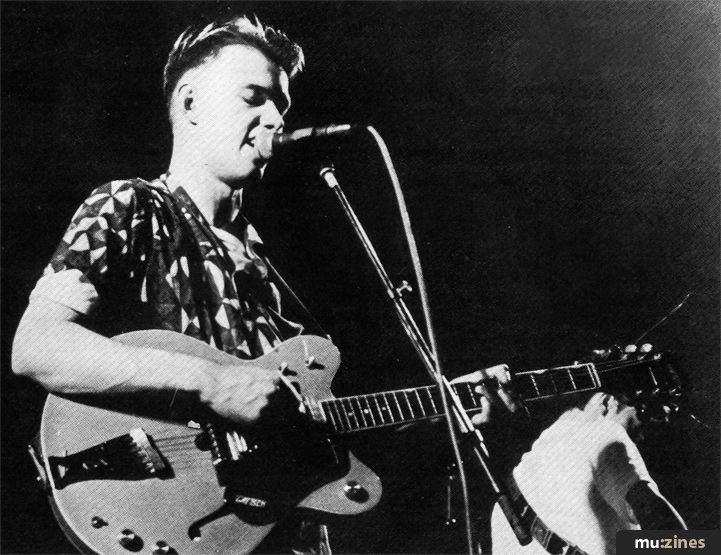
Edwyn Collins of Orange Juice grapples with his Gretsch.
Gretsch was established way back in 1883 as a maker of drums, which they continue to make today. Guitars weren't introduced until the late 1920s, electric models appearing some 20 years later, and Gretsch instruments have experienced widely fluctuating fortunes over the subsequent four decades.
Many of the now-classic Gretsch models first appeared during the 1950s, such as the original Country Club and White Falcon designs, plus the 6120 Chet Atkins Hollow Body model, this being the first of his Signature Series. As well as being an early and enthusiastic endorser, Atkins contributed many actual design ideas to the instruments bearing his name.
Other famous early Gretsch players included Eddie Cochran and Duane Eddy who made the deep 'twangy' sound of his 6120 an instrumental trademark. Bo Diddley was another Gretsch man, and his very distinctive custom instruments were later to become almost as famous as their owner.
By the late 1950s the cheaper Anniversary models had been introduced, and the Chet Atkins range expanded to include the single-cutaway Country Gentleman and Tennessean designs. Various solid-body models were launched, such as the Jet Firebird and Duo Jet, to partner the Chet Atkins version already in production.
However, it wasn't until the 1960s that Gretsch guitars really achieved worldwide exposure and popularity in the hands of George Harrison. In earlier Beatles days he had forsaken his trusty old Futurama solid for a Gretsch Duo Jet, but it was his later use of a Country Gentleman semi that almost single-handedly transformed the fortunes of the company, bringing the brand to the forefront of the guitar field. Sales boomed as Gretsch guitars became standard ware for numerous groups of the era, including The Animals, Small Faces, Troggs and Moody Blues.
By this time the Chet Atkins Hollow Body, White Falcon and Country Gentleman models had been substantially revamped, with double-cutaway body styling and new hardware. The solid range had also been re-styled and featured the British-made Burns vibrato unit. Upmarket Gretsch guitars included such idiosyncratic features as the Neo-Classic fingerboard with "half-moon" (thumbnail) position markers, built-in double or single "muffler" (string damper), padded back, standby switch, simulated f-holes, Project-O-Sonic stereo circuitry and the new Filter-Tron and Hi/Lo-Tron pickups replacing the original De Armond-made units. Many of these innovative ideas came to Gretsch courtesy of Jimmy Webster, their leading design consultant and a fine musician. His then-revolutionary Touch System guitar style pre-dated Eddie Van Halen by a good 20 years!
Later additions to the Gretsch range included the rather ungainly Astro-Jet solid and the Viking and Rally semis, while the success of the Gretsch-wielding Monkees led to a similarly named model appearing in 1966. An option on certain guitars was the Floating Sound unit, another Jimmy Webster gadget, this one designed to enhance sustain.
The early 1970s witnessed a decline in demand for Gretsch instruments as the Gibson Les Paul gained ascendancy as the in guitar. However, Crosby Stills Nash & Young did help to redress the balance somewhat with their use of the White Falcon and other models. Country music continued to provide a strong market; the pure, clear Gretsch tones had long proved ideal for the playing style, but in general popularity continued to dwindle during the 1970s, despite the efforts of the Gretsch design team to recoup some of the lost ground by up-dating existing instruments and introducing new models (such as the Super Chet) and various solids including the Super Axe, the Atkins Axe, TK and Committee models, later followed by the Beast. Of course, certain already-established models continued in production, but these more recent versions lacked the character inherent in their predecessors.
The rockabilly revival at the advent of the 1980s certainly renewed interest in the vintage big-bodied Gretsch electrics, and these instruments began to appear ever-increasingly in the hands of Brian Setzer of The Stray Cats and other bands of that genre. Since then, Gretsch guitars have met with wider appeal, being adopted by players like Nick Heyward (a Nashville, Streamliner, Country Club and Country Gentleman, at least), Dave Stewart (an unlikely sounding 'Country Clubman'), Edwyn Collins (Country Club), and even Elvis Costello (the occasional Anniversary between more normal Fender Jag bouts), while Malcolm Young of AC/DC can often just be discerned lurking behind a White Falcon.
With Gretsch instruments so fashionable at the moment (and in particular the various versions of the Chet Atkins Hollow Body and Country Gentleman models) prices have risen dramatically to somewhat unrealistic levels. Nevertheless, Gretsch guitars are quality products, providing excellent playability allied to a very distinctive, clear yet punchy sound. The Gretsch company has changed hands on a number of occasions and continuous guitar production has been in doubt more than once (although the same problem doesn't seem to afflict the drum manufacturing side). At the time of writing all guitar manufacture has ceased – a sad state of affairs which will, I hope, soon be rectified.
Here's a rough guide to the prices being asked for Gretsch instruments at the moment.
Early single-cutaway models, late 1950s: eg the 6120, early White Falcon, and so on... £900-£1000.
1960s up-market models: eg the Country Gentleman, Country Club, and Hollow Body... £500-£600.
Other 1960s models and more recent semis, eg the Tennessean, and Anniversary... £250-£300.
Publisher: One Two Testing - IPC Magazines Ltd, Northern & Shell Ltd.
The current copyright owner/s of this content may differ from the originally published copyright notice.
More details on copyright ownership...

One Two Testing - May 1984
Feature by Paul Day
Previous article in this issue:
Next article in this issue:
Help Support The Things You Love
mu:zines is the result of thousands of hours of effort, and will require many thousands more going forward to reach our goals of getting all this content online.
If you value this resource, you can support this project - it really helps!
Donations for April 2026
Issues donated this month: 0
New issues that have been donated or scanned for us this month.
Funds donated this month: £0.00
All donations and support are gratefully appreciated - thank you.
Magazines Needed - Can You Help?
Do you have any of these magazine issues?
If so, and you can donate, lend or scan them to help complete our archive, please get in touch via the Contribute page - thanks!
If you're enjoying the site, please consider supporting me to help build this archive...
...with a one time Donation, or a recurring Donation of just £2 a month. It really helps - thank you!

 @mu_zines
 RSS Feed
 Blog
Blog