


Magazine Archive
Home -> Magazines -> Issues -> Articles in this issue -> View
Innovators | |
MensanaArticle from Electronic Soundmaker & Computer Music, May 1984 | |
Mensana — Computer Music Band
Joseph Kay interviews those MIDI pioneers and TV stars, Mensana.
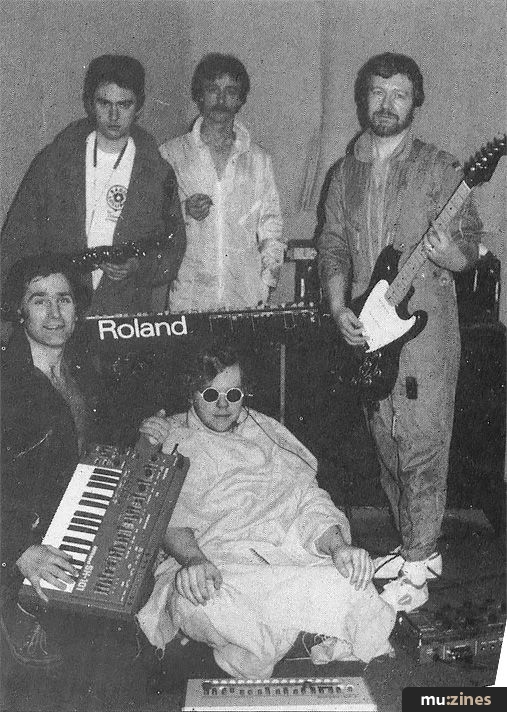
Mensana wear the latest fashions
It's always pleasing to think that an appreciation of electronic music requires higher than average intelligence, and some new evidence that's come to light tends to confirm this theory. That evidence is in the shape of Mensana, who laugh off the label 'the most intelligent pop group in the world' even though it's probably quite justified. The explanation lies in the fact that all the band members met through the music special interest group of MENSA, which has an IQ of 140 or more as the major entry qualification. The band have some other dubious distinctions — such as a potential audience of 900 million without every having played live — but more of this later.
Founder of MENSA's music group was Barry Connor, for many years a commercial photographer. His musical interests somewhat outrunning his technical knowledge, he asked the society to find him the country's top software writer and (failing that, as the band remark in unison) came up with Rupert Goodwins, who began by learning up on the recently-published MIDI specification for instrument communication. The first project was to be a computer-to-MIDI interface, and by the time this was under way the rest of the band had been recruited — Chris Giles on keyboards, Greg Holgate on guitar and Steve Ogilvie on sax and keyboard.
Within two weeks Rupert had a prototype interface up and running and the band were trying to establish some common musical ground. The interface began to look like a worthwhile commercial proposition and some final decisions had to be taken as to the exact design, as Rupert explains — "we wanted to explore the MIDI interface and the Spectrum seemed to be the cheapest computer which was up to it, although it does create a few of its own problems. Originally it was going to act as a sequencer and a patch switching device, but we could see it doing a lot more than that, and finally decided to make the system modular, so more capabilities can be added on later. Because most of the program is in machine code with a BASIC support program, it's fast enough for almost any purpose. You have to make it switch off part of the Spectrum memory as its BASIC ROM isn't needed for the machine code functions and there wouldn't be enough space to use otherwise, but at the moment you've got 3,500 notes of sequencing together with patch changing — rather more for monophonic sequences which could be played on a small synth using a MIDI-analogue converter".
The power of the Upstream interface aside, the band were facing the problem of writing and choosing material for a possible single. Barry usually writes on guitar but the diverse tastes of the band usually result in a complete change to his original concepts — Chris by trade a recording engineer, explains "we tend to find focuses within the pieces but still end up with a wide diversity of styles. Barry's stuff is often quite funky but we have some more melodic pieces and some heavier ones depending on who comes up with the original idea. If we were putting half-a-dozen tracks down we'd have half-a-dozen diametrically opposed ideas at the start, but by the time we'd finished there'd be some degree of integration. You could think of the band as a cross between Motorhead, level 42 and Jean-Michel Jarre!"
Cycling Upstream
Interest in the band has been generated by the MENSA connection, but they have been doing some powerful self-promotion and offering their services to a number of worthy causes at the same time. Steve is a regular broadcaster for hospital radio Lollipop and the band intend to provide the entertainment following a charity cycle race for hospital finances in the summer. This means completing the fifty miles from London to Brighton before the gig, but that isn't intimidating them any more than did the prospect of a seven million live audience on the BBC's Tomorrow's World. Barry explains "we did a run-through in the afternoon, then another completely different one before the programme was due to go out around seven in the evening. They changed the script entirely between rehearsals and we didn't think they really appreciated the idea of MIDI — in fact the overall impression was that we'd invented it, whereas all we'd done was to make it accessible to a home computer. When we did the show it was completely different again, and because they asked us to play some demo pieces in a different order I had to pull the plugs out of one of the instruments half-way. Also we had to play them out with the programme's theme tune which we'd only had a chance to learn during that afternoon!" Despite the tensions of live TV the performance went pretty well, due in no small measure to the participation of Roland UK. MD Brian Nunney responded to the band's call for help by flying the new programmable guitar synthesizer back from Tokyo, and this was used to demonstrate the guitarist's potential to produce church organ sounds using synthesizer voicings. In addition the HP400 piano was used to play drum sounds on the TR909 via MIDI, and a Jupiter 6 synth filled in the backing sounds.
"We've thought of providing custom-designed software for some of the bigger bands and we're talking to technical people from several groups at the moment"

Rupert shows how it's done - b flat bent.
To demonstrate the possibility of an all-synthesized band Steve abandoned his sax in favour of an SH101, but the possibility of a MIDI-equipped sax is not out of the question for the future, although conventional pitch-to-voltage techniques may not be suitable. Rupert's experimented with ultrasonics in the past and therein may lie the answer.
The Upstream interface presents a wealth of possibilities to the band, who are keen to develop new ways of playing. One possibility is a perspex surface which responds to touch as its refractive index is changed, and another hope for the future is that sound sampling software can be developed. None of these additions to the system will make the original interface obsolete, however, as they'll come in the form of new modules to be added to the existing hardware. It may be possible to use a light pen to define waveshapes for a synth, and since Chris was one of the first owners of a Yamaha DX7 there'll be a lot of possible applications aimed at that particular keyboard. One facility allows sounds to be saved and reloaded via MIDI, and sounds on the synth can be displayed on a monitor in the form of a diagram relating to conventional synth sliders, making programming much easier.
"Think of the band as a cross between Motorhead, Level 42, and Jean-Michel Jarre"
The interface is so versatile that the band plan to save valuable studio time by using it in the programming of entire tracks. Since both notes and sounds can be specified, a single computer cassette can contain all the information needed to programme a Spectrum (MIDI information itself cannot be stored on tape) and replay that information in a perfect first-take performance in the studio.
In the live situation the MIDI bus could also control and synchronise a light show, something the band are investigating at the moment, but they're equally interested in what the system has to offer those less fortunate than themselves. "The interface can be used with a joystick to programme in tunes, which would be ideal for the disabled who otherwise couldn't play any form of music. Initially the Spectrum will play back the notes using its Beep command, but if you connect a MIDI synth you'd have a very professional music system. Also we've thought of providing custom-designed software for some of the bigger bands, and we're talking to the technical people from several groups at the moment."
Mensana At Work
When the band record their first single an expanded version of the interface will be capable of doing all the work, with power comparable to Roland's MSQ 700 or Yamaha's forthcoming MIDI sequencer. An analogue interface is on the cards, so the SH101 could also be in the picture if need be and all timing can be synchronised to a computer-generated click on tape. The programme is menu-driven, and even without the Spectrum connected the interface itself will act as a 1 in/3 out MIDI converter, Rupert's even investigated the new Sinclair QL, but concluded that it would be cheaper for the musician to buy a Spectrum than for Mensana to develop the necessary hardware for non-Z80 or 6502 machines.
In a sense Mensana's technological development is far outstripping their musical opportunities, but it won't be long before they're able to catch up. Some of the technical possibilities of the equipment they're using are quite frightening — the ability to play 32 analogue synthesizers from a single MIDI keyboard for instance. All this and more is available to the public for something under £200, and there's no knowing what they might come up with next.
As to the future — Greg Houlgate is determined to make his fortune, if not with Mensana then with a space board game called "G-1" which, he solemnly assures us, is big now but is going to be 'huge next year'. Barry Connor seems to have his work cut out publicising the band, and the Guinness Book Of Records is going to have to keep looking for a pop group with a combined IQ higher than 960. And, after a broadcast on the BBC's World Service, we're all going to have to think of a band who've never played live but have had a potential audience in the region of 900 million.
Publisher: Electronic Soundmaker & Computer Music - Cover Publications Ltd, Northern & Shell Ltd.
The current copyright owner/s of this content may differ from the originally published copyright notice.
More details on copyright ownership...
Electronic Soundmaker - May 1984
Donated & scanned by: Mike Gorman
Interview by Joseph Kay
Help Support The Things You Love
mu:zines is the result of thousands of hours of effort, and will require many thousands more going forward to reach our goals of getting all this content online.
If you value this resource, you can support this project - it really helps!
Donations for May 2026
Issues donated this month: 0
New issues that have been donated or scanned for us this month.
Funds donated this month: £0.00
All donations and support are gratefully appreciated - thank you.
Magazines Needed - Can You Help?
Do you have any of these magazine issues?
If so, and you can donate, lend or scan them to help complete our archive, please get in touch via the Contribute page - thanks!
Please Contribute to mu:zines by supplying magazines, scanning or donating funds. Thanks!
Monetary donations go towards site running costs, and the occasional coffee for me if there's anything left over!

 @mu_zines
 RSS Feed
 Blog
Blog