


Magazine Archive
Home -> Magazines -> Issues -> Articles in this issue -> View
Martin Guitars | |
Article from One Two Testing, August 1984 | |
C.F. Martin IV appraises acoustics
The whys, whens, and woods of a 150 year old guitar company. Paul Colbert (a mere 120) twangs some history and a D28 (below).
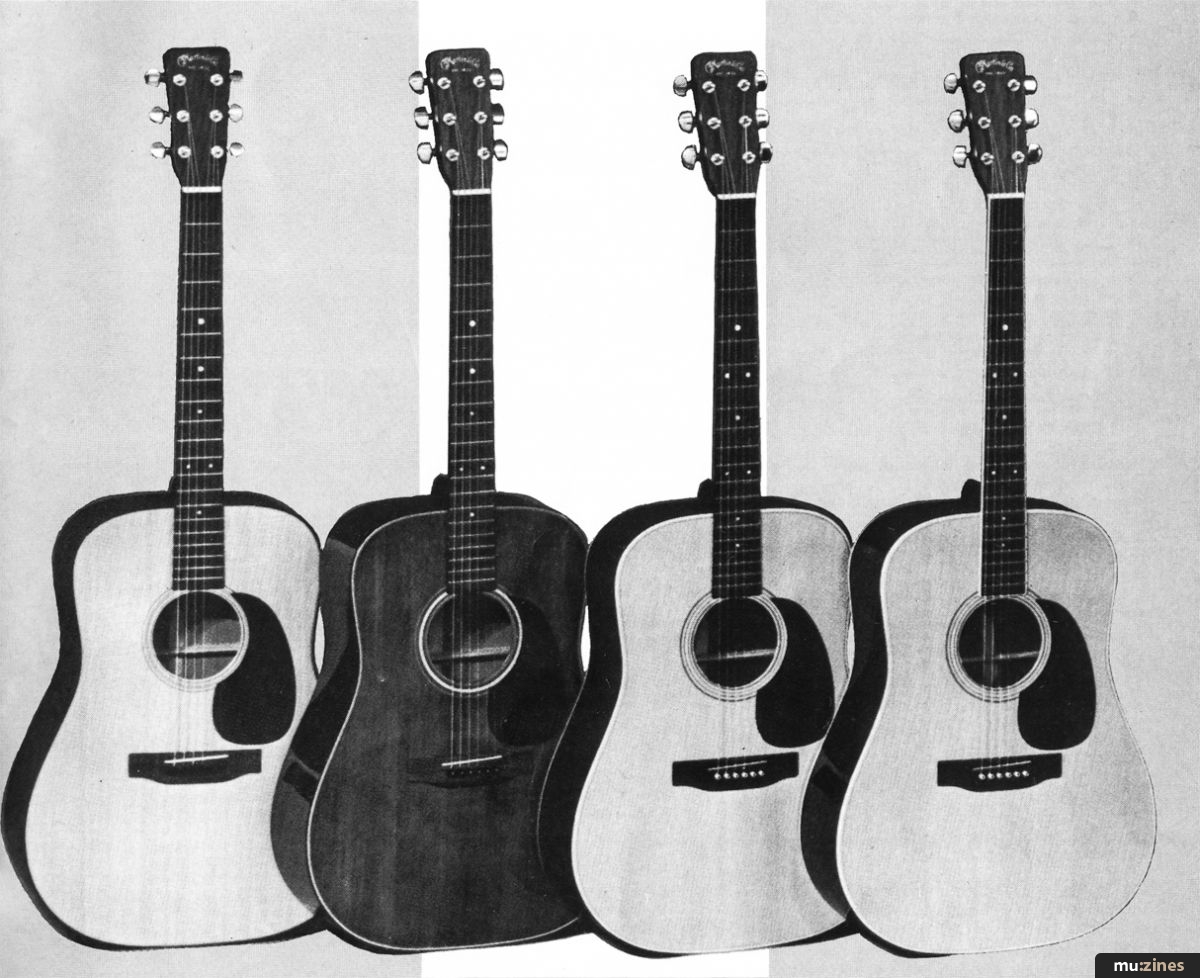
Most synths last perhaps two or three years before they're out of date. Electric guitars are veterans if they make it to their early thirties. So where does that leave an acoustic six string with more than 150 years of history behind it?
If your name is Martin then it leaves you as arguably the most famous steel strung acoustic alive today with a price tag of 1000 dollars, a production schedule that runs into months rather than weeks and a 300 man business empire that has stayed in one family since 1833.
Chris Martin the Fourth is the latest in a resolute line of C. F. Martins. His great, great, great grandfather built guitars in Germany in the early nineteenth century but fell foul of the strict furniture guilds of his town. He moved to America to pursue his dream; first New York, then out to Pennsylvania where the factory has remained to this day.
C. F. Martin the Fourth recently visited Britain when we asked him how a guitar name a century and a half old had survived.
"We've realised we can't force any more business out of the world," was the stoic reply from the fair haired American with 15 decades of reputation on his back. "The one thing we don't want to do is compromise on quality. We pay our craftsmen very well and use expensive materials and even during the recession the phone never stopped ringing. People always want Martin guitars – maybe not as many as ten years ago, but they still want them."
Undoubtedly the legend of the range is the D28 – the much copied Dreadnaught, originally embraced by Bluegrass and Country guitarists but later acknowledged as an acoustic standard of excellence by the rest of the world.
"The Dreadnaught was developed as a bass guitar at a time when there were banjo and mandolin orchestras that needed a bass but it wasn't considered appropriate to play an upright – they were for symphonies. The early Martins were small with gut strings. The turn of the century brought about steel strings which made the guitars sound better, but in an orchestra you still couldn't hear them. So we made larger bodies which created a really powerful bass sound which was just what they wanted.
"That was in 1916... and we haven't changed it."
The calculator makes that about 78 years. Wasn't it possible to get browned off with people asking for the same guitar for all that time?
"I don't think so, there's nothing wrong with a classic. Why abandon it?" And there are certain practical advantages. The company doesn't have to retool in order to produce new models. There have been alterations in that time, however, most of them down to World War Two. "For example, the herringbone trim on pre-war D28s or triple 0-8s was unavailable because it was German; the scalloped bracing was done by highly skilled craftsmen many of whom came to fight. We hired women instead and figured that rather than going through the arduous task of training them how to scallop the braces, we just wouldn't bother."
Today that practice of shaving away the braces under the guitar top is coming back into fashion. With less timber to restrict it, the top can vibrate more freely: "I explain that it's not a different sound, but whatever sound that guitar makes, with scalloped bracing it will make more of it." It's a labour intensive job, can't be applied to guitars that will be under the extra strain of heavy gauge strings, and requires the finest quality top that money can buy.
Wood seems an almost paranoid obsession with Martin. They employ experts to examine, test and buy timber – not from American yards but from the country of origin, such as India.
"To our minds, right now, Indian rosewood is the best wood. It's pretty, it works fairly easy – it can be a little brittle but not as bad as ebony which can crack – and it develops a character over time that has been unequalled.
"When you buy a Martin guitar then that day is the worst it will ever sound."
A rosewood log qualifies by being big – D28s, still the bulk of Martin's production, are big guitars. If the log will cope with those, it will cope with anything. Martin quarter saw their timber. Instead of simply slicing the log from the top, they cut it in half, then half again, and only then begin to take the material they need, thus ensuring the most consistent grain. The centre of the log – the heart – is always junked so an expert needs to know if it meanders seriously through the length of the tree, rendering certain sections useless.
In recent years there have been stories about sources of Indian rosewood drying up, even claims that it will shortly be impossible to acquire. Martin have begun to experiment with other timbers "to be on the safe side... we don't want suddenly to find one day there IS no Indian rosewood, and then have to change overnight."
Yet they have their own theories over exactly where the elusive Indian lumber has gone. "A couple of years ago the Japanese anticipated that the guitar boom would never end. They went around the world and bought an awful lot of wood and drove the price right up. But now the boom has petered out and they're sitting on it." Whether the orient will keep a grip on its supplies, or begin to release some for the world market, we'll have to see. Meanwhile other materials have become even rarer. Genuine ivory is virtually impossible to get and you can't bring it into America unless you can prove it came from an already dead elephant, not one slaughtered for the purpose. Tortoiseshell is likewise unobtainable, but that's a hoarier old myth.
"People think we just stopped using tortoiseshell a couple of years ago but we haven't had the real thing since the turn of the century. Now there's a plastic called Ivoroid which has a grain that mimics Ivory. Brazilian rosewood is difficult to get. We had enough to make 150 guitars and they were sold immediately."
That is what they call in the business 'demand'. What do people expect of Martins? "Mainly quality. They're very fussy, they pick them up, go over them with a fine tooth comb... smell them. If we have any secret, it's in our finish. It's cellulose, hand rubbed between sprays, left to dry naturally not through infra red heaters. A standard guitar takes three months to build with 300 steps involved.
"We had some research done a couple of years ago. We sent a few tops to a university in North Carolina which analysed the wood, sent certain frequencies through them, poured graphite on them to see if the nodes lined up. In the end they gave us a great thick report which essentially said – yes, you do know how to pick a good guitar top."
Even so, people do have strange ideas about their guitars. "They think that if they turn their stereo on and place their guitar next to it, the vibrations will do something to improve the wood. That's rubbish. You improve a guitar by playing it. And you don't use old wood to make a guitar. A guitar should grow old as an instrument.
"And people often ask how they should treat their guitar. I tell them to treat it like a human being. Store it in a room where you would feel comfortable, not in an attic in the winter or a cellar in the summer."
In many eyes, a guitar's identity is confirmed by its idiosyncrasies. For example, years ago certain Martins had headstocks joined to necks by a dovetail joint because at the time it was difficult to get hold of lengths of mahogany long enough to do the job in one piece. The dovetail left a small diamond at the rear of the neck. When larger stretches of mahogany became available, Martin craftsmen found themselves having to carve small triangles on the back with penknives, otherwise the customers would doubt the instruments were the real Mcoy.
Some flaws are being ironed out. Improved adhesives have led to the firm experimenting with attaching pickguards on top of the lacquer. In the past they could only be fixed direct to the wood and would then shrink, pulling the timber with them, producing a tiny split between pickguard and bridge — the familiar Martin Crack.
Finally, how do you convince someone to spend 1000 dollars on a single acoustic guitar. C. F. Martin the Fourth paused to consider his response. "Well, I guess the best salesmen we have are our satisfied customers... er... we do have more than 450,000 of those..."
Publisher: One Two Testing - IPC Magazines Ltd, Northern & Shell Ltd.
The current copyright owner/s of this content may differ from the originally published copyright notice.
More details on copyright ownership...

One Two Testing - Aug 1984
Feature by Paul Colbert
Help Support The Things You Love
mu:zines is the result of thousands of hours of effort, and will require many thousands more going forward to reach our goals of getting all this content online.
If you value this resource, you can support this project - it really helps!
Donations for May 2026
Issues donated this month: 0
New issues that have been donated or scanned for us this month.
Funds donated this month: £0.00
All donations and support are gratefully appreciated - thank you.
Magazines Needed - Can You Help?
Do you have any of these magazine issues?
If so, and you can donate, lend or scan them to help complete our archive, please get in touch via the Contribute page - thanks!
Please Contribute to mu:zines by supplying magazines, scanning or donating funds. Thanks!
Monetary donations go towards site running costs, and the occasional coffee for me if there's anything left over!

 @mu_zines
 RSS Feed
 Blog
Blog