


Magazine Archive
Home -> Magazines -> Issues -> Articles in this issue -> View
MPC Electronic Kit | |
Article from One Two Testing, December 1985 | |
new pads and racked modules
TRAILING well behind the keyboard synthesiser both in terms of quality and sophistication is its poorer relation, the drum synth. Driven by fierce competition the keyboard has developed from the almost primitive knob-twiddling of the Prophet-5 to the mind-boggling algorithmic potential, sleek design and value-for-money of the Yamaha DX7 in what seems like no time at all. Which is good news for all keyboard players — with the exception of Prophet owners, of course.
Meanwhile the drummer's DX7 still seems a long way off. Over roughly the same timespan, product leaders Simmons have dabbled with digital but most manufacturers have persisted with a succession of variations on the theme of analogue synthesis — which is bad news for everyone but owners of the Simmons SDS5.
That the SDS5, the original electronic drum, remains the yardstick by which such competitors must be judged is a damning indictment of the makers' slow rate of progress, particularly since (as I opined in last month's issue) musical fashion has already left these sounds well behind.
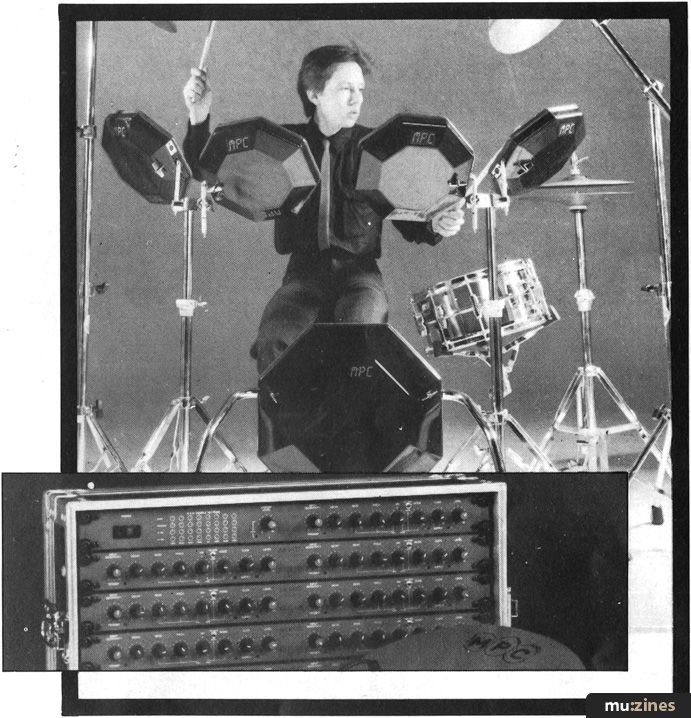
All this leaves me scratching the head as I contemplate the MPC modular synth kit. Undoubtedly it is well made, comprising five pads, five modules rackmounted in a smart flight case, and two robust, well-made Taiwanese double tom stands. Undoubtedly its price, £499.95 (three hundred quid less than the SDS8) cannot be scoffed at. But will it actually be of much use to its owner in six months' time, never mind about a couple of years? Sadly, I think not.
The octagonal pads are reminiscent of those developed by Simmons and supplied with the SDS7 and 8. They have a hard, plastic base and a rubberised playing surface which forms a slightly raised lip around its edge. They also achieve Bok Factor Six when whacked with a stick, which means that the user must monitor their playback level at what might seem an unreasonable volume in order to ensure that enough stick "click" is being programmed as well as heard.
There are four different types of module in the control rack, and they vary from the enterprising to the curious.
The DSM1 is the most simple with its nine knobs varying Master Level (of all five units), Pad Sensitivity (good), Decay, Bend, Pitch, Mix, Noise, Click, and Level (all self-explanatory), plus a small (irksome and largely unnecessary) two-way switch filter with either snare or tom/bass-drum settings.
The back panel layout is equally straightforward and includes a five-pin DIN connection for the supply of power to a maximum of five other DSMs and reception of their signals. So users can adapt their combinations of modules according to the dictates of taste and finance. Realistic and sensible.
Likewise the inclusion of a Trigger Input jack socket which allows use with an external sequencer, and an Accent Input socket which will add accents to a sequencer pattern. Why, then, is the knob which adjusts the level difference between accented and unaccented beats placed next to these sockets, and not on the front panel where it would obviously be more accessible?
All these functions are duplicated (literally) on the next module in the rack, the DSM2, which is a DSM1 with two sets of matching knobs for use with two pads. Simple enough.
The DSM8+ is subtitled "Auto Tom". To the regulation controls are added four more knobs which will provide up to 16 sequential pitch changes, modulating up, down, or up and down in steps of one to five beats. Thus from one pad the busking home-recorder or aspiring pro drummer can simulate the sound of Billy Cobham working up a sweat, and casually down a glass of water with the free hand. This function does have a certain novelty value but it's rather a pity that there is no random modulation option, that this unit's functions cannot be assigned to other modules, and that it can only be over-ridden by footswitch. I doubt that a front panel on/off switch would have pushed the price up beyond feasibility.
The DSM32x4 has the now familiar nine knobs, but Master Level is substituted by a Frequency Modulation alternative, and there's no Accent Input or Adjust facility. It does, however, have 128 programmable memories. But is this an entirely well-researched number? Simmons have long since learned that few drummers used anything like the 100 memories available with the SDS7 and have consequently trimmed those of the SDS9 to a more realistic 20 (plus cassette dump and load).
Would it not have been more useful to provide fewer memories for all the modules? The test set ends up with a daft combination of four pads' worth of modules with no memories, and two with a total of 256. Although I realise that MPC simply wanted One Two to see all of their DSMs and accordingly sent this selection along, it does restrict the very flexibility which they are trying to introduce by producing this kind of imbalance.
In sound terms, MPC also make the potentially suicidal gaff of begging comparison to the real thing with talk in their promotional literature of "first class percussion sounds", snare drums of "all varieties" (all?), "tubular bells", and (best of all) of making "tomorrow's designs today".
This must qualify as very creative copywriting. Even the standard DSM sample settings (found on the front of the DSM1) are unimpressive and only directly comparable to those of the SDS5 (and imitations) when tom tuning extremities produce a choice of whale fart or ping-pong balls in torment. And it's infuriatingly hard to program a bass drum sound with punch since the Click function only adds a broad "chip" which sounds more like a hi-hat being struck simultaneously than beater hitting skin.
At least the DSMs do offer a variety of functions at a relatively low price. But anyone seriously interested should think hard about exactly what they expect from their set-ups and how long they expect the instrument's sounds to stay fashionable.
MPC super pads and modules: £499
CONTACT: MPC Electronics, (Contact Details).
Also featuring gear in this article

A Different Drum - M.P.C. Percussion Roundup
(ES Jun 85)


MPC DSM8 AutoTom
(EMM Dec 84)

MPC Electronic Drumset Mark 2 - Drumcheck
(IM Oct 85)
Browse category: Drums (Electronic) > MPC Electronics
Publisher: One Two Testing - IPC Magazines Ltd, Northern & Shell Ltd.
The current copyright owner/s of this content may differ from the originally published copyright notice.
More details on copyright ownership...

One Two Testing - Dec 1985
Donated by: Neil Scrivin
Gear in this article:
Drums (Electronic) > MPC Electronics > Super Pads
Drums (Electronic) > MPC Electronics > DSM1
Drums (Electronic) > MPC Electronics > DSM2
Review by Andy Duncan
Ads for Gear in this article:


Previous article in this issue:
Next article in this issue:
Help Support The Things You Love
mu:zines is the result of thousands of hours of effort, and will require many thousands more going forward to reach our goals of getting all this content online.
If you value this resource, you can support this project - it really helps!
Donations for May 2026
Issues donated this month: 0
New issues that have been donated or scanned for us this month.
Funds donated this month: £0.00
All donations and support are gratefully appreciated - thank you.
Magazines Needed - Can You Help?
Do you have any of these magazine issues?
If so, and you can donate, lend or scan them to help complete our archive, please get in touch via the Contribute page - thanks!
If you're enjoying the site, please consider supporting me to help build this archive...
...with a one time Donation, or a recurring Donation of just £2 a month. It really helps - thank you!

 @mu_zines
 RSS Feed
 Blog
Blog