


Magazine Archive
Home -> Magazines -> Issues -> Articles in this issue -> View
News | |
Article from Music UK, July 1983 | |
Bootleg synths a killer?, New EX, Alligator PA, More scoops

V-AMP GO FOR KEYBOARDS TOO...
Just launched is a brand new range of keyboard combos for the budget-conscious keyboard player, by Deanvard Ltd., makers of the V-Amp range. Three models are to join the already highly successful guitar and bass models and these are to be called the VA-10K, VA-30K, and VA-60K.
The ultra-compact VA-10K delivers up to 17 watts R.M.S. into its own built-in 8" speaker. It features twin inputs and features advanced quality treble, middle and bass controls. Ideal for teaming-up with some of today's low-cost mono synths (the makers suggest) the RRP of the new V-Amp is just £69.52 inc. VAT.
More powerful is the VA-30K, fitted with a 10" twin cone speaker. This also has treble, middle and bass controls, but also comes with what V-Amp call a 'balance' control which allows you to set the relative levels of two instruments. It also has an on-board reverb with footswitch control. This model sells for £137.25 inc. VAT.
Daddy of the new V-Amp range is the VA-60K, a 70 watt R.M.S. rated unit fitted with a 12" twin-coned speaker plus treble, middle and bass controls, a balance control and a parametric equaliser. The VA-60K also features on-board reverb and will sell for £165.77 inc. VAT.
All the V-Amp keyboard series share the tough construction of the guitar and bass models, made of 15mm birch ply, bonded to 18mm chipboard and can be had in any of a range of colours including black, white, grey, red and blue. The speaker grilles are the usual kickproof 16 gauge steel welded mesh coated with black nylon finish.
See Dave Crombie's review of the VA-60K in this issue. In the meantime further details can be obtained from the manufacturers, Deanvard Ltd. (Contact Details).
MELANIE GOES ELECTRIC
Following on from their now very successful Fantom and Tri-Fantom drums, Melanie drums have an exciting new development almost ready for launch. These are to be called "electric" Fantoms, and are essentially standard Fantom type shell-less concert toms modified with a special head and pickup which works in a similar way to a guitar pickup. This means that the characteristics of a "real" drumhead vibrating can be fed to a P.A. system from a drum that's little larger than an electronic drum format. The exciting possibility therefore exists of capturing the true timbre of a real drumhead from a very compact package.
In order to complement this, Melanie are also working on compact format bass and snare drums (the bass currently being a perspex cube!) so that they can offer a complete kit.
We'll keep you posted on developments and will, as ever, bring you an in-depth review as soon as we can get our hands on a kit! In the meantime Melanie have just moved to larger premises and can be contacted, from now on, at (Contact Details).
Cheaper Ross
A new line of low-cost effects units has been launched by Leeds-based John Hornby Skewes and Co. Called Ross, the series comprises ten models, as follows; R10 Graphic Equaliser (10 band for £49.00), R30 Compressor (£32), R40 - doubling as a Noise Gate and Direct Box (£39.00), R50 Distortion (£27.00), R60 Flanger (£69.00), R70 Phase/Distortion (£54.00), R80 Stereo Delay (£99.00), R88 Chorus (£49.00) and R99 Phaser (£39.00).
The Ross pedals should be in your local retailer's by the time you read this issue and further details can be obtained from the importers, John Hornby Skewes & Co. Ltd. at (Contact Details).
War declared on bootleg gear
For the first time in the history of the instrument business, top manufacturers have joined forces in a collective attempt to warn musicians off buying 'bootlegged' or 'grey imported' gear — especially synthesisers.
The three companies concerned are Rose-Morris (importers of Korg), Roland U.K. and Yamaha. Jointly they are advertising in all the Music Press, warning customers that buying Korg, Roland or Yamaha products which have been imported without having passed through the controls and checks of the official importers can, in some cases, be positively lethal. Peter Clarke (Chairman of Rose Morris and Co.) told MUSIC U.K. that his company had been contacted by one customer who had recently bought a Korg synthesiser from a leading music shop and that, upon getting their new purchase home, had discovered that the serial number had been removed from it and that the instruction book, which should have been written in English, was actually in Japanese.
These, according to Rose Morris and the other companies concerned, are clear indications that you have bought a 'bootleg' or 'grey' import.
The customer in question was unable to obtain insurance cover on their Korg and Rose Morris (to their credit) offered to take the unit into their London premises for a checkover. When their technicians probed inside they found, so Peter Clarke told us, that the unit had been inadequately converted to U.K. voltage and that under the worst conditions it could have turned completely live! Rose Morris have told MUSIC U.K. that any customers suspicious of a potential Korg purchase should check the model they are thinking of buying with them first. Things to watch out for are missing serial numbers, extremely low prices, instruction books in Japanese and anything else unusual. All you have to do is call Rose Morris, they have told us, and they will confirm whether or not the product in question has passed through their hands. Much the same goes for Roland whose M.D. (Brian Nunney) explained to us that, while Roland haven't found any bootleg Roland products which could be lethal, he couldn't rule out the possibility of this happening some time.
Whilst the apparently low prices offered by the bootleggers might appear attractive, and one may have one's suspicions that there is a certain amount of sour grapes on the part of official importers against this particular form of free enterprise, it isn't at all in the interests of the general Public for this sort of thing to be going on. With any normal imported instrument a guarantee is provided by the importer, who has a very strong incentive to make sure that the products he is selling work well and are properly set-up for the UK market. This costs money as does the general promotion and backup of the product in question, staff training, spares stocking, servicing etc. The bootleggers may seem to be offering the musician in the street a better deal, but the absence of backup could leave you high and dry without service in the future. MUSIC U.K. is VERY concerned at this latest development in importation and warns readers that, in our opinion, the complaints of the official importers in question, Rose Morris, Roland and Yamaha are quite justified. We too will do our best to protect musicians from these risks and if any reader feels that they may, inadvertently, have bought a 'grey import' we'd like to know. You should also contact the importer of that product and make sure that you are safeguarded (no reputable importer would leave you 'high and dry' if you've been genuinely duped).
TUBBY DRUMS GETTING BIGGER
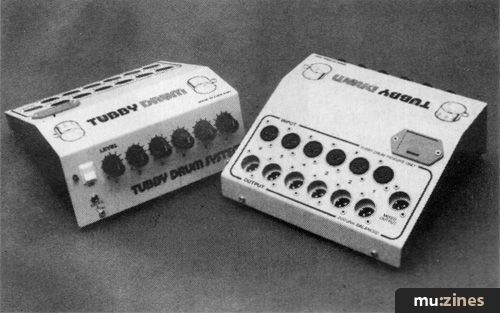
The Tubby Drum system (reviewed in issue 13 by Rick Palmer) has now been expanded to a Mk. III Model. The Mike system from Tubby Drum has undergone several improvements, including a battery compartment which is accessible from outside the mixer plus an overall better cosmetic look.
The baseplate has a threaded bush in the centre, enabling the mixer to be mounted on a mike stand and thus sit beside the drummer who can gain easy access to it. The XLR version has seen the replacement of the previous jack socket with an XLR mixdown socket, another improvement over the earlier Mk. II version. Importantly, a replacement baseplate is now being offered which comes with its own integral mains supply. This provides a changeover switch and full fitting instructions. When fitted, either battery or mains voltage can be used, the mains power unit being offered in 240, 220 or 120 volt versions. The new Mk. III system can be supplied ready-fitted with the mains unit.
New are Tubby Drum Systems with only three pickups (ideal for Latin Music percussionists). Additional pickups can be added later on as your needs grow.
Further details from Musimex at (Contact Details).
Kawai comes good for J.H.S.
Regular MUSIC U.K. devotees may recall our Frankfurt Fair report, when we drew your attention to a fascinating new synth promised from leading Japanese manufacturers Kawai. Well, several months have passed since then, but the new Kawai is here now and it's going to be distributed by Leeds-based wholesalers John Hornby Skewes & Co. Dubbed the Kawai SX120, the new keyboard is a 61 note polyphonic programmable synthesiser. It comes with DCO, VCF, VCA, EG, and HPF. The keyboard assigner offers chord memory and 8 note polyphonic, 4 note polyphonic or mono operation, plus continuous editing of on/off controls. These are just some of the many features this new Kawai offers.
Uniquely, J.H.S. claim, the SX120 carries a voice identification feature which allows the user to name individual memory settings. Thus far we've still not covered the full extent of the remarkable Kawai's features but space prohibits us from going further just now. If this beast interests you, further details can be obtained from John Hornby Skewes and Co. Ltd. at (Contact Details).
Oh yes; the price? A recommended retail figure of £1,000 and it's available from this month.

Alligator makes big sound
Latest gear from pricebusters Alligator is a range of P.A. equipment destined to prove an eye-opener, we reckon, for cost-conscious musicians.
The line will comprise, initially, a series of PA cabs, starting with tiny and easily transportable 1x10 twin cone speakered models, measuring around 10"x 15" x 14" but capable of handling 80 watts per pair. Price of a pair (including covers and leads) is just £139. Next up in the new range is a larger cab, fitted with a single 10" twin cone speaker and a horn. These will handle 140 watts per pair and will sell for just £169.
Leading the new Alligator PA range is a model fitted with two 10" twin cone speakers plus a pair of horns. These will take a full 250 watts per pair and are going to sell for £269 a pair.
Also new from Alligator is a thoroughly ingenious unit called the 'mini-Mix'. This features just three inputs and is designed for use by multi-instrumentalists. This offers several advanced features such as +12dB of active tone controls per channel, LED's to show channel peaks, plus master volume also with a peak reading LED. A headphone socket is provided with a switching arrangement which lets you choose overall monitoring or individual channel sound and the unit has an in-built tone generator which produces a 1 kHz test tone for making sure leads and cabs are connected and working. As if all this wasn't enough, if you connect the headphone output to any channel input with a lead, the unit then functions as a lead tester. However, not only will it show you if a lead is working or not, it will even tell you which connections are duff! If you promise to sit down and hold your breath, we'll tell you the retail price of the unit — yes, just £45 including VAT. Further details of all these products (oh yes, there are add-on horns for PA use too, and these sell for just £99 a pair) from the Musician's Direct Supply Co. Ltd., (Contact Details).

ULTIMATE TECH FROM REVOX
Readers whose ears are attuned to only the very finest sounds (and who have the lifestyle to support such tastes!) should undoubtedly take note that, some six years after introducing their virtually definitive B700 Series of Hi-Fi products, Swiss electronic giants Revox have just replaced the range with two innovative new products — none of your Japanese built-in obsolescence here!
The new products are the B251 integrated amplifier and the B261 tuner. The B251 is, the company tells us, designed to accept the demands of digitally recorded Hi-Fi material and looks like being as ahead of its time as was the old B750 when it was first launched. The volume control is active, using CMOS digital to analogue converters, there is a 'heat pipe' for efficient cooling and a series of microprocessors for input and output programming.
Signal to noise ratio is quoted at an optimum 96dB when the Revox is working as low as 5 watts output (!) and the rated power is 100 watts per side into 4 ohms. For those who listen to F.M. broadcasts with a close ear, then its tuner partner, the B261, looks like becoming the best tuner on the market today. This also offers microprocessor control station details. Now all we need is for the antediluvian BBC to catch-up with Revox!
Both units can be infra-red controlled and it's typical of Revox that existing products will run with the same controllers.
If ultimate Hi-Fi is your scene, then further details can be had from F.W.O. Bauch at (Contact Details).
AMIR IS HERE
The past 12 months or so seems to have seen virtually unprecedented activity on the part of cymbal makers Zildjian, who have now launched yet another range of products — to be called the Amir Series.
Cheaper than the current Zildjian A or K Series cymbals, the Amir range (Amir is arable for 'Prince', by the way) offers what Zildjian call the best level of performance for the money on the market (mind you, they would, wouldn't they!)
The Amir range comes in Ride (Medium weight, 20"), Hi Hats (Medium top with medium/heavy bottom 14", or available in singles). Crash (thin 16" and thin 18"). MUSIC U.K. reviews the new Amirs in this issue and interested readers can get more information on this new range from: International Liaison Office of the Avedis Zildjian Co. at (Contact Details).
Blue Suede movers
Readers wishing to contact Blue Suede Music Ltd. (distributors of Tokai guitars and amps as well as other items) should note their new address, which is (Contact Details). The telephone number remains the same, that's Lancaster (Contact Details).
NEW AWARD FROM AKG
Mike manufacturers AKG have announced a new award scheme for professional and non-professional recording and broadcast engineers. To be called the AKG SOUND AWARD, it will be in three sections; professional recording, broadcasting, and a special 'open' category for non-professionals. Entries can include, so AKG tell us, an innovative use of existing techniques and equipment to produce a truly original result, or can feature new ideas and equipment not previously used in a professional studio. The first award will be presented at the 1984 A.P.R.S. Show and AKG is organising a competition for designers, art students and others for the design of the trophy. Entrants for the design competition (which has a cash value of £250) should contact Keith Ellis at AKG Acoustics Ltd, (Contact Details). Keith will also be able to let you have details of the AKG Studio Sound Award.
Livin' on the frontline
Another new effects range, called Frontline, has just been launched by importers Strings & Things Ltd. Prices are pitched particularly attractively, with a Pre-amp at £19.95, Super Phase at £37.95, Distortion at £22.95, Compressor for £26.95, Delay £73.95, 6 Band Graphic £35.95, Overdriver for £19.95, Drum Synth Box for £37.95, Chorus £46.95 and Flanger at £49.95. Further details of this new line can be obtained direct from Strings & Things Ltd. at (Contact Details).

HH JOIN THE KEYBOARD AMP KRUSH
1983 has certainly been the year of the keyboard amp (surely not just due to our editorial in issue 8!) and now HH have announced a brand new series of keyboard amps — packed with that maker's usual high-tech features. The new K-Series comes in the form of two heads and two cabs, designated the 80 watt K80 combo and head or the K150, 150 watt, ditto. Both combo and head models offer the same configuration, including (for the K80 version) three inputs with separate channels, (Channel 1 having a special input sensitivity of 1M Ohm, making it ideal for electric pianos, the makers state). Each channel offers active tone controls (bass and treble) plus a 'Pull for Bright' function.
Furthermore, every channel offers a special effects link jack with push button control on each channel. A master effects send and return is featured on the back panel. More effects can be added by the built-in reverb system which, again, has a push button per channel. The amps also feature headphone outputs, master volume and reverb controls and Slave/D.I. sockets. Price of the head version is to be £189 inc. VAT. Add a specially developed HH speaker (designated the HH B12-LA) with 100 watt rating and a bullet tweeter, fit them with a crossover into a typically sturdy HH cab with a porting and the price becomes £289 inc. VAT. Much the same facilities are on the K-150 head and keyboard, except you're getting 150 watts RMS power and four channels but, curiously, there isn't a provision for individual tone control on each channel, rather the makers have opted for an overall master 7 band graphic equaliser with a graphic in/out push button on each channel.
On the K150 version a separate effects send control is provided on a channel by channel basis, and there is a master effects return control by the master volume pot and the overall reverb depth controller. The K150 is equipped for bi-amping, having an on-board electronic crossover which splits the low frequency output for connection via a separate power amp to bass speakers. Finally, both a D.I. socket and a balanced line output are provided. Price of the K-150 head version will be £275 inc. VAT.
On the K-150 combo (with an RRP of £445 inc. VAT) an HH 200 watt driver in a tuned port is fitted, alongside an HF Bullet radiator, connected via a built-in crossover network.
Further details of these new units from HH Electronic at (Contact Details).
Publisher: Music UK - Folly Publications
The current copyright owner/s of this content may differ from the originally published copyright notice.
More details on copyright ownership...

Music UK - Jul 1983
News
Previous article in this issue:
Next article in this issue:
Help Support The Things You Love
mu:zines is the result of thousands of hours of effort, and will require many thousands more going forward to reach our goals of getting all this content online.
If you value this resource, you can support this project - it really helps!
Donations for May 2026
Issues donated this month: 0
New issues that have been donated or scanned for us this month.
Funds donated this month: £0.00
All donations and support are gratefully appreciated - thank you.
Magazines Needed - Can You Help?
Do you have any of these magazine issues?
If so, and you can donate, lend or scan them to help complete our archive, please get in touch via the Contribute page - thanks!
If you're enjoying the site, please consider supporting me to help build this archive...
...with a one time Donation, or a recurring Donation of just £2 a month. It really helps - thank you!

 @mu_zines
 RSS Feed
 Blog
Blog