


Magazine Archive
Home -> Magazines -> Issues -> Articles in this issue -> View
Noise Rejection | |
Art of NoiseArticle from Making Music, November 1987 | |
Anne Dudley is 50% of the Art of Noise who have 100% of a new album out. You can see 0.3% of her in the picture and Paul Colbert gets a bit of the story, at least.

Isn't there one tiny part of you which would like to be recognised in the street?
"No. What possible reason could there be. It's a terrible idea. I think it's what people in the limelight regret the most, their loss of anonymity."
Anne Dudley, a half of Art of Noise, has been entirely certain about this ever since the band's first, unusual success, of which we'll hear more later. They've always sheltered behind eccentricity in their announcements and disguise in their publicity pictures. At first few people outside the business of recording and production knew what Anne and partner JJ Jeczalik looked like. Those inside did, very well. Anne Dudley is one of the best known orchestral arrangers working in 'rock and pop' (vile phrase, but you get the picture), and is sought after for her own production work and keyboard sessioneering.
She's shortly to start co-writing with Jeff Beck for his new album — "a fantastic guitarist... a legend who lives up to it" — and has just returned from a soundtrack writing stint in Hollywood. "I'll tell you what I really like about working on films," she enthuses over a cup of tea in the press officer's office. "It's the teamwork. You're involved with the producer, director, editor, music editor, possibly the writers, all of whom have put a great deal of effort into getting this film as far as it is. There are no rivalries and the team sees it through. Sometimes it's like that when you're making a record, but so often it isn't. And the music suffers."
But first the new Art of Noise album, 'In No Sense, Nonsense".
"The sounds on this album... I'll start again, a lot of the sounds on this album derived from a natural environment, either animals or birds... a helicopter's not a natural thing, I know, but the sound of it outside is quite stunning. With the kind of scope you can get on compact disc now, it seemed that the chance for exploring these natural sounds should be expanded. Take the helicopter... the sound you hear underneath when it's landing is pretty staggering, but usually it's recorded so badly that when you hear it on disc it sounds pretty naff. But if you make an effort and record it with a good stereo mike and get the levels right it can be just as good on a digital recording as it really is. So when I listen to the album I get a sort of open air feeling..."
"In No Sense, Nonsense" was a tighter project than previous Art of Noise output. Recorded over eight weeks, and broadly demoed beforehand, Anne and JJ broke with tradition by bringing in other musicians to see what they could do with something conceived as a Fairlight sequence.
"How can I put this... there's a great tendency — and I don't mean this in any snide way — for musicians with a very good technique to get a bit... well, the word we use is 'muso'. A little bit indulgent. You have to keep pulling them back and say, play like this. I don't care if you can play it in 13/8, I want it in 4/4.
"But they can bring out different things in the music, and it's nice to have people around, rather than machines."
But do the Art of Noise write songs? Apparently not. 'In as much as the terms verse and chorus are quite useful, then we do," Anne assents, though only briefly. "To me a song is something that's sung and has words. I've got nothing against songs, and I write songs as well, but the Art of Noise doesn't do them." Unfortunately there's no other easily coinable word to cover instrumental-pieces-of-music-liked-by-a-pop-audience-with-recognisable-tunes-in-it. "Bagatelle, aria... I don't know."
And while they may start out with a trusted verse and chorus format, the tracks are fairly soon ripped up anyhow. "On 'EFL', its final form was nothing like how it went in the studio. I played it to the bass player, and he barely recognised it. It was a fine piece of music, if you like, but desperately ordinary... lovely feel, nice riffs, but nothing really happened. So we got extremely radical with it, used four bars that we liked and looped and looped it round, did something else over the four bars, transposed it, did a piano solo over the end without changing the key, and just took this very cavalier attitude towards the material." The end of 'EFL' (English is a Foreign Language, apparently) does something extremely unsettling to the ear. The final section drops dramatically in speed, as if someone had switched the tape recorder to a slower rate. What it doesn't do is tumble in pitch as you'd expect. Peculiar, but not difficult, when left to the Fairlight III.
"To be an artist involves a different kind of mentality... you're not even supposed to turn up on time."
What does come first, the riff or the sound? "I think things tend to happen together, you find a sound then you find something to do with it." A moment's pause. "I guess that means I've just contradicted myself... right... probably the sound first, but the riff will follow pretty soon after, otherwise it's not much use."
The search for noise took the Arters outside fairly often: into stations to capture the horn of an Inter City 125 ('Galleons Of Stone') and down to Ely Cathedral to record a choir ('How Rapid'). "A fairly outrageous, pretentious thing to do, but an absolutely incredible place. Right through the middle of the best take, the verger walked up the aisle with his keys rattling and ruined it, but sent us all off on another tack. We couldn't decide which sounded better, so we had a bit of both." Incidental sound effects from real life are sandwiched between most of the tracks; a verger here, a door closing in Finchley Road Waitrose there. "We just wanted to record these different acoustics."
And having played with the real thing in the real world do you feel disappointed on returning to the studio? "Yes, I think you do, to be honest. If you spend an awful lot of time in the studio working with a digital reverb, which is what people do these days, you get a certain kind of one dimensional sound which doesn't occur in a natural environment."
One of the instruments which has suffered most from studio interference has been the innocent drum kit. "It seems the hardest thing to record well," offers Anne, "and the sound people get in the studio is almost nothing like what drums sound like. If you listen to a drummer playing live, it all spills everywhere and the natural sound of a kit is a real mess. It's part of a drummer's skill to sort out a sound that fits together.
"When drums started coming to the front of the band people began searching for different sounds all the time. Until fashions in music change that's going to stay. My idea of a good drum sound is, I suppose, one that's compatible. I get very tired of these artificial sounding snares which have nothing to do with anything. Why? People aren't always reinventing the piano, are they?"
No, but they are always resampling it, albeit not when the Art of Noise are around. 'I've never been one to use samples to emulate real sounds," Ann exclaims. "I can't see the point." One track, 'Debut', uses a real string section. Would it have worked on a synth? Maybe, "but it would have taken three days and we got the guys in and recorded it in 20 minutes."
The thing is Anne, before all this AON stuff began, did you ever picture yourself as a writer? "Me, myself, I? No, it's really rather unexpected. I didn't plan it, if," she adds reflectively, "anyone ever plans anything." We could all name half a dozen other producers who would give their right Lexicon to step from studio to stage, but isn't there a greater responsibility, and worry, in having to create your own material instead of nurturing other people's. "Oh yes, it's easier to do a string arrangement or play keyboard on somebody else's track than it is on your own. When it comes to making Art of Noise records it's a completely blank piece of paper — they're not songs, you don't have a lyric to work to, and often not even a title. It can be difficult to get started. Sometimes we have to discipline ourselves. We've got six hours in the studio and we've got to get something done. You may hate it in the end and scrap it, but at least you've got something to show for the time.
"To be an 'artist'," she holds up fingers for mid-air quote marks round the word, "involves a different kind of mentality. You're not even supposed to turn up on time, but to me that's second nature, it's force of habit. I panic."
One last question... who do you think your audience is?
Long silence.
"You'll say long silence here, won't you? Let me say that when we first had a record out it was 'Beat Box', which was only released in America and became number one in the dance charts and was very high in the black charts. We were voted the second best new black act in America that year... yes, exactly.
"That surprised us. We thought, here we are, these honky whites in suburban London making a noise in New York dance clubs and being terribly hip. I don't think it's like that any more, the music is less dance oriented, maybe a little more mainstream. I suppose the audience we'd like to have is an audience which appreciates a well made record and is as interested in the sound and quality as well as a few nice tunes. An audience which new age music thinks it's aiming at, but which is actually very underwhelmed by new age music. And an audience which hopefully will buy a CD."
More with this artist
 Noise Reduction (Art of Noise) |
 Art - Empire - Industry (Art of Noise) |
 Art & Science - JJ Jeczalik (Art of Noise) |
 Artistic License (Art of Noise) |
 The Art of Noise (Art of Noise) |
More from related artists
 The Lexicon Of Strings (Anne Dudley) |
 The Noise of Art (JJ Jeczalik) |
 |
Publisher: Making Music - Track Record Publishing Ltd, Nexus Media Ltd.
The current copyright owner/s of this content may differ from the originally published copyright notice.
More details on copyright ownership...
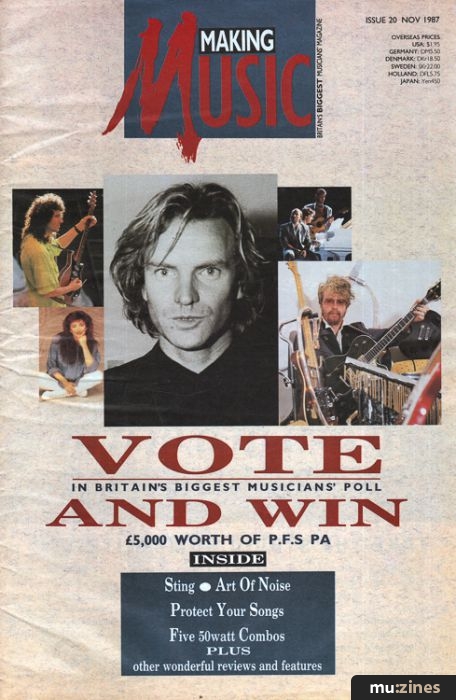
Making Music - Nov 1987
Interview by Paul Colbert
Help Support The Things You Love
mu:zines is the result of thousands of hours of effort, and will require many thousands more going forward to reach our goals of getting all this content online.
If you value this resource, you can support this project - it really helps!
Donations for June 2026
Issues donated this month: 0
New issues that have been donated or scanned for us this month.
Funds donated this month: £0.00
All donations and support are gratefully appreciated - thank you.
Magazines Needed - Can You Help?
Do you have any of these magazine issues?
If so, and you can donate, lend or scan them to help complete our archive, please get in touch via the Contribute page - thanks!
If you're enjoying the site, please consider supporting me to help build this archive...
...with a one time Donation, or a recurring Donation of just £2 a month. It really helps - thank you!

 @mu_zines
 RSS Feed
 Blog
Blog