Studio Of The Month - The Strongroom
Recording Studios
(IM Jul 86)


Magazine Archive
Home -> Magazines -> Issues -> Articles in this issue -> View
Papa Lou's Southern Style | |
The Jimmy Skinner Music Store: Southern music menArticle from Sound Engineer and Producer, November 1986 | |
Cincinnati's 16 track blue grass specialist studio; run by veteran Papa Lou Ukelson
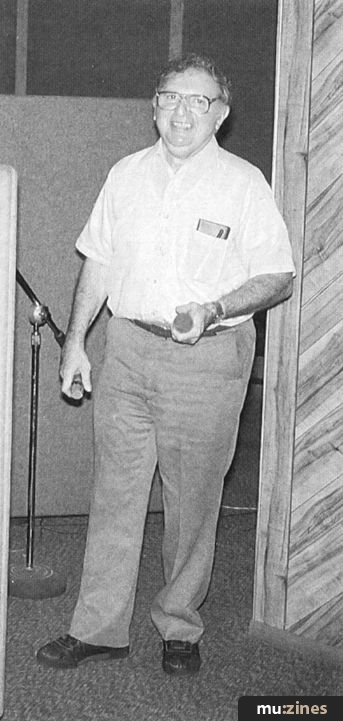
Image credit: Richard Buskin
A country artist of the calibre of Charlie Feathers — a man whose experience stretches back to Fifties sessions at the famed Sun studio in Memphis — chooses to record some of his hit albums of the present at a small studio in downtown Cincinnati.
The Jimmy Skinner Music Store has recently updated its facilities to 16 track and it attracts bluegrass, blues and gospel artists from all over the US — and the states of Indiana, Kentucky, Ohio, Pennsylvania and West Virginia in particular. The popularity of the studio lies both in the tradition of the small complex and the style and technological demands of the music recorded there.
The 'Store was opened in the late Forties by country artist Jimmy Skinner. Together with his business partner he promoted his own material on the radio and sold it, along with that of other musicians, through the store and its related mail order business.
When Lou Ukelson joined, the company was recording artists on its own Vetco label at the four track studio of Country musician Rusty York. This mode of operation continued until the early Seventies — by which time Ukelson was the sole owner of Jimmy Skinner Music. Then the warehouse and facilities adjoining the back of the music store were converted into a four track studio, complete with a 4x4 board and a Scully eight track machine.
A Sony MX 16 eight track was introduced in order to expand recording capability, while during the past year an Allen Heath System 8 sixteen track has replaced the original desk.
'It's a very clean sounding console,' Ukelson enthused, 'and a good feature is that it's user-oriented; most of my experience in engineering has come from just doing the work — I didn't go to a school to learn how to do it.
'When it comes to bluegrass music — there are very few effects that are used on it. They don't use drums. They use a little bit of reverb — very little. The only thing you'll have a problem with is some of the singers who you may want to use a compressor limiter on because of the dynamics of their voice. I purchased the Yamaha REV7, but we probably only ever use the regular reverb on it.
'Bluegrass artists try to keep the music just as if you were listening to it outside, whereas country music or rock music... God, they're looking for just about anything that's different, and I can understand that!
'I don't think bluegrass music has changed that much over the years because it consists of primarily acoustic instruments, but in some of the latter things done by people like the Osbourne Brothers electric steel guitar and drums are used in it. You'll find very little of that however. A lot of the bluegrass groups today are also using an electric bass, whereas most of them only used to use an upright.
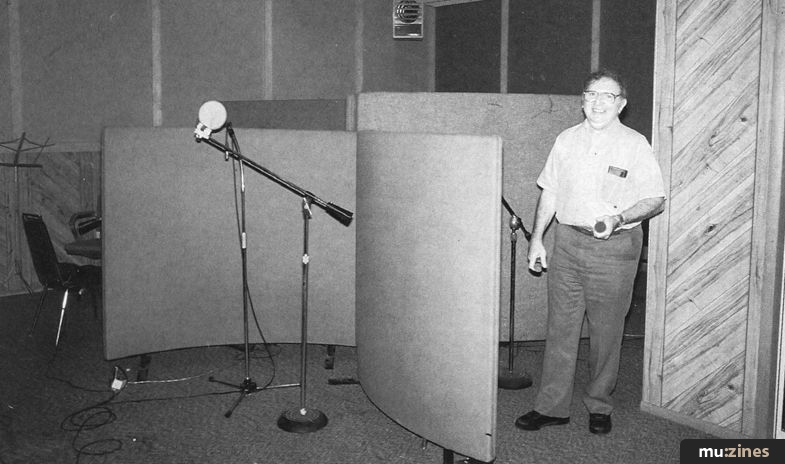
Lou displays his customised pop shield
Image credit: Richard Buskin
'Of course the miking changes according to the individual, but for a muffler over the microphone I went into a fabric shop and bought one of those small round knitting frames — the circumference is about six inches — and just took a piece of cloth, covered over it and put it up there! Before, we'd just put a bit of foam over the mic.
'Many of the bluegrass singers aren't experienced like some of the country singers, who know whether or not to back away or turn their face away when they hit a certain note and syllable, so that they don't get a pop.
'When it comes to equalization, I don't use too much of it. I try to keep it as natural as I possibly can. We'll use some on some of the instruments; we'll take off some of the highs in most cases.'
The Papa Lou Recording studio, as it has now come to be known, consists of a small but amenable control room with access and view at one end of the 24' x 21' main room. Contained inside is a 10' x 9' isolation booth. Much of the wall surfacing comprises fabric covered "wafer-board" in order to deaden the sound, while the main room has a dropped 12' sloping ceiling. Various screens are employed to separate the musicians.
'We try to work in a circle quite often,' explained Ukelson, 'which not many studios do; they'll separate, and have someone over here, someone way over there. A lot of the bluegrass singers want to be close together so they can actually see each other when they're singing, because they want to get a tight harmony.
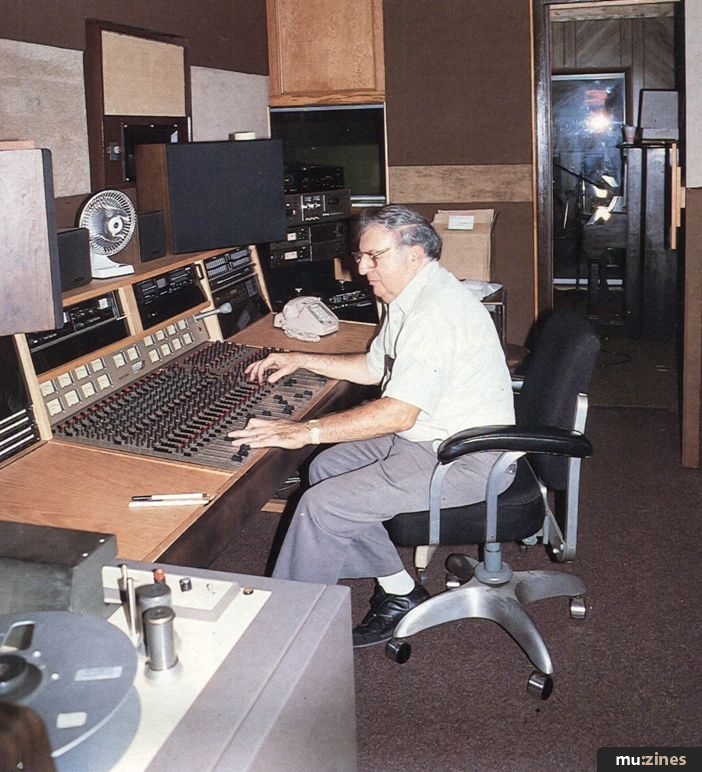
Lou at the controls behind his recently installed AHB desk
Image credit: Richard Buskin
'In most cases, recording them is almost like a live session. It all depends on the experience of the group. A lot of the times you'll find that some of these people just don't have the experience of doing overdubs, and they're a little worried about doing them, they're scared of them. So rather than do that they just go ahead and do the whole thing.
'Obviously, with all the instruments being recorded together we experience some spillage, and although noise gates are the best device I usually avoid it just by the miking. Y'know, the obvious method of pointing a guitar mic downwards towards the guitar, so that when a person sings up in a different direction he won't get involved with that particular mic.
'What with all the screening, there are very little bleed-throughs with the exception of the bass. But what we do then, if there's too much bass coming through we put the bass in the drum-booth. In most cases, however, a bass singer's not doing any singing.
'One particular album that I've done I think we spent about 60 hours on — a very long time for these kind of records — and we did a lot of overdubbing on that.
'We have the drum booth for country musicians, or the gospel groups that want to use drums, but it doesn't get used a lot. Most of the work that I do is acoustical work.'
At present Lou Ukelson has no intention of expanding to 24 track; he does not feel that the majority of the recording he undertakes requires it. But this in no way diminishes his appreciation of the technological advances being made in the music industry — and the inherent advantages presented by them.
'I think that what's happening in the music industry today is utterly fantastic. Taking a computer and recording an entire album on it is phenomenal as far as I'm concerned! What we're doing is like riding in a Model A Ford compared to what's going to happen in say the next five or 10 years! I bought the Yamaha REV7 for $1195; Roland has just put out one that'll do practically the same, and that's only somewhere around $300! It's remarkable.
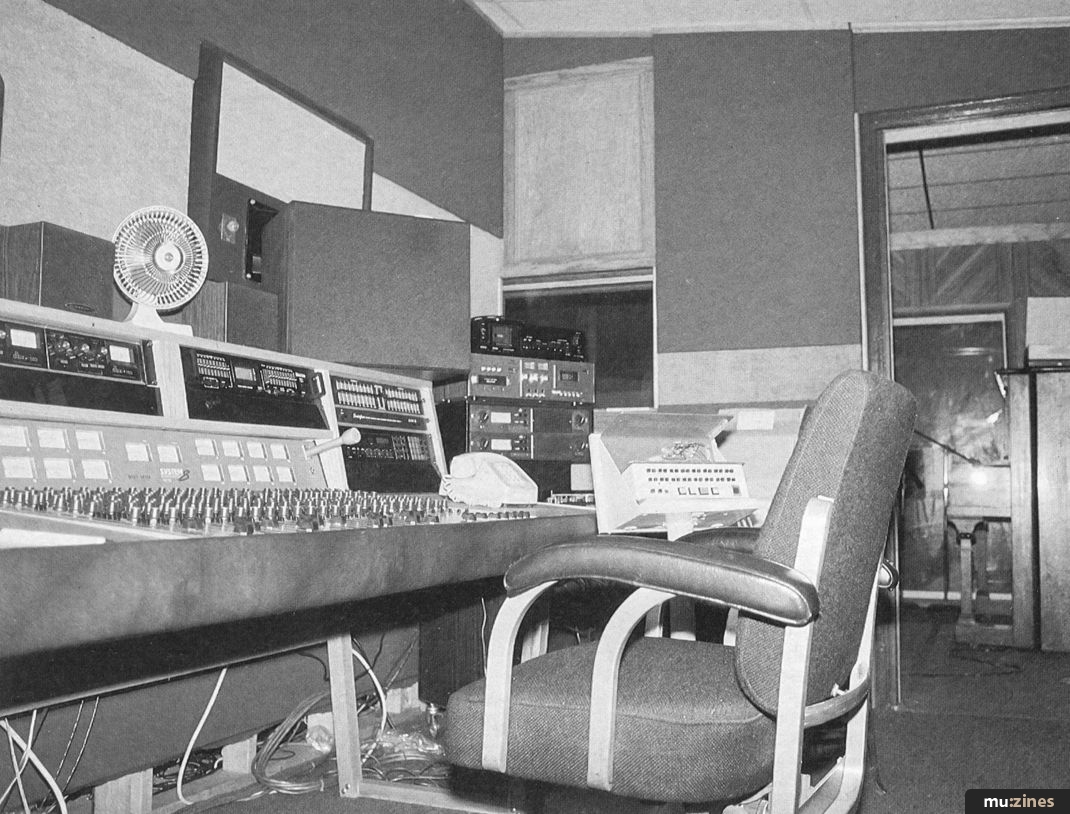
Image credit: Richard Buskin
'I don't know when we'll ever get involved in Compact Disc or digital recording, but there is a requirement for it with bluegrass music as with any other type of music. Transfer from one tape to another and you lose something, but with digital you don't; you have that transparency in there, that sound that you want, and I think that's fantastic.
'We still get round things in our own way, however. If I feel I have a problem on mixing, I have a blind young man from Dayton, Ohio, named Dave Gordon, who helps me out. I know he can hear a lot better than I can, so I brought him in here and taught him the board. Now, when I need a custom-mix on something, his wife comes in with him to run the equipment as far as the tape machines and everything, and he does the mixing. And he does a far better job than I've ever done!
'Another thing is when we go out and record live in a club we'll take just a little Dokoder four track machine; not a commercial machine, but just a regular thing that anybody would buy for their home use. What we then do with it is run it through the board so that we can do a lot more equalization and add to it. We did that with one of Dave Gordon's albums, where we just turned the machine on and let it play while he was recording. Then he came in here and added bass to it and other things of that nature, and it's one of the best recordings we've ever put out.
'It's amazing what you can do with just a little ingenuity!'
DATA
Studio Dimensions: 24' x 21' main room with 12' ceiling and 10' x9' isolation booth.
Recording & Mixing Consoles: Allen Heath System 8 1616 16 track, Sony MX 16 eight track (for remote)
Tape Machines: MCI J100 16 track with auto locators, Ampex 440 quarter inch two track, Ampex quarter inch two track, Dokoder 7070 four track (for remote), Denon DR M33 cassette deck, Fisher Studio Master eight track and cassette deck.
Monitor Amplifiers: Phase Linear, Scott
Monitor Speakers: Altec A-7 Studio Monitors, Auratone 5C Super Cubes
Outboard Gear: Yamaha REV7 digital reverb, Fisher Spring reverbs, DBX 160 compressor limiters, Electra stereo graphic equalizer (with pink noise generator), Soundcraftsman Audio Frequencies equalizer, Aphex Type C compellor, drum machine
Microphones: AKG, Audio Technica, Crown PZM, Electro Voice, Neumann, RCA (Ribbon), Shure, Sony
Address: (Contact Details)
Recording & Mixing Consoles: Allen Heath System 8 1616 16 track, Sony MX 16 eight track (for remote)
Tape Machines: MCI J100 16 track with auto locators, Ampex 440 quarter inch two track, Ampex quarter inch two track, Dokoder 7070 four track (for remote), Denon DR M33 cassette deck, Fisher Studio Master eight track and cassette deck.
Monitor Amplifiers: Phase Linear, Scott
Monitor Speakers: Altec A-7 Studio Monitors, Auratone 5C Super Cubes
Outboard Gear: Yamaha REV7 digital reverb, Fisher Spring reverbs, DBX 160 compressor limiters, Electra stereo graphic equalizer (with pink noise generator), Soundcraftsman Audio Frequencies equalizer, Aphex Type C compellor, drum machine
Microphones: AKG, Audio Technica, Crown PZM, Electro Voice, Neumann, RCA (Ribbon), Shure, Sony
Address: (Contact Details)
More with this topic
 |
 Speaker's Corner - CHOOSING & USING: studio monitoring |
 Studio Of The Month - Flexible Response |
 Studio Of The Month - The Chocolate Factory |
 The Sound House - BBC Radiophonic Workshop |
 At Home in the Studio - Castleridge Studios |
 Studio Diary |
 SAV - Synced To Serve |
 Studiofile - Riverside Recordings |
 Stronger Than The Rest - Strongroom Studio |
 Inside Abbey Road - Careers In The Music Industry (Part 1) |
 Town House Studio |
Browse by Topic:
Recording Studios
Publisher: Sound Engineer and Producer - Media Week Ltd.
The current copyright owner/s of this content may differ from the originally published copyright notice.
More details on copyright ownership...

Sound Engineer and Producer - Nov 1986
Donated by: James Perrett
Feature by Richard Buskin
This article features:
The Jimmy Skinner Music Store
Help Support The Things You Love
mu:zines is the result of thousands of hours of effort, and will require many thousands more going forward to reach our goals of getting all this content online.
If you value this resource, you can support this project - it really helps!
Donations for August 2026
Issues donated this month: 0
New issues that have been donated or scanned for us this month.
Funds donated this month: £0.00
All donations and support are gratefully appreciated - thank you.
Magazines Needed - Can You Help?
Do you have any of these magazine issues?
If so, and you can donate, lend or scan them to help complete our archive, please get in touch via the Contribute page - thanks!
If you're enjoying the site, please consider supporting me to help build this archive...
...with a one time Donation, or a recurring Donation of just £2 a month. It really helps - thank you!

 @mu_zines
 RSS Feed
 Blog
Blog