


Magazine Archive
Home -> Magazines -> Issues -> Articles in this issue -> View
Reelin' In The Years | |
Jeff BaxterArticle from Sound Engineer and Producer, June 1987 | |
Ex-Doobies and Steely Dan guitarist turns producer. Jeff Burger catches the vibe
Ex-Doobies guitarist and West Coast jack-of-all-trades Jeff Baxter has re-emerged as producer of a recent US chart topper. Jeff Burger listens to the voice of experience

Image credit: Ann Summa
Many people remember Jeff Baxter as the respected guitarist with the Doobie Brothers in their heyday from 1974 to 1979. Those with longer memories trace his roots further back as a founder member of Steely Dan. Still others think of him as a rock 'n' roll guitar mercenary called in as heavy artillery for anything from national TV sports to a Julian Lennon tour. Industry insiders recognise him as a longtime consultant for Roland and Akai. Under the circumstances, it's not surprising to find him in yet another role — as producer.
Over the years, Baxter has taken on many diverse production projects including Beach Boy Carl Wilson (CBS), Bobby and the Midnights (Bob Weir, Billy Cobham, Bobby Cochran and friends, CBS), Sneaker (Handshake), Nazareth (A&M) and Agent (Virgin). The highest charting Baxter production of all, Billy Vera and the Beaters, recently went gold as the single At This Moment reached Number One after five weeks on Billboard's charts.
Ironically, the recording was originally made in 1981 for the Alfa label in Japan, which subsequently terminated its US operations leaving the group without any support. Last year, At This Moment was used as background music for the TV show Family Ties and got 8,000 phone calls in response. Rhino Records took the hint and leased the masters from Alfa.
Most of the album was recorded live over two days at The Roxy in Hollywood. 'The challenge was to see if we could do an album that could compete world class on a studio level and be live,' Baxter reflects.
'The hip thing about The Beaters was that it was a band put together from studio musicians to let out steam. All the band members were excellent musicians so no matter what they played, the music came out well rehearsed and tight. Even though I was warned that live hit records were extremely rare, I felt I could record the band live because they played at their best when they were just having fun.
'Because we wanted to make a world-class recording, we busted our ass to make sure that everything — the mix, picking the truck and the equipment, the people who were involved — everything was up to the highest standards. And it looks like we won — but it took a while!'
To compound the unusual circumstances, Baxter performed on stage as part of the group while simultaneously producing audio and directing video.
'I really wanted to see if it was possible to produce, play and direct at the same time. I had two sets of headphones — one set to hear the stereo mix, the other with the Clear-Com from the audio truck on one side and the Clear-Com from the video on the other side. It was a real balancing act.
'I tried to get hold of a set of quad headphones, figuring that would do the trick but they never arrived in time. Sometimes I had to yell to people to be in different places for the video. We did the whole thing for $25,000, including video!
'One very important part of this project was using talented people to their fullest ability — the best guys that I knew and trusted the most. Larold and Bruce Robb were in the truck, with five others in the audience — all on the Clear-Com and listening to the live show.'
The Clear-Com system allowed constant communication to maximise the results. 'Bruce would say, "I'm getting all tenors, nothing else" and ask me what the problem was, and I would look up and see that the guy was in the wrong spot. I'd tell players what the story was and they would all compensate. The whole thing happened very quickly.
'The idea was to keep the band on mic and mix themselves, because everybody's involved and that is where it is the most exciting. Instead of setting up a single mic for each horn player, we had the whole section play around a pair of mics to accentuate the different parts of the section so we didn't have to do it. There was a sound that was invented years ago simply because everything was mono and a lot of guys sat around one mic, and it gave a certain sound to a horn section. I didn't want to lose that.'
The Record Plant's truck was called in for the gigs with two Otari MTR-90s (used alternately) with an API console with the outboard 55OA equalisers. Great care was taken to maximise mic isolation on the 20 foot x 40 foot stage (The Roxy seats around 600) and have the players comfortable at the same time. 'We were able to replace some things — buzzes and drop outs, etc. We got great isolation, due mostly to the way the stage was set up with amplifiers on the floor, and the drums on a riser. The amplifiers were facing in different directions to enhance the isolation.'
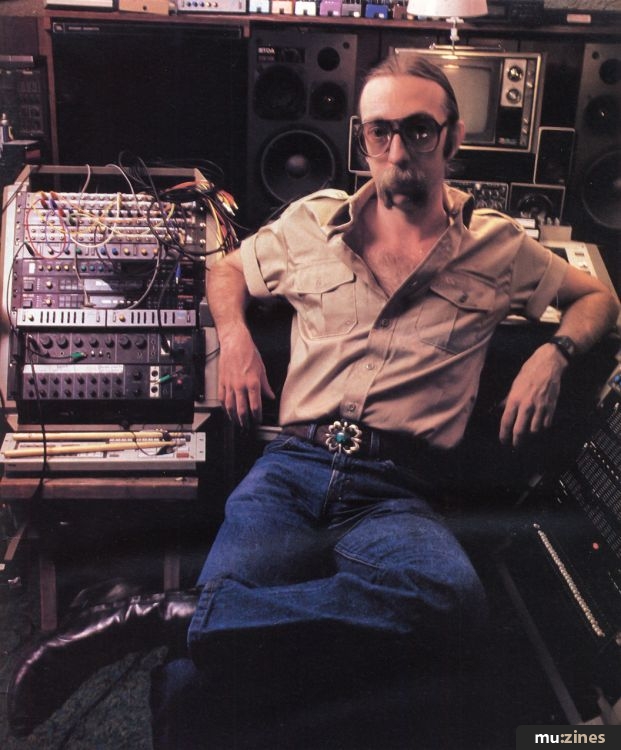
Image credit: Ann Summa
Baxter feels the choice of Shure SM-56s and SM-57s was crucial to the overall product. 'It's an older kind of sound — the sound of a live band over a PA system. If you record instruments that are familiar — old Fender amplifiers and Electro-Voice microphones, for instance — things have a certain signature sound.
'That was what I wanted to create with Billy because Billy loves those older style records. We used AKG 414s on the snare drum but I also used the Shure — I recorded a couple of different snare tracks. We used 87s for the overheads and most of the rest were the Shures for guitar amps, horns and vocals.' As many tracks as possible were recorded both direct and miked 'not only for art, but for insurance!'
'If it sounds good, use it,' is one of Baxter's philosophies. 'Who's to say what the best technique is now, because there are really no rules anymore. It's a question of understanding the available technology. Just because you know all about cars doesn't mean you have to go out and buy a Ferrari. In an age where a great deal of music isn't even recorded on multi track it's not going to make any difference — coming right off a Macintosh or a synthesizer being driven from MIDI or SMPTE clock and going directly to two-track, R-DAT or other audio format, you have to trust your ears.
'The fact is that the quality of an MG-1214 with an R-DAT is going to be better than an MTR-90 with the latest two-track machine.
'This R-DAT stuff is going to enable home guys to make master-quality recordings. Of course you have guys with clipboards and pens in their shirt pockets saying that it lacks warmth on higher harmonics and super distortion or whatever, although a good argument could be made for both viewpoints. Meanwhile, the band out in your living room is burning, putting the stuff down on eight-track live and you don't even have to mix it!
'Even when I produced the Carl Wilson solo album back in 1980, we used some of the demos that we did on eight-track, simply because the guy was a fantastic singer and that Otari eight-track sounded great. And with a good SMPTE lock up there was no reason why we couldn't do it. There's always someone who will give you a technical reason why you can't, but the proof is in what is coming over the speakers. We found that out earlier with the Otari.
'The when I got involved in the Akai MG-1214 system I realized that as a recording tool it was the same thing, only hipper and started using that system to make records. I notice more people are transferring stuff back and forth between formats.'
One trick Baxter often uses is to mix from the Akai through a Dynakit pre-amp to introduce a controlled level of distortion and put a bit of warmth back into the sound. 'A lot of what I like about producing is being able to reach out and use different kinds of equipment. Larold loved climbing around a chimney with a microphone trying to find the right echo sounds for Bobby and the Midnights — stuff we hadn't done in years. Those kind of things put you in a seriously relaxed state where you are ready to accept art as well as create it. That's important.
'A case in point — we were doing Carl's album, we put him up to a blindfold test and we said "we're going to play your vocal back through two different pieces of equipment and we want you to tell us which one you want us to use".
'One was a $79 Boss Chorus pedal and the other was a $2400 EMT. No matter what we did, he went for the Boss pedal — and here is a guy who has ears that are just golden. And that's not to say that one is better than the other — we all know that it is a question of personal taste.'
Under these circumstances it's not surprising to find that Baxter's favourite recording environment is his home studio, Casual Sound. 'In every house I've had there has always been a Casual Sound studio, and a record has been made in each one. A lot of the Bobby and the Midnights record was done in my living room on a Stevens 24-track. We made a lot of transfers with eight-track.
'One of the things I really liked was to record drums with no Dolby at 15 ips for bottom end — everybody should try it. Then I'd either transfer that to something or use that as the drum track.
'The Otari half-inch eight-track really records drums well because it has a little bit of a bump at 100 cycles and a couple of other things that makes drums sound great. So even now, sometimes I'll record a drum machine on to the Otari simply because of the way it sounds.
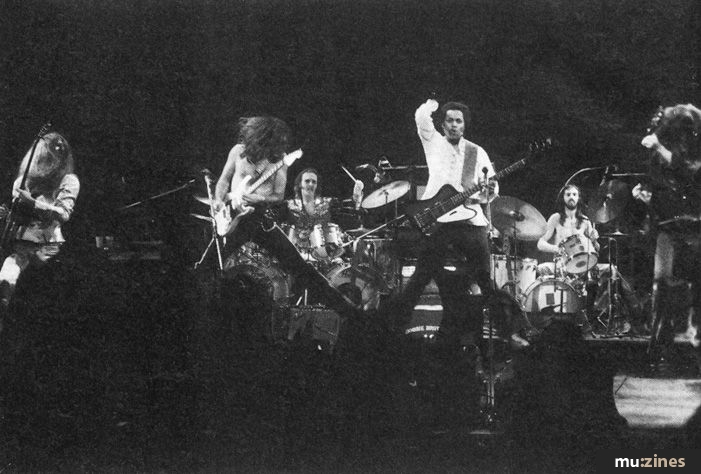
Doobie Brothers
'Another case in point — when I produced an album for a band from Canada called Agent, much of it was recorded on Akai MG-1214 in a hotel suite, because they didn't have a great deal of money and I liked the sound of the equipment. The singer was literally singing in the shower, along with a Neumann 87. You can plug an 87 directly into the console if it is a tube one, because it has enough power to power the mic amplifier. Then turn the top end up 15dB at 15k.
'Anyway, we went back to put it up on the console in the studio and the wife of one of the guys in the band said how wonderful the vocals sounded. I replied, "because he's in the shower". And I realized, yeah, absolutely, because everybody is real familiar with that sound. It is easy to mix if it automatically fits in the right place.'
Baxter sees some changes in the way electronics are being used in music. 'With the introduction of drum machines, synthesisers, sequencers and so on, a bunch of guys with haircuts got together and said "I don't even have to learn to play an instrument, all I have to do is sing and arrange and I can be an artist."
'All of a sudden the engineer/producer became the other member of the band. Studio records were made by engineer/producers, sung by the band and then performed live with machines. Maybe these machines are the first Japanese contribution to pop music. There was a British contribution, and a German contribution, an Australian contribution — why not the Japanese?
'Now, however, because machine music loses its flavour after a while, pop music has split again, where musicians have said, "OK, I'll use a drum machine but maybe I'll play the bass live and get a couple of keyboard players". I've seen jingle contracts now that specify live drummers.
'I think we're over the synthesiser/haircut player of the month and we're going to start seeing live music again. I think one reason why the Billy and the Beaters record was Number One was not only the exposure on Family Ties, but a sort of vox populi crying, "how about a real record with real musicians even playing it live". I think it's a testament to changing taste.'
The role the studio itself plays is also changing according to Baxter. 'What we have now is a situation where multitrack recording on a semi-professional basis has really crossed the road. With the introduction of machines by Otari, Fostex, Tascam and now especially with the Akai MG series, master quality multitrack recordings is available to everyone.'
Baxter doesn't see the transition from full service to on-line production as a problem for the recording industry. 'The video industry has operated in that particular architecture for many years. You go out and hire a crew, and you get equipment and you shoot.
'Then you go on-line in a place that was specifically designed to edit. You may have a system where you can do pre-production, so when you go to on-line at $800 an hour, you're not sitting there with a notebook logging editing numbers — you're fusing your final product together.
I think you're going to see the same thing in the audio business as recording studios become the places where basic tracks are recorded and mixed. Some studios have started pulling their hair out over MG-1214s saying "we're going to lose business".
'Any smart studio manager knows that the real profit in the studio business lies in cutting basic tracks and mixing, where every mic and every piece of equipment and outboard gear in the studio is being used.
'The amount of profit to be made on one guy standing in front of a microphone for six hours is not a whole lot. If studios can understand that idea, they can address themselves to this new system and in fact be making more money just for basic track and mixing.
'Do the overdubs where you can work inexpensively and comfortably. Since spending money in the studio has always been the bane of the artist who has been trying and trying to get a performance, if he has unlimited studio time, the chances of him catching a good performance are all that much better. I think that's the way it's going to go.
'The recording studio in some cases will be linking with video and certainly with CD-I — that's going to be a major part of recording both audio and video.
'Audio work will be done in audio production houses as opposed to recording studios. But regardless of what you use or where you use it, always keep the tape rolling because it's the performance that counts.'
Publisher: Sound Engineer and Producer - Media Week Ltd.
The current copyright owner/s of this content may differ from the originally published copyright notice.
More details on copyright ownership...

Sound Engineer and Producer - Jun 1987
Donated by: Chris Maund
Interview by Jeff Burger
Next article in this issue:
Help Support The Things You Love
mu:zines is the result of thousands of hours of effort, and will require many thousands more going forward to reach our goals of getting all this content online.
If you value this resource, you can support this project - it really helps!
Donations for August 2026
Issues donated this month: 0
New issues that have been donated or scanned for us this month.
Funds donated this month: £0.00
All donations and support are gratefully appreciated - thank you.
Magazines Needed - Can You Help?
Do you have any of these magazine issues?
If so, and you can donate, lend or scan them to help complete our archive, please get in touch via the Contribute page - thanks!
If you're enjoying the site, please consider supporting me to help build this archive...
...with a one time Donation, or a recurring Donation of just £2 a month. It really helps - thank you!

 @mu_zines
 RSS Feed
 Blog
Blog